Monday, December 14, 2020

DHAX: Monster Conversion - Lone Wolf to D&D adjacent and Call of Cthulhu 5e

The snickering, ghoulish Dhax.
Gary Chalk.

One of the monsters from Lone Wolf that made an impression on me - the Dhax from Castle Death.

Canine skull, caracal ears, whale-like hide (or black scales, or short fur), webbed forepaws with retractable claws, and hoof-like feet - they're pack hunters, skilled trackers and craving for fresh meat. 

Sometimes armed with devastating Power Staves - these are not of Dhax manufacture, but are attuned only to them. 

The Dhax are intelligent and cruel, but their lifecycle, culture (material or otherwise) and non-predatory habits are unknown.

Dhax for Old School D&D Adjacent.


Armour Class +4     Hit Dice 6     Move 125% Normal Human     Morale 9 

  • Claw/claw/bite for 1-6/1-6/1-8
  • Dexterity min. 15 (+2 AC included)
  • In their dungeon lairs, surprised only on a 1.
  • Keen sense of smell and highly developed tracking skills: surprise on 1-3.
  • Intelligent - at least high human average (12).
  • Power Staff: damage as mace, morning star or staff (or just use d8) + d6 for baleful energy 
    • save vs. wands to avoid 2d6 baleful energy blast/ bolt (60' range); recharges on a 1-2 on d6 at the end of each round.
    • trying to pick up and use a Power Staff causes d6 baleful energy damage to non-Dhax per round. And it won't work for you.
    • as an alternative to the above, a Dhax Power Staff is equivalent to an Int 9 Ego 12 sentient sword which tries to take control of anyone who touches it - you deliver yourself to the Dhax. If it fails to master you, take d6 damage and leave it alone.
  • On death, Dhax immediately begin to smoulder, then burst into flames and are reduced to fused and stinking clinker in a matter of moments: 2-8 hits to anyone within 10'.

Rich Longmore's Dhax, giving it the old Anubis via Russ Nicholson vibe.

DHAX, Ghoulish Snickering Trackers for CoC 5e.


The Dhax are (d6):
  1. Ancient astronauts once worshipped as gods, long since trapped on Earth.
  2. From the Dreamlands, but physically present in the waking world at certain times, in certain places, or when certain words have been spoken.
  3. One of the lesser known types of Ghoul.
  4. One of the lesser known monstrous humanoid species of Earth.
  5. Extra-terrestrials accidentally or deliberately transplanted to Earth by the Mi-Go.
  6. Formless Spawn bound into this form by the will of Nyarlathotep at the behest of some long dead sorcerer.
I've no particular ideas on how the Dhax fit into a Mythos setting (canonical or otherwise) - I just like 'em.

STR 4d6 (14)     CON d6+12 (15-16)     SIZ 2d6+8 (15)     INT 2d6+6 (13)     POW 2d6+6 (13)

DEX 3d6+3 (13-14)

Hit Points 15               Damage Bonus +d4     Move 10

Weapons:
  • Eight-fingered Claw Swipe 50%, d6
  • Powerful Bite 30%, d8, automatic against grappled targets
  • Power Staff:
    • Strike 65%, d6 + db + d6 baleful energy
    • Bolt 100%, 2d6 and destroys armour, point-for-point (Dodge, Jump or block to avoid injury)
    • non-Dhax attempting to handle a Power Stave must match their current magic points with the Dhax's POW or lose d6 magic points per round - at 0 magic points, the victim will deliver themselves willingly to the Dhax in their lair. The same magic points vs. POW match is required to release a Power Stave once it has been taken up
  • On suffering a death blow, the Dhax bursts into flame and burns to almost nothing in a matter of moments - 2-8 fire damage to anyone within 10' when this happens.

Armour: 2-point hide.

Skills: Tracking 60%, Sense of Smell 80%, Swim 70%, Jump DEX x3, Sneak 75%, Snicker Ghoulishly 85%, Dodge DEX x2

Spells: roll under INT on d20 for d6 spells

Habitat: Forbidden necropolises, nameless cities, lost temples. 

Sanity Loss: 0/1d6 to see the Dhax; 0/d2 to hear their ghoulish snickering and the soft thump of their hooves echoing through the tunnels ahead.


Commentary.


I found some 2e AD&D stats in a very unofficial looking Monstrous Compendium supplement that I probably shouldn’t haven’t been looking at/ for online:

AC +4 Mv 12 HD Att. d4x2/d6 or weapon Size M (4’-6’tall) Morale Average  INT 8-10

How the author came up with the stats, I don't know - because this seems more like a rung on the humanoid threat ladder, rather than monsters 'among the most powerful of all the mutant guardians’ - ‘so evil, cunning and physically strong that they resemble the Agarashi’ (Bestiary of the Beyond, p. 92).

By a crude measure, Lone Wolf could be a 7th level character (one with numerous special abilities, too) when they encounter the Dhax, and there's a good chance of being killed - even without going toe-to-toe.

There's no mention of their signature weapon - the Power Stave - either; there's nothing beyond the stats, pic and reference to the book of origin. It is significantly more formidable if given the special abilities and the Power Stave described above.

(Converted to Coc, this Dhax would have characteristics close to that of a Ghoul, which has characteristics close to that of a Normal Human.)


Sam Manley. From the LW Bestiary of the Beyond.
Just looks a bit like something on the humanoid threat scale, or an AD&D demon.

Bestiary of the Beyond and https://www.lonewolfitalia.com/ are -I suppose- canon sources and helpful (the Dhax, as far as I'm aware, didn't feature in the Lone Wolf d20 game), but I'm mainly going by my memories of playing through Castle Death, Gary Chalk's somewhat ambiguous attitude towards fur and scales, and where my imagination took me.

While they're described as mutants, hybrid of human and beast, I think there's a definite whiff of the demonic about them.


Monday, December 7, 2020

d66/d36 Dungeon Monsters.

In the notes doc for my previous post, I also had another d66 table - more general monsters this time. Filled in a few gaps, swapped out a few regular generics and tidied everything up a bit.


Black Ichor is something like this: https://dysonlogos.blog/2018/08/06/further-delves-for-the-black-ichor/ 


Unless specified or you have it planned out, HD = DL (dungeon level) and Number Appearing is d6 + DL. 


Solo monsters have HD = average party level + DL.


As always, season according to taste and usual caveat about probability distribution. 


Roll d6:


1. Roll d6:

  1. Silverfish, Giant: If surprised, they immediately try to escape; roll HD vs. HD to see if they overrun you; 2d6 + DL appearing. A really big one could cause ramming damage and knock you prone. Eat paper, glue and rations.
  2. Spider, Giant (1): Reroll any initial Hostile Reaction. This human- to pony-sized monster is content to feast on the more numerous dungeon fauna rather than risk losing a leg against you. Odds/evens, it's a web-spinner/ running hunter. Use the same chances as Dragons for whether it's sleeping, a talker, intelligent etc.
  3. Woodlice, Giant: Not aggressive; roll HD vs. HD for overrun; will attempt to eat your rations. A really big one could cause ramming damage and knock you prone. Armoured. You can cook and eat them - they smell and taste strongly of piss and make you wet the bed, but it's nutritious and may help with GUI.
  4. Ravenous Larvae: Hungry and relentless; will destroy your backpack, leather goods, belts, spellbooks, rations etc.; bite for continuous damage; only scared of fire; 2d6 + DL appearing. Grow up to be Beetles, Moths or Tunnel Worms, but you'd need to be a specialist to tell them apart.
  5. Beetle, Giant - Snicker-snack (1): It looks scary, it acts peaceful, it can take off an extremity on a critical hit. Heads they glue in a cluster to their abdomen as egg-chambers (they drop off when the egg is ready to hatch). Always wins Initiative when it deploys its wings, either to charge or escape.
  6. Vapour Rats: Wispy trails with inky, defined eyes, teeth and nails; 1-2 on d6 each round, it coughs or sneezes and curls in on itself to nothing, uncurling a short distance away (as a Blink Dog). Intelligent animals, curious, playful - steal your trinkets and eat your rations. Magic weapons or fire/ lightning to harm.

2. Roll d6:

  1. Rust Grubs: Squeal loudly as they feed; immediately try to eat your armour and weapons; first grub has double chance of surprising you;  1d6 + 1d6/DL appearing. Their acidic jaws do not harm flesh, wood or leather, but leaves an orange stain with a horrible smell.
  2. Rot Monster (1): Grotesque, stinky (pineapples!), curious and sort-of-friendly, it will kill by accident or by design. Might be mistaken for something undead, as it constantly decomposes and regrows its flesh. Or it might actually be undead.
  3. Ghouls: Roll d6: 1. frenzied & rotting, 2. hairy & panting, 3. pale & whispering, 4. sallow & creeping, 5. well-dressed & smiling, 6. fungoid & glowing.
  4. Wererat Skeletons: Stealthy, mist-shrouded undead; chill touch drains STR; living Wererats are absolutely terrified of them.
  5. Croglin Vampires: BECMI Giant Shrew crossed with a Thoul; wants to suck your blood; d6 - 1 + DL appearing. They have treasure stuffed in a greasy burrow or scattered about a bone-strewn chamber.
  6. Wererats: Odds/evens, they’re armed with muskets and pistols, as well as knives and cudgels. Odds/evens, they're in human form (if capable). d3 to see if they're like Skaven, Lankhmar wererats or RAW.

3. Roll d6:

  1. Frilled Priests: Ignore all bonuses to Reaction because they're not happy you’re interrupting their pilgrimage/ sacred rites. Their artefacts are valuable but cursed/ venomous.
  2. Trolls, Dwarves, Elves, Gnomes and/or Goblins: The grim fairy tale kind. At least one spell & possibly full casters (L=HD); 2-3 on 2d6 to spot them if you're L3 or less, 1-2 on d6 if you're L4 - L7. Only take min. damage unless from iron or blessed weapon. d3 appearing DL 1-3, d6 4+.
  3. Ogres: Base HD 4 + 1 (17hp) plus 1 + 1 (5 hp) per 2 whole dungeon levels. No. App. is d2 x DL - these Ogres are friends and/or a family. Not that much bigger than humans, but much tougher. Like food and treasure more than they like recreational cannibalism. Which they do like.
  4. Giant Moth Swarm: Big, but no bigger than a substantial thumb. Disturb them and they swarm all around and over you. Keep calm and you'll be okay, otherwise you'll agitate them even more and they'll start smothering you. 1 on d6 they're blood suckers, too (a polymorphed Vampire if there's one in the dungeon).
  5. Kobolds/ Knockers: You can’t hurt them unless you use iron or blessed weapons or mining tools; death throes in spectacular Dragonlance Draconian fashion. They definitely know where there's treasure, traps and Black Ichor. Reskin duergar,  gnome, halfling or svirfneblin. d3 appearing DL 1-3, +DL-3 on 4+.
  6. Beetles, Giant – Fire: Easy-going arthropods with glowing glands (red, yellow or blue). Non-aggressive unless you start messing with their eggs. Often devoured by their Ravenous Larvae.

4. Roll d6:

  1. Moth, Giant – Brillig: From head to torso sized. If one hovers (can't do anything else), it's like a +2 mirror image effect. If there's 3 or more flying around, they're under a blur effect. Their vomit is like Giant Locust spit. Non-aggressive. Killed by sunlight.
  2. Mound People: Tall, pale skin, black hair, glazed eyes; finely crafted antique armour, weapons and equipment. Everything is as if in dream to them. Odds/evens, they attempt to charm you into following them, and eventually disappear into solid earth or stone - taking you with them or leaving you behind, heartbroken (Black Ichor is the only cure).
  3. Custodians/ Guardians: They won’t hurt you unless you’re harming the dungeon, but they make you feel uneasy, creepy little cherub-things. Reskinned BECMI Halflings.
  4. Bugbears: There’s a good chance that Black Ichor (or a shrine to Tsathogghua) is nearby; they’re aggressive, but not stupid, and they've got homes to go to not that far away.
  5. Ghosts: Lots of people and monsters died down here; odds/evens, they have remains that can be laid to rest; d3 appearing, regardless of DL. They can scare (even unto death) and curse the living, but otherwise cannot harm them directly.
  6. Troglodytes: Nude and slinky reptile people who think material culture is pointless - especially that of dry-skin surface-dwelling light-seers. Unless you surprise them, they will be camouflaged; will follow you to pick off stragglers, because you're tasty.

5. Roll d6:

  1. Blind Hairy Underworld Cannibals: Don’t speak your language but they're not stupid, and not necessarily hostile if they’re not hungry (odds/evens).
  2. Guardian Skeletons: Hand weapon, spear, shield, helmet, armour in any combination; either on patrol or tied to a particular area or object. They will fight to the death, but won't attack unless you interfere with their duties.
  3. Tunnel Worm (1): Odds: soft and slimy, drools and spits digestive enzymes that eat through flesh (vinegar or wine to rinse). Elongated, it runs the length of the passageway; compressed, blocks it like a fleshy plug. Evens: armour plated, jaws bite through metal, superheated innards so dangerous death throes. Burrows through rock.
  4. Creeping Shadows: Hang around at the edge of the lamp light, waiting to drain the life from the dying (any Casualty/0 hp, but also 3 hp or less); immune to normal weapons.
  5. Crawling Slime (1): Shimmers with hypnotic rainbow colours; destroys wood, metal, and flesh.
  6. Mad Dogs: Not necessarily rabid, but hungry and dangerous.

6. Roll d6:

  1. Shuffling Corpses: Bog-standard zombies; will attack half-heartedly, unenthusiastic in pursuit. 1 on d6 each round to realise they've been hungry for living flesh all along and that's the motivation they needed. Or roll on this table.
  2. Miners: Underworld humanoids, digging out treasure or remodelling the dungeon. Probably short in stature, but odds/evens they're mundane/ supernatural.
  3. Lost Hirelings: They’ll join you for a chance to get back to the surface world. Odds/evens, at least one is a disguised monster.
  4. Bristling Burrower (1): Bear-badger-mole-porcupine; claw/claw/bite; shed/shoot diseased spines. It's almost blind, but has a superb sense of smell and echo-location. Strong, identifiable musk to mark its territory. Aggressive; avoided by all intelligent dungeon denizens.
  5. False Healer (1): Whatever it turns out to be, it appears to be a healer with a safe place to rest. Doppelgangers, medusas, mind flayers, undead and subterranean nymphs all spring to mind.
  6. Adventurers: You might even know them. Roll d6 to determine how many of No. App. are actual adventurers, the excess are hirelings, prisoners and animals. Odds/evens, they're doing better/worse than you so far.

Sunday, December 6, 2020

d66/d18 Horrible Humanoids

Not done a d66 for a while now - here's 18 types of humanoid monster encounter you might run up against in your local megadungeon. Season according to your setting and system.

Number Appearing is d6 + dungeon level; HD can be capped at dungeon level. Damage d6.

Lone monsters are 50% specials with HD = average party level + dungeon level. Damage d6+1 (or d8).

Controlling Cloaks and Brain Bats are not humanoids, but will 50% be in possession of one as a host (roll again on this table for type if you like). If more than 1 is encountered, you can check for each or the one is trying to lure hosts for the others.

d66

Result

11,12

Hyperboreans.

Short, slim, red hair and beards; Stone Age hand weapons but 50% chance of ancient technology that looks like magic; at least one spell each (B/X Elves). You’re a come-lately sub-being driving them inexorably to extinction, but they don’t automatically hold that against you.

13,14

Black Ichor Addicts.

Wretched dungeoneers (human or otherwise) without a choice; if they don’t know where there is Black Ichor, they want to know; always initial Neutral Reaction.

15,16

Eyeless Cannibals.

They don’t need eyes to find you (so you can surprise them even with a light); they don’t need clothes, either; don’t want to eat you more than they want to live.

21,22

Radioactive Dwarves.

Solemn, slow, bald, robes and jewelry of lead; their very presence weakens and kills you; if they’re Hostile, it’s because their brains are rotten. You could reskin duergar, svirfnebli and similar - or give them psionics.

23,24

Minions.

Of the dungeon master; they have been sent to foil or imprison you; know things you can beat out of them; 1 on d6, there’s a spell-caster with them; similar chance they have a double strength leader/ champion/ brute.

25,26

Doppelgangers.

Whether made out of shadow or made out of meat, they want to walk into your life and then out of this dungeon; might not look like you at first.

31,32

Bandits.

They only want your stuff, but will kill for it if they need to; probably not welcome in the dungeon, either; probably adventurers/ dungeoneers/ murderhobos like you.

33,34

Controlling Cloaks.

A sort of vampire; clings to your back and shoulders; do what they say or they’ll bite and smother you; can’t go out in the daylight; good relations with Dark Ones, know where there is Black Ichor, hate Brain Bats and Frilled Priests.

35,36

Custodians.

Cherub/putti, elemental manifestations that maintain and protect the dungeon; essentially neutral, they’re there to stop chaotic disruptions to the dungeon, so might step in to break up a fight. Reskinned B/X Halflings.

41,42

Berserkers.

They can’t help it – they just love to fight. Odds/evens, they’re thigh-slapping Brian Blessed knock offs who’ll share a pint with you afterwards, or cruel bastards who like to cripple and kill.

43,44

Carrion Sifters.

Ghoulish wretches that like to send others against others and pick over the corpses; spies for the Dark Ones, know where there’s Black Ichor and monster lairs.

45,46

Brain Bats.

Ugly telepathic winged brains that are low-rent, off-brand mind flayers/ intellect devourers; it’s really obvious to everyone else if you’ve got one clinging to your head, but you have no idea; hate everyone.

51,52

Dark Ones.

Ultimately out to dominate and supplant the human race, but never overlook an opportunity to do a little business; Hostile means you’ve stumbled on something private and secret. They run those incongruous shops in mega- & roguelike-dungeons. Cartilage instead of bones, nails and teeth; stretchy.

53,54

Cenobites.

Flayed men and rubber maids, armed with hooks, chains, spikes, hooked and spiked chains, and flensing knives; they just want to share the exquisite pain with you. Each round, 2 on 2d6 they’re sucked back to their hell dimension - you might go with them if they’ve hooked and chained you.

55,56

Frilled Priests.

Never stop pilgrimaging; can spit holy venom and use telescopic rods to shrink down and escape; interested in Black Ichor and Hyperboreans; know spells.

61,62

Lost Souls.

Not quite alive, not quite undead; they’re attracted to your light and life, but can’t tolerate it for long; some can still remember their mortal lives.

63,64

Shape Devourers.

What they kill and eat, they can turn into; if intelligent, they’re collectors/ connoisseurs; hate Doppelgangers and can recognise them.

65,66

Ancient Knights.

They chose… poorly, and must guard the thing forever; not undead; cannot leave their charge; must be destroyed or they eventually reform and rise; at least full chainmail armour, with ancient weapons and shields; might never have seen a firearm.


Tuesday, December 1, 2020

OARD: Monster Conversion - BECMI D&D to Call of Cthulhu 5e


I recently did a CoC to D&D conversion for Mi Go, and mentioned the Oards as a front for the Mi Go - so here's a version in BRP format. 

OARDS, Cat's Paws of the Mi Go.

Grown in vats, augmented with technology, the Oards are the things behind most of the commonly recognised types of UFOnaut -and some of the more bizarre Men in Black encounters- using cloaking devices and cerebral dampeners to manipulate human witnesses. 

Physically, Oards are humanoid and very similar in appearance to each other. Diversity of appearance is dependent on cultural expectations of the intended human audience. Oard technology can be used to disguise their appearance or to confuse human senses, but this is a projection rather than a changing of form. 

Their general appearance, behaviour and technology will superficially reflect the historical background of your game, and what people at the time were describing/ experiencing when they encountered an unidentified flying object and/or its crew - aliens, fairies, German spies, Napoleonic troops, flying saucers, rockets, airships, ornithopters, balloons, even boats lifted by evaporating dew.

Oards are intelligent and self-willed, but are the creations of the Mi Go and ultimately serve them, consciously or unconsciously. Only the Mi Go know whether the Oards are the source of or are built on the template of the cross-culturally common characteristics of the UFO abduction/encounter experience.

Oards do not know that they are constructs of Yuggoth, and believe themselves to be a galaxy-spanning civilisation of ancient pedigree. The lack of clear cross-references in Mythos sources concerning the Mi Go suggests that the Fungi have either been successful in hiding their authorship or that the creation of the Oards is of a comparatively recent date.

All Oards are programmed not to harm or interfere with the Mi Go. An Oard encountering a Mi Go will either be utterly unable to detect its presence, or immediately stop what it was doing and await orders. A Mi Go can command an Oard to harm another Mi Go, but rival Fungi can match POW to wrest control from each other.

Humans can be converted into Oards. The process is comparatively simple for the Mi Go, and an Oard body is sometimes used instead of a brain cannister. If carried out by the Oards, conversion is much more protracted (it can be done over several years and multiple procedures) and much more like torture - it has more to do with Mi Go terror-tactics than efficiency.

Most Oards are STR, SIZ and INT 10, with those having 13 SIZ and 14 INT representing leader types. 

STR 18 Oards are combat/ invasion ready - it has no bearing on their apparent rank.

STR 10 or 18    CON 20     SIZ 10 or 13     INT 10 or 14     POW 0     DEX 13

Hit Points 15 or 16              Damage bonus nil or +d4     Move 8

Weapons: 

  • Air Rifle: 95%, range and damage as whatever is the best similar projectile weapon available to the characters for their historical period, but preferably one that they do not possess or have easy access to.
    • Smoke- and heat-less, nearly silent, and the ammunition can be envenomed, drugged, explosive etc.
    • 6 shots when fully loaded.
  • Flame Pistols: 100%, 2d6 + sets fires 
    • Discharges a 20' streamer of burning gas - Dodge or block.
    • Fully charged, good for 6 shots.
  • Ray Glove: 100% for single shot in a combat round, 50% each for two, 30% each for three, d6+1 and ignores most armour, up to at least late 20th Century Earth tech.
    • You can attempt to Parry or grapple to push it away in melee, otherwise Dodge, Jump or get behind good solid cover.
    • A single shot has an effective range of as far as the Oard can see.
Armour: Minimum damage from impales. Unaffected by terrestrial poisons and venoms. 

Immune to mind-reading, mind-control and emotion - except when caused by Mi Go or some kind of genius computer hacker.

Oards may wear a protection belt that generates an invisible personal forcefield - this becomes especially common from the 1960s onwards.

This gives 10 armour points vs. frontal attacks from hand weapons and directed energy (including explosions), and complete protection from non-magical projectiles (either deflecting or dropping them, you decide).

The wearer is unaffected by extreme environmental heat & cold, and has limited anti-gravity - they can descend straight down 50' without harm, can cross 20' of water or similar without danger of sinking, and walk across any distance of snow, sand, dust or similar without hindrance and without leaving footprints 

Spells: None - Oards do not use or understand magic. 

In a pre-modern (and/or magic-heavy) setting, their technology will be seen as magical.

Skills: Abduct 100%, Cattle Mutilation 99%, Probe 100%, Resistance is Futile 80%, Misunderstand Human Subtleties 95%, Misuse Human Artefacts 35%, Appear Benevolent 15%.

Habitat: It seems likely that they maintain secret bases on the Earth and its Moon, not being truly extra-terrestrial. Oards will sometimes be in the entourage of Mi Go, or disguised Mi Go will be mixed in with the group.

Sanity Loss: To see the true form of an Oard, 0/d3; to be abducted, 0/d6; to survive conversion, 0/d10; to discover that Oards are a front for the Mi Go, 0/d6.


Using Oard Technology.


The short answer is that you can't - Oards interface with much of their equipment through cybernetic implants, so their weapons are unlikely to have something as simple as a trigger to squeeze, nor their computers a keyboard and mouse.

Partial Oard conversion or a surgical intervention by the Mi Go could equip a human to use Oard equipment - while possibly to the character's advantage, this will be to create more useful minions.

If even this seems too generous, you can rule that this is part of Nyarlathotep's portfolio and will be done only to further the designs of the Outer Gods - or to simply further humanity's plunge toward bloody chaos and extinction.

I wish these two were holding hands so they could exchange long protein strings - if you can think of a simpler way, I'd like to hear it.

Commentary.


The Oards are time-travelling aliens from the 1985 BECMI module Where Chaos Reigns by Graeme Morris (CM6 UK). They're androids or cyborgs, combining technology with their organic body, that are attempting to prevent the development and ascendancy of magic on the world of Aelos by interfering at critical points in history.

Which seems to me like the kind of thing the Mi Go would do.

I've seen unsupported statements that they were the prototype for the Borg in Star Trek, but they seem more likely to be descendants of the Cybermen from Dr. Who.


Dungeons & Dragonwarriors - Who is That?

Okay. A bit of a change of pace, so bear with me on this one.

In 1986, Out of the Shadows - the fourth in the Dragonwarriors series - hits the shelves and introduces us to the Assassin Profession.

In illustrations accompanying one of the included adventures -'The One-Eyed God'- this faceless character turns up twice. Apart from the armoured figure on the left (being the exception to prove the rule), there are no other characters illustrated in this fashion throughout the 4 books so far.
 

Because this is book 4, I think the character is an Assassin: staff and dagger/short sword are their speciality weapons, and they prefer light or no armour.


Other special abilities of the Assassin include Climbing, with added acrobatics: 

An Assassin can leap up to scale any obstacle below 3m in height, given at least 5m as a run-up. This is executed as a single jumping somersault - spectacular, though it can lead to problems if the drop on the other side is more than 6m!

Assassins can fall up to 6m without sustaining injury. 

- Out of the Shadows, p.19-20

So the boots are off for some jumping, leaping or tightrope walking.

Though we can't definitively determine gender or ethnicity from the illustrations, I think that this character is Diana the Acrobat from the Dungeons & Dragons cartoon (1983-1985).


The outfit is not 100%, but I think that could be for the same reason the face is hidden - so as not to poke the D&D litigation monster. Alternatively, Bob Harvey might just have thought that her original get-up wasn't suitable for the frosty wilds of Algandy.

Why? 

Is this an Easter egg or a coincidence? Does anyone know either way, or even think this is plausible?


Monday, November 23, 2020

Not Quite Canon: MI GO for D&D adjacent.

I did this - once upon a time.
I think I painted it with a wooden skewer on (what looks like) a bit of a box.

I like the Mi Go, and I think that they should be able to turn up in pretty much any setting or genre that doesn't specifically exclude them.

These are 'common' Mi Go - they come from 'Out There' but are not ultraterrestrial horrors from an anti-matter universe.

Converting from Call of Cthulhu 5e, we get the following D&D-adjacent Mi Go:

AC +2     HD 2     Mv. 75% Normal Human (Flying 125% Normal Human or 75% Bat)     ML 8
  • 1 nipper attack for d6 hits, or by weapon, or grapple (then drop you from a great height)
  • the AC bonus is for a high average Dex, and they can wear armour 
  • average Int is 13, with a 25% chance of being able to cast d3 spells (or same % of 1-3 caster levels, though that's much the same)
  • any Mi Go weapon (including all but the most straightforward hand weapons) has a 40% chance of being used incorrectly by a human - 50/50 it's aimed at the wielder/ aimed at the floor
  • they are unaffected by silence/deafness and darkness/blindness because of their weird eyeless heads - you might choose to extend this to all visual and aural effects, including illusions
  • my gut tells me that Mi Go are familiar with psionics, but might not be psionicists - they might even be completely immune and unable to use them
This is a fairly typical conversion profile for a CoC monster with human-range characteristics (compare to Ghouls and Serpent People), so you might want to tweak it depending on your vision for the Mi Go - those from the old AD&D Deities & Demigods are stupid giant space lobsters that communicate by clicking their nippers.

If you kill one of these Mi Go...

  1. It bubbles and rots away in 1 round, leaving a slimy puddle.
  2. It abruptly transforms into dense mineral - Dex check at -3 or the killing weapon is stuck. It crumbles to dust in 1-4 rounds.
  3. Its flesh blackens and shrivels away, leaving an apparently human skeleton - on the next round, the bones explode for 1-6 hits to all within 10'.
  4. It dissolves into a 10' acid pool that evaporates in 1-6 rounds - d8 hits per round and you have to throw away your boots.
  5. It bursts into flames, causing 2-8 hits to all within 10'.
  6. It transforms into a lifeless duplicate of whoever struck the killing blow, appearing to be a normal dead body in all respects until it disintegrates into black soot after 3 days.
These are Draconian death-throes, from Dragonlance, and I think they suit the weird alien/ 'mysterious Little People' Mi Go just fine.

To these Mi Go, human brains are...

  1. Delicious, extracted messily in 1-4 rounds.
  2. A delicacy if prepared correctly, extracted carefully over 1-4 turns.
  3. Crude computers for their organic robots, shelled like peas in 1-4 rounds.
  4. Part of their dastardly plans for infiltration and conquest, carefully removed and sustained with uncanny surgery over 1-4 turns.
  5. The raw material for spawning servitors and minions, harvested enthusiastically in 1-4 rounds.
  6. Delicate experimental subjects for developing psionic biotechnology, painstakingly and reverentially separated from their host over 1-4 turns.
They definitely want brains, of that I'm sure.

The hummadruz of these Mi Go...

  1. Makes humans of 0-1st level drowsy - save vs. spells at +2 per round or nod off; they will have forgotten the 2 minutes prior to nodding off (AD&D 1e forget spell).
  2. Hits the Brown Note - save vs. paralysis each round or become nauseated/sick (BECMI Centipede venom, Cave Locust spit, Troglodyte stench etc.) and you have to throw away your underwear.
  3. Makes eyes vibrate, ears buzz and noses tickle - save vs. paralysis each round or be afflicted by AD&D 1e blur spell.
  4. Fills you with unease and intrusive thoughts - save vs. spells each round or be subject to fear.
  5. Prevents spoken, written, telepathic and electronic/mechanical communication.
  6. Causes bleeding from every orifice - 1 hit per round, plus save vs. effects as 2 above.
It might require several Mi Go to produce an effective hummadruz - it might even just be a secondary effect of their mass presence in an environment. HPL's The Whisperer in Darkness suggests it can be used by human agents of the Mi Go (presumably through surgical modifications).

In addition to any hand weapons and projectiles, some of these Mi Go are armed with...

  1. Energy Mantles: + 5 AC, +5 to all saves; if you strike them, take 2-12 hits plus save vs. paralysis or stunned 1-4 rounds; primarily defensive, but they can make a touch attack vs. unarmoured AC with the same effect; can levitate 12 turns/day, capable of leaving planetary atmosphere/gravity and can sustain one air-breathing prisoner/passenger.
  2. Flame Pistols: 1-6 charges, fires a 20' streamer of burning gas for 2-12 hits.
  3. Shock Pistols: 1-8 charges, fires a 20' burst of blue sparks for 1-4 hits, but you must also save vs. death (or your heart stops, go to 0 hp) and save vs. paralysis or stunned 1-4 rounds.
  4. Cloaking Devices: non-magical illusion to appear as a humanoid up to 10' tall; cannot be disbelieved, can only be seen through with truesight or second sight. Anyone looking at them with dark- or infra-vision will also be fooled, but must save vs. paralysis each round or be affected as hummadruz result 3.
  5. Hypnotic Lanterns: flickering blue-white octagonal cylinder mounted on a pole; save vs. spells at +2 each round or fall under non-magical hypnosis - cannot look away from the Lantern and will move as directed by the Mi Go (perfect for brain extractions). Anyone with dark- or infra-vision looking at the Lantern must save vs. paralysis each round or roll 2d3 against the hummadruz results above.
  6. Personal Force Fields: protection from normal missiles, resist cold/fire, +3 AC, +1 to all saves, repel anyone within 5' once per round, hurling them 20' for 2-7 hits unless they save vs. dragon breath; can levitate 6 turns/day, but cannot use repel attack while doing so.
Wot no mist projectors or living armour? They're not compulsory.

The purpose of these Mi Go is...

  1. To civilise the savages.
  2. To domesticate the animals.
  3. To uplift the primitives.
  4. To extract rare resources.
  5. To go boldly/ "What Is This Earth Thing You Call Kissing?"
  6. To exterminate all the brutes.
If it isn't clear, by savages, animals, primitives and brutes, I mean you humans. Emergent psychics and/ or spell-casters might be rare resources.

In human terms, these Mi Go are...

  1. Absent-minded professors.
  2. Evangelists of galactic transhumanity.
  3. Unsentimental project managers.
  4. Millennially patient and reclusive.
  5. Benevolent colonisers heartbroken to punish you for your ingratitude.
  6. Full-on Mars Attacks space-bastards.
Even though they seem like the kind of monster that might not, roll Reaction for Mi Go -  though ultimately they aren't really Friendly at all, and their Neutrality can get very chilly, very fast. 

In this case, the Mi Go are fronted by...

  1. Scro (Spelljammer space orcs).
  2. Mind Flayers and/or Doppelgangers.
  3. Oards (BECMI module Where Chaos Reigns).
  4. Human agents/cultists (up to and including national governments and 'deep states').
  5. Elves.
  6. Dragons and/or Githyanki (1st edition AD&D, when they were pals with Red Dragons).
There doesn't need to be a front, and the fronts may use fronts of their own, but Mi Go will always have some indigenous allies, agents or servitors.


Tuesday, November 17, 2020

Old School Druid Class (wip) - Atheist/BOSR/Folk Horror/Pagan/Psychedelic/Witch

This Druid is the Dionysus to this Cleric’s Apollo, and this Druid from Basic Red is a significant recent ancestor/inspiration - I was never that keen on the medieval environmentalist take.

The BECMI (or B/X) Cleric class is the template, including spell-casting not being available until 2nd level.
The Wicker Man (1973)

Description: The Druid class is defined against the Cleric, being the pagans, shamans and witches observing the Old Ways, in defiance of the True Faith and the Universal Church. Druids are not the Clerics of another religion, though some are part of priestly traditions.

The Old Ways are a sprawling array of belief systems, without any overarching harmony or hierarchy, though they tend towards a strong relationship with the elemental, natural and supernatural worlds - whether through appeasement, domination or veneration. 

A Druid does not necessarily identify as a Druid - it's a metagame term of convenience. Not all Druids know they are Druids, some will reject the label, and define themselves within their own milieu.

Within the class, there will be those who do not make full use of the special abilities - if you don't know you can Call the Wild and the Weird, you won't try; if you only get naked and high for fun, you might not notice you can Pass Without Trace.

XP, Saving Throws, Attacks & Hit Dice: all as Cleric. 

Prime Requisite: equal chance (roll d6) of any, with usual benefits/penalties – but you do this after you’ve rolled your Ability Scores and chosen Druid as your class. 

Your Prime Requisite will reflect in how your special abilities manifest, the way you carry yourself, your choice of equipment, and the nature of any uncanny forces that take an interest in you.

If you are in an Altered State, you can count a negative Prime Requisite adjustment as positive when using Druidic special abilities.

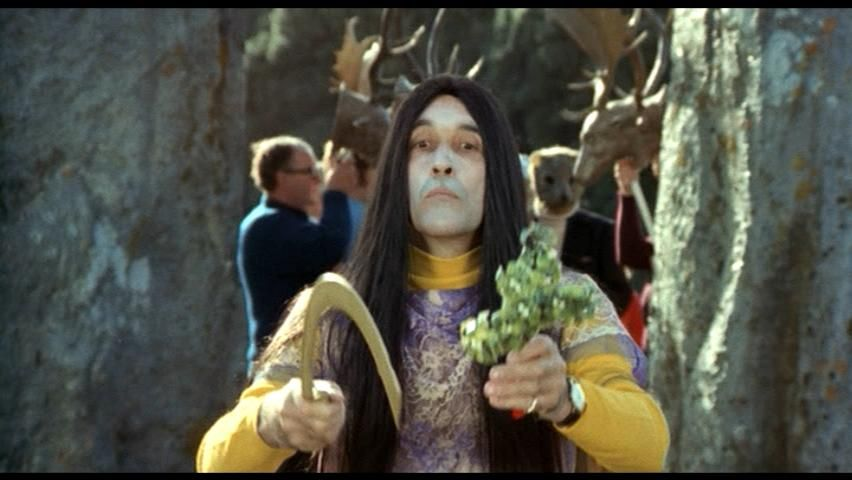
I don't know who they are or what they're doing, but they look the part, don't they?
Britannia (2018 onwards)

Armour: Any, but you can’t use your Druid special abilities while wearing iron or steel armour, or armour you didn’t make yourself or strip from a defeated foe.

A naked Druid in an Altered State counts as carrying a shield if wielding a staff weapon, and can also use their Prime Requisite modifier as an AC bonus and for saves vs. fire, frost, poison and lightning.
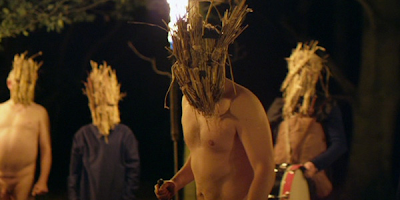
Kill List (2011)

Weapons: Any, but you can’t use your Druid special abilities while armed with iron or steel weapons that have not been wetted with blood in the last minute. Must be at least a dagger-cut's worth. 

Staff weapon includes anything with a long wooden haft, so spears, pole arms, flails and battle axes could all be allowed (negotiable). 

There is no reason a Druid couldn't use a firearm, though some will scorn them through affectation or strong belief.

Alignment Restrictions: None - all that True Neutral stuff was propaganda.

Special Abilities.
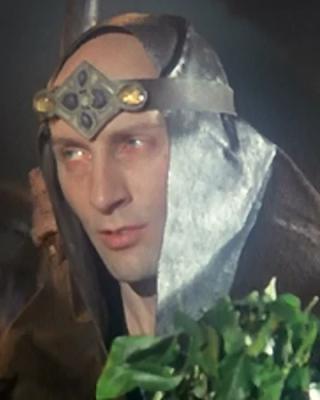
Richard O'Brien as Gulnar, 'pagan sorcerer'.
Robin of Sherwood (1984-1986).

Altered States: Druids spend a lot of time in Altered States, and not just because it activates or enhances their special abilities - some take them very seriously as sacred rites, others just like to get messy.

If you are in an Altered State, you count a negative Prime Requisite adjustment as positive. Because of this, some Druids will have an incentive to degrade their Prime Requisite, and this is often easier to do than to raise it.

In addition, in an Altered State you can apply your Charisma or Prime Requisite adjustment to Reaction Rolls, whichever is favourable.

I've covered Altered States a bit here, if you don't already have systems in place or want a few ideas.

A simple alternative for the mechanical effects of Altered States would be to roll Dexterity, Initiative and Intelligence at disadvantage (except when it directly relates to using a Druid special ability) or to apply an Initiative penalty like the Mystic class from AD&D 2e Masque of the Red Death. 

The undead, the faerie folk, demons and elementals are probably always in an Altered State by mortal standards. Conjured/summoned monsters, the mentally ill (your group may need to discuss whether this is appropriate), and/or those under a spell can also be considered to be in an Altered State.
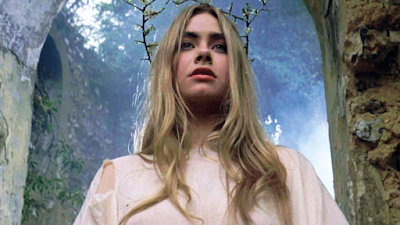
Linda Hayden as Angel Blake.
Blood on Satan's Claw/The Satan Skin (1970).

Authority/Influence (Glamour): Analogous to the Cleric special ability, but you can only use it on individuals or those in an Altered State - Druids do not have the awesome centuried might of the Church behind them, but they do possess a mysterious, tangible authority or an oddly compelling manner. It's not far removed from mesmerism, but this is not mind control - they might lose their inhibitions, but they won't lose their will.

You receive no adjustment to the subject's save for your level. However, if your audience is in an Altered State - or you are using this ability to cause/reverse an Altered State in an individual - you can apply your Prime Requisite adjustment.

Three successes in a row on an individual can be used to lessen/remove emotional/mental effects of spell-level equal or lower than that the Druid could cast (in a similar fashion to the Cleric's Casting Out ability.

If both parties are in an Altered State, they do not have to be able to understand each other - the comprehension is not total, but extends to animals and monsters.

Otherwise, the same restrictions apply for the Druid as for the Cleric.
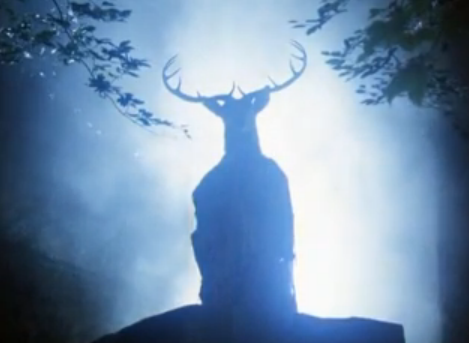
Herne the Hunter - elemental spirit or bloke in a stag's head?
Robin of Sherwood (1984-1986).

Call of the Wild and the Weird: You spend exploding d6 rounds/turns performing a sacred ritual, making loud and varied animal noises, or closing your eyes, spreading your arms and reaching out with your mind. 

You can't do anything else while you're Calling, except for slow movement, cautious or guided. You can Call during combat, but you can't fight while you're doing it.

At the end of this time (it includes narrative/nominal travel time for whatever comes to you), roll 2d6 - you can use your Prime Requisite modifier to either buy down the time or boost the roll. You can keep on trying until you give up or something comes.

On a 9 or better, normal and/or giant animals answer - roll on an appropriate random encounter table. On an 11 or better, your Call attracts supernatural (or otherwise powerful and/or unusual) denizens of the area - random roll or GM choice. Success always Fatigues you.

Spending exploding d6 turns performing the Call improves your respective target numbers to 7 and 9.

If you are in an Altered State, their Reaction is Neutral on arrival.

To try to summon something specific (a wolf or wolves is general; the pack leader/ alpha female/ Ragged General One-Eye is specific) that you know/think dwells hereabouts, your roll is 3d6D1 disadvantage.

You can’t call anything from another plane or from outer space unless you are in a Place of Power associated with it, and there may be specific additional requirements.

Penny Dreadful (2014-2016).


Invisibility to Mortals (Glamour): You must be nude, in an Altered State, in non-magical, non-daylight illumination, and cannot activate this ability if you are under direct observation by anyone who would be affected by it.

You are invisible (actually, automatically camouflaged against your surroundings) to characters of 0 to 2nd level, even if you attack. You are invisible to 3rd level characters, but will become visible to them if you attack them or they manage to hit you. Characters of 4th level and above are unaffected.

Gained at 3rd level, and requires a round of concentration to activate.

Pass Without Trace (Glamour): This is basically the AD&D Druid ability '...to pass through overgrown areas (undergrowth of tangled thorns, briar patches, etc.) without leaving a discernible trail and at normal movement rate.'

However, you get it at 1st level, and you must be nude, in an Altered State, at night. Probably works with dust, sand, snow etc. Those trying to track you might believe you have taken flight as the only explanation.

Recognise Mystery (Second Sight): Similar to the Cleric’s ability to Recognise Evil, but for subtle signs of Old Ways practice, the presence of spirits, places of power, and omens both natural and bizarre. Recognise Evil is more 'know thy enemy'; Recognise Mystery is 'friend or foe?'.

You’re much better at this when you’re in an Altered State, and you can also use your Prime Requisite adjustment to boost the effectiveness of divination (spells or magic items), if such a thing makes sense in context.

Things that might constitute Mysteries: spell-casters, some staple D&D non-human character kindred (duergar, gnomes, elves, half-elves, tieflings, aasimar, genasi), sexuality, gender, kink, secrets, dreams, lies, codes, cant, heredity, pre-scientific science, those under a spell, time travellers, undead, demons, shape-changers, illusions, faerie folk, aliens & alien technology, ancient super-science that seems to be magic, allegorical history/anthropology, arcane and divine language.

Druids also see better in the dark than others, especially in an Altered State. We're not talking full-on dark- or infra-vision here, but definitely at a significant advantage over other human characters.

Spell Casting: You can cast spells from 2nd level onward, using Cleric spell progression. You have automatic access to 1st and 2nd level Druid spells (or Cleric and reversed Cleric spells, if your game doesn't have Druidic magic).

Spells of higher level must absolutely come from (3rd, 4th, 5th) 'supernatural servants of the cleric’s deity' and (6th, 7th) 'direct communication from the deity itself', and should be something of an adventure in itself (1e AD&D DMG).

To cast Magic User spells from scrolls, use Recognise Mystery in an Altered State. I leave it ambiguous whether or not you can do this from 1st level.

You can also learn Magic User spells. Until you reach 9th level, these can only be from a higher level Druid or Magic User (or a monster). Each one blocks out a spell-slot for good – you can only use it for that spell. You are allowed to change or delete a spell when you gain a level. 


What Was Left Out.

The Druid class is meant to encapsulate pagans, witches, mediums, shamans and cultists (groovy and/or Satanic) - it's intended to include the type of character that isn't already a Magic User, but lies outside what is acceptable for the True Faith and Universal Church: elementalists, animists, werewolves (bloodthirsty and/or environmentalist), warlocks, berserkers, dhampirs, emergent psychics (check for psionics or wild talents each level, or when they hit 0 hp and survive), poltergeist girls, firestarters, uptight suburban Satanists, sibyls, practitioners of ceremonial, chaos and/or sex magick, unkillable slashers, seventh offspring of seventh offspring, chosen ones, dryads and hamadryads (if they're not monsters), mystic assassins, changelings, teenagers too deep into The Game of Dungeon or The Game of Vampire, planeswalkers, fairy and witch doctors, uncanny monks, tricksters, occultists, psychonauts (serious and recreational), death metal bards, kings of the wood, defenders of the forest groves, those possessed by devils, even flagellants, heretics and mystics of the True Faith.

There's a lot more I wanted to pack in - some of which can be inferred from the Basic Red Druid - but it was roaming all over the place, so I had to try and tighten things up. 

Anyway, I might revisit in future to cover: Trading Humanity for Power (think Ravenloft and The Blood on Satan's Claw, but not irredeemably evil), Spirit Possession/ Projection (this is where the wildshape special ability goes in my version), Sex and Blood Magick (drawing on the Basic Red Druid), Ceremony/Ritual spell-casting, Cause Mystery (messing with people when you and they are in Altered States).

I've also left out Druid hierarchies and organisations - partly because there isn't an equivalent to the Universal Church for the Old Ways - but I do like the AD&D feature of Druids challenging each other to claim the higher levels, which logically leads to rival covens vying for power while they attempt to defenestrate their own leaders/teachers.

The Hierophant Druid - I know it from 2e AD&D, but I understand it pre-dates that - also didn't make it, though I think there's room if it could be toned down for lower levels.

Commentary.

This is specifically a fictional, pop-culture class - my sources that aren't films, TV or comics (Slaine and Summer Magic from 2000AD) are the (politely) debatable anthropology/history of Margaret Murray's Witch Cult in Western Europe and James Frazer's The Golden Bough, and the religio-magickal traditions of (amongst others) Aleister Crowley, Gerald Gardner and Alex Sanders. 

Some of the Old Ways are not that old at all.

At some point during this process, I looked back on the AD&D Druid with fresh eyes and realised that it's always been a pretty solid Witch class (in the same way as the 2e AD&D Bard is actually a pretty solid Cleric/Priest) - it's just that the medieval environmentalist got in the way.

The original concept was a lot bloodier and sexier, but in the end I cleaved closer to the BOSR Cleric seen in a mirror in a dim room. In much the same way as the Cleric, this class is meant to look villainous from the other side of the hedge - spell-casting as a core special ability for one, rather than an option for the other, is meant to raise the narrative and mechanical stakes between them.

I don't think Clerics and Druids should be able to multi-class with each other, but the idea that the one might abandon all to convert to the other seems narratively interesting.