Tuesday, November 30, 2021

Experience! Gold! Thieves! - Kinder Surprise Houserules/Mods.

Your kind of party, eh?
Russ Nicholson for Citadel of Chaos.

Quicker Advancement.

  • If you're playing with only three classes (OD&D style), shift down the XP tables so MUs advance as Fighters, Fighters as Clerics and Clerics as Thieves (or unchanged), or:
  • Use 3e/4e/5e XP tables, and subtract that amount from corresponding older school class XP requirements. So, a BECMI Cleric needs 500 (3e) or 1200 (5e), a Fighter needs 1000 (3e) or 1700 (5e) to hit 2nd level. 

(This is one way of reducing the economy-busting amounts of gold that are an issue for some, and a way of speeding up advancement for the time-poor while keeping the staggered class advancement model)

Bonus Extra: if the table agrees, every time you roll a save, you get XP equal to the amount you missed or made the save by x10. Roll exactly your save value for 100 XP.

It's more book-keeping, but rewards general adventuring behaviour/risk-taking as you get something whether you fail or succeed. As your characters rise in level, it will make much less impact and you can drop it once it gets too cheese-paring.

Less Cash in Circulation.

Related to the lower XP requirement idea above and the fairly common trope that adventurers/heroes start off each story broke, hoping to make one big score and then end up cheated and broke again.

Characters do not keep ANY treasure that goes towards XP. 

It is out of your hands by the time the next adventure comes around, through debt, carousing, alms-giving, theft, gifts, living expenses (at the appropriate level of extravagance), cheats, gambling etc. You can even call it training costs. Narrate or hand wave this as your table likes.

Any cash (or choice items) you want to keep (in hand, in the bank, buried under a particular tree, put towards buying a castle, whatever) or spend on adventuring assistance/supplies does not count towards XP.

For extra misery, allow included living expenses to exceed the amount of XP you gain, so you end up in debt.

Are healing and curse removal costs inclusive or extras? 

More Thief Mods.

Because we just can't help it! 

Under either of the following (and I don't think they can work together), keep Hear Noise as a d6 skill (if that's in the system) and Backstab is unchanged.

Skills as saves: allocate your Thief skills to your saving throws (combine as appropriate), and test them on a d20 (or convert to %). 

You can swap a pair of saves/skills every time you gain a level.

You can apply Ability Score adjustments as agreed/appropriate.

Skills as hit rolls: each skill is an attack roll vs. unarmoured AC (or convert to %).

Your skill advances as a Fighter's attack progression, and leather/chain/plate can be used to represent grades of abnormal difficulty or increasingly stressful conditions.

In a mod of 2e AD&D weapon specialisation, the Thief can spend max. one of their NWP slots to specialise in a single skill at 1st level and get a +1 bonus. They can use a single additional slot gained at higher levels to specialise in another skill, or take their bonus to max. +2. This might also work with the 'skills as saves' method too.

Bonus Extras:

  • Thieves open doors, locks, chests, disarm traps etc on an Open Doors roll, but use INT and/or DEX (depending on characterisation, and Dragonwarriors would suggest an average) to generate a STR bonus equivalent.
  • Keep percentile skills, but you get to add your Prime Requisite % bonus to the base value.
  • Thief skills % start at equivalent of 3rd level and scale from there.

Commentary.

Quick crude mods for a basic D&D adjacent game. Not playtested but someone's probably already tried all/most/some of these already in the last 40+ years.

Realise I could have held them back to pay this Joesky Tax I've heard about, but they've been hanging around my drafts and notes for a while now so I'm putting them out rather than letting them fester.

XP for saves is a rip from T&T.


Monday, November 22, 2021

Helm and Shield for the Unarmoured Old School Fighter (D&D adjacent)

Bearing in mind cavalier attitudes to encumbrance mechanics, this is the common-or-garden 1st level Fighter in the D&D I started out with:

Plate and Shield AC +7
(Citadel D&D Adventurers set/Lost Minis wiki)

Until magic items get into the mix, there is no reason not to load up like this: plate and shield is just better than chain and no shield.  And probably one of the reasons why it has been said that every Human Fighter is/was the same.

Shield AC +1
(Citadel D&D Adventurers set/Lost Minis wiki)

Mechanically, there's no reason to play the Unarmoured Fighter or even to give them a helmet in some of the older editions - except for an exceptionally bad starting gold roll, or after an encounter with one of the equipment-destroying monsters. But this Fighter-type is, I think, an iconic/important archetype/figure in the fiction and was poorly supported by the game.

(I know the Unarmoured DEX Fighter comes into their own and then goes beyond in later editions (3e onwards?), but I'm still living in a past when Clerics were Clumsy and Thieves were Foolish)

Shields.

I owe an awful lot to this post I stumbled on via an OSR Facebook group.

It covers (the now venerable) Shields Will Be Splintered, but my main takeaway was from Wolves of God: shields give you significant AC bonus, but don't stack with worn armour

So, I'll offer three shields following the basic/classic AC scale, with cost and weight half that of the equivalent armour. There’s even room for a buckler/parrying dagger at +1 AC (cost and weight of a shortsword?).

Materials and designs as you see fit. Pay extra for mods like horns or spikes. Still can be splintered. Shield bash like a club or subdual strike. 

Whether as a Fighter benefit or so it's not just an either/or choice, +1 AC for having a shield when using armour that's the same or better.

Maybe there shouldn't be an AC +6 shield so that plate mail remains The Best. This is better than full cover in a number of D&D adjacents, and might be better applied to static (or semi-static) shields like the pavise or mantlet. Or you need a trained shieldbearer to wield it two-handed on your behalf.

With shields having many more ‘points’ in them and possibly scaling to 6, there’s room for doing something with them if you want that sweet further complexity. Like, they can suffer attrition until they are broken or repaired - WFRP rimless shields were only good for one adventure. Or the AC value is also a save vs. shield-breaking attacks, or the threshold for triggering a usage die.

Gary Chalk for Talisman.

Helmets.

In lots of D&D adjacents, the helmet is more something that you lose for a penalty than possess for its defensive value, which seems to do it a disservice. After all, it's one of the pieces of armour kit that has survived into the modern era. 

I believe (as in "I heard or read it somewhere") that the (re)introduction of the helmet into the British (?) army led to a rise in recorded head-injuries, as soldiers survived previously fatal wounds. Like with that diagram of the bullet holes in the aeroplane.

Tucked away in the 1e AD&D DMG is the information that, if you're not wearing a helmet, there's a 1 on d6 chance of attacks going for the unarmoured head and being made vs. unarmoured AC (don't think it specifies whether or not you get your DEX adjustment). This feels like a spot ruling that made it into the rules (d6 would break down into a basic hit location roll of head, torso, each arms, each leg) and feels a bit clunky.

Instead, use the 1 in d6 as a save vs. critical hits (thank you, abstract combat and hit points). I don’t think this is game breaking, and makes it worth wearing one if you can’t afford full armour. 

(Yes, not all systems use crits, but it's one of those houserules that was so instinctive a lot of us thought it was written down somewhere. I can't remember ever not using it)

This x-in-x save vs. crit/fatality can also be used for pocket Bibles, a locket from your beloved, silver cigarette cases and so on, if you like.

Commentary.

Does this mean everyone in a suit of chain or plate (my assumption is that leather doesn't come with a metal helmet) gets a save vs. crit? 

My intention was to make helmets mean something by themselves, rather than give all armour a boost, and I was coming at it from the perspective of a low armour setting where people don't go around in full battle dress day-to-day.

In Dragonwarriors, wielding a shield in combat gave a 1 on d6 saving throw. There was no guidance on whether shields were class specific, how many blocks per round they could do, nor if they were effective vs. crits (in DW, crits auto-penetrate armour). Magical shields gave you a Defence bonus rather than improved the save, and a little reading around suggests that the d6 save was often forgotten at the table or houseruled as a Defence bonus (so back to +1 AC for a shield).

A feature of the older editions of Talisman and Warhammer that I'm familiar with: roll d6 to save your life.

Which is why I've labelled this post BOSR.

DW makes the shield different in execution to worn armour and to normal combat defence, and I like that mechanical diversity for its own sake.

I've seen (in passing, over years, so not sure where or when) other options for unarmoured Fighters, such as allowing them to use a STR or CHA modifier to their AC (in addition to DEX and shield), representing the bare-chested barbarian/chainmail bikini end of the fiction.


Thursday, November 18, 2021

FOMORIANS (the Fhoi Myore from the Chronicles of Corum)

They look like this, more or less.

 Armour Class +7     Hit Dice 13     Move 75% Normal Human     Morale 10

Seven rotten mountains stumbled out of the sea or from under the ground, groaning under the weight of their diseases, and found the world not to their liking. Too loud, too warm, too bright - it is agony to them. They seek to make conditions more hospitable by laying the peace of death on the mortal sphere, muffling it in eternal snow and endless fog.

Gigantic and at least roughly humanoid, the gross and unpleasing shapes of the Fomorians are mercifully obscured from mortal sight by a dense shroud of freezing mist. Yet their hazy bulk can still strike terror into those that glimpse them.

They creak across the landscape in hefty chariots and carts - slowly, inevitably, like entropy - never setting foot on the mortal earth. It might be that they deem themselves too grand to walk or have lost their divine toes to millennia of metaphysical gangrene.

As well as bringing the Hounds, the Fomorians are served by the Half-Dead and Bitter Dryads. They are also served by mortals and others that give up on resisting them in the hope of surviving just a little longer, or because they too yearn for oblivion.

They seem capable only of making hooting, braying, squealing, snorting and gibbering noises, without language or wit. Or maybe this is the sound of unseen beasts that pull the carts, and the Fomorians are no more the masters here than the Bitter Dryads?

The Fomorians are gods:

  • Of a sort. Not omniscient or omnipotent, but can be assumed to have plot armour and legendary actions as needed.
  • Their effect on the local environment (fog and winter) expands and becomes self-sustaining the longer they remain, eventually changing the climate indefinitely.
  • Use subvocal/telepathic communication without barrier of language or distance. They know things. Can send visions. Prefer to deal via intermediaries (Bitter Dryads). Will not acknowledge direct communication in the field.
  • Their divine presence causes awe and horror:
    • 1st to 3rd level suffer -2 to all dice rolls except damage; 4th to 7th level -1. Higher levels no penalty, but can feel it.
    • For NPCs, monsters, animals, also apply to Loyalty/Morale.
    • At the start of a combat round, a Fomorian can force a Loyalty/Morale check on individual NPC of max. 3rd level as a free action (or whatever you want to call it) 
  • Minimum 6 hp/HD and use d6 up to d12 (depending on system/edition/needs).
  • Invulnerable Monsters and min. possible damage from non-magical source.
  • Regenerate damage from any source, 1 hp/round, even from 0 hp or less.
  • Very hot/large (min. 10+ hp damage per attack/round) and magical fires cause half damage and the Fomorian must take a Morale test or retreat 1 combat round.

Their presence changes local conditions:

  • Fog surrounds them out to normal/unadjusted wilderness encounter ranges.
  • Gives disadvantage on all vision, distance, getting lost and missile attack rolls.
  • Fomorians, Hounds and mounted Bitter Dryads are unaffected.
  • The Fomorians and their allies get advantage on surprising you (or a +1 to +3 situational bonus), or advantage on stealth etc. Encounter range is point-blank.
  • Aura of cold causes cumulative harm in 1 round increments at melee range.
    • Outside of encounter range, use longer intervals as appropriate.

They can make one attack per round for 4 damage dice:

  • 4d6 or 4d8 depending on game/edition.
  • Describe/narrate as appropriate: uprooted tree as a club, giant rotting fist, filthy serrated bronze knife, boulder hurled from out of the mist, a ponderous cart rolling inexorably over as they ignore you in the fog.
    • Wounds at least double chance of infection with revolting and unusual diseases.
    • vs. monsters/NPCs only: excess damage from kills cleaves others nearby until used up.
  • Compare damage roll vs. Ability Scores and AC (either ascending, or 20-minus-descending, or something) for special weapon effects (excess as hp damage):
    • net of intestines and spinal columns: vs. STR or pinned (d6 targets in a group).
    • whip of tangled ancient roots: vs. DEX or grappled at range (min. Fomorian STR is 19).
    • bolas of severed heads: vs. DEX or pinned; vs. STR or KO'd.
    • ballista-sized crossbow bolt: vs. CON or impaled and pinned until you can remove it (STR check per round, excess on failure is more damage).

One of them has a baleful Evil Eye:

  • It's Balahr/Balor, and that Eye can be difficult/slow to open.
  • Gaze automatically ignites combustible material. This is normal fire.
  • Save or spontaneously combust for 2-13 unsoakable magical fire damage. 
  • Save or be turned to stone.
  • Fail both and turn to stone, then collapse/explode into smoking chunks - irrevocably dead, even if you're otherwise immune to magical fire.
  • Range as you like, AoE as you like, non-flammable cover must save or collapse/explode.

One of them carries the Horn of the Hounds:

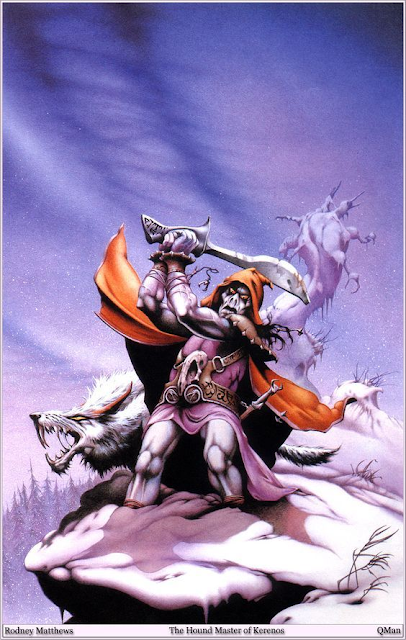
  • In the Chronicles, this is the chief of the Fhoi Myore, Kerenos. Described as male, with antlers, if that helps. Calatin, a mortal wizard, is able to counterfeit the Horn, so its power does not appear solely concentrated in the object.
  • The Horn is at least giant-sized, and requires min. STR 18 to lift/blow. 
  • It can be used to command, dismiss, slay and summon Fomorian minions. I suggest only the Hounds can be conjured out of nothing, coalescing out of the mists and bloodstained snow.

They are vulnerable to the Tathlum:

  • A missile/sling shot made of brains and bones of your enemies, ideally used against their relatives. They are effective for one attack only, successful or not.
  • Process can be as simple or as convoluted as you like, with or without magical ingredients and spells to enchant it. Resists mass production, resulting in numerous unidentifiable duds (and possible curses, if magical).
  • Tathlum damage to Fomorians regenerates at equivalent natural healing rate rather than 1hp/round, and is fatal if it brings them to 0 hp or less.
  • If made of the remains of Bitter Dryads, Half-Dead and/or Hounds, the Tathlum inflicts normal sling/thrown rock damage. 
    • On a crit, all Fomorians present must make a Morale Check.
  • If made of the remains of a Fomorian, roll to hit vs. unarmoured AC and it inflicts flat damage equal to half the donor's undamaged hit points. No save and all Fomorians make a Morale Check at ML 8. 
    • Instant kill on a crit, and all Fomorians make a Morale Check at ML 6.

Commentary.

I rather like this summary description of them as implacable leprous nihilistic geriatrics with a death wish.

The Fhoi Myore/Fomorians occupy an elevated position in my imagination, hitting the confluence of the Cthulhu Mythos, Steven King's The Mist, the Mists of Ravenloft, mythological retelling and (retrospectively) Silent Hill and Shadow of the Colossus. The Chronicles/Moorcock suggests that they are remnants, the bitter end of the deposed Chaos Gods, thrown out of their Heaven and eking out their existence by spreading their doom around. 

Figures of pity as much as horror, this affected my view of weakly godlike colossal Cthulhuvian entities since. They (and things like them) are uncomfortable and unhappy and without much hope - we'd sympathise if they weren't also actively incompatible with our existence. Or possibly if they were sexier.

The Chronicles is fairly low on detail on the Fhoi Myore, but does give hints and names. Balahr and Kerenos are the most obvious links back to Irish myth.

One (possibly two) are characterised as being female, whatever that would mean in their context - in the Chronicles, it means the sexual mutilation of male victims. Sreng is described as wearing a kilt of seven swords, but not if these are captured mortal swords or of more appropriate scale. One is credited with the creation of the Ghoolegh - is this an exclusive ability or just a statement of innovation?

One is named Bress, and as one of the Irish Fomorians is Bres the Beautiful, I like the idea that he/it can project an appearance more palatable to mortals or even a semi-independent astral body not working entirely in the interests of the original.

The motive force for the carts/chariots is opaque in the Chronicles, but it could be magic or alien technology or some horrible beast of burden (or dominant symbiote, as noted above).

I used the basic Fomorian statblock from AD&D 1e Monster Manual 2 as a mechanical starting point. They might need beefing up depending on your campaign - I'm envisaging a world where Corum is only a 4th level Fighter (a Hero, right?).


Tuesday, August 17, 2021

BITTER DRYADS (Brothers/Children of the Pines from the Chronicles of Corum)

The People of the Pines/ Rodney Matthews/ 1977

AC +4 (see below)    HD 4+4 (see below)     Move 100% Normal Human     ML 10 (see below)

Once mortals, the Fomorians poisoned the first with mistleberries and transfused them with the sap of winter pines, making them undead. The Dryads now carry out the ritual themselves, sometimes even persuading the living to join them of their own will - but otherwise by submission.

Bitter Dryads retain their mortal form but skin and hair turns green. Morphic resonance has evergreen leaves and needles, moss, lichens and berry-like growths replace their hair, clothing and personal ornament over time. They bleed green, sticky and slow.

They prefer the shade of the forest, the gloom of winter, and the dark of night, but are not vulnerable to sunlight.

Retaining their intelligence and memories, the Bitter Dryads are the ironic, rustling voice of the  Fomorians in the mortal sphere. They are fully conscious of what they do even as it goes against anything they once loved or believed in their mortal life.

Three blasts of the Horn will strike them as instantly dead as it does the Half-Dead.

The Dryads are inextricably linked (and loyal) to the Fomorians through their weird reptilian steeds.

Dryad Horses are intelligent, capable of subvocal/telepathic communication with their rider and the Fomorians, and serve to direct the Dryads according to that greater will.

It is said that these lizard-things are vomited up by the Fomorians, fully formed extensions of their dire personality.

  • As long as a Dryad is in the presence of their Horse, they are an AC +4 HD 4+4 Invulnerable Monster. If they are mounted, they regenerate 1 hp/round - even from 0 hp - and cannot be Turned. 
    • Treat mount and rider as a single unit/statblock wherever possible/reasonable.
    • A Dryad without a Horse is AC +2 HD 2+2 and normally vulnerable; they also have a -1 Initiative penalty. Morale drops to 8 (or 6 vs. fire). Turned as similar HD undead.
    • A Horse without a Dryad is AC +4 HD 2+2, an Invulnerable Monster and regenerates 1 hp/round. Move without a rider is 200% Normal Human, 150% with an unarmoured or shielded rider, 100% with an armoured rider. It is otherwise mechanically the same as a Bitter Dryad.
  • No armour benefit unless it is better than their base AC. Shield bonus stacks.
  • Can make weapon, missile and unarmed attacks with a Strength of 13 and a Dexterity of 10.
  • Immune to cold, gas, hold, charm, sleep and missiles (inc. magic missile).
  • Save vs. fire at -2 and take +1 damage per die (ML 8 vs. fire).
  • Surprise 1-3 on d6 and undetectable when stationary 1-4 on d6 in evergreen/winter forest.
  • At 0 hp, unless by fire or acid, the Dryad is helpless, not killed, and able only to sense and speak. Even beheading and dismembering cannot silence them.
    • Dryad Horses try to recover their fallen riders.
    • Killing a Dryad's Horse allows the Dryad to be killed with normal damage.

Commentary.

I first encountered the Brothers of the Pine in The Best of White Dwarf Scenarios Vol. II

I hadn't read the Chronicles of Corum at this stage, so they were just a cool monster in their own right. 

I remember being fazed by the '-20% Morale' because I thought Morale was on 2d6 not d%, but assumed it was the kind of shorthand that I'd eventually get to understand. At that stage, I thought of rpgs (and rpgs being mainly D&D) in general being a new thing, rather than something that had been around for 10+ years, and expected there to be a lot more compatibility between them than there was.

I've used the BECMI/OSE Wood Golem as the base monster for both mount and rider. 

The relationship of the Pine People to their mounts was something I'd forgotten about, and I couldn't not include it.


THE HALF-DEAD (Ghoolegh from the Chronicles of Corum)


I have a very strong mental image of what the Ghoolegh look like. This is not it, but this is what I could find.

AC as armour     Move 50% Normal Human     HD 5+5 (hp only)     ML 12 (see below)

Balanced on the very edge of death, their blood runs cold and slow and only at the behest of their Fomorian controllers/creators.

They are death pale with bloody red eyes. They are dull-witted, clumsy and sluggish, but capable of operating devices and independently carrying out orders. Their speech is halting and sombre, without emotion. They dimly remember their mortal life and skills.

The Half-Dead act as handlers to packs of Hounds of the Horn (Fomorian hunting dogs) and may be mounted on Ghoul Horses (unarmoured light warhorse, immunity and attacks as a Ghoul and Horse, will not accept rider with more than light armour & shield; carnivorous, intelligent, disloyal and sly).

They must obey whoever blows/holds the Horn of the Hounds, allowing new saves vs. charms etc. If they do not respond promptly to the first two blasts, the third will instantly slay them.

  • Always loses Initiative/acts last in a combat round.
  • Only defeated when finally cut to pieces or beheaded:
    • On critical and/or 9+ damage hits, they lose a limb. On 12+ damage hits, they lose their head.
  • Attacks as a Normal Human at -1 to Hit, damage bonus of +2 (or as Strength 16).
    • Makes missile attacks as Dexterity 6.
    • Can also make unarmed strikes, grapples and overbearing attacks.
  • Immune to cold and do not breathe, but are otherwise not undead and can't be Turned.
  • The Half Dead are without fear of mortal foe, but fear fire (ML 8), though they can and do use it and are not especially vulnerable to it.
  • When the Horn blows once, they panic, struggling to interpret meaning and respond (ML 6).

Commentary.

I'm genuinely surprised that I can't find more gaming material related to The Chronicles of Corum (Michael Moorcock), though that might be because they (especially the more strongly pseudo-Celtic second part) made such an impression on me rather than any wider merit or need.

In an attempt to fill that gap, here's the Ghoolegh (pronounced however you like) in approximately older edition D&D dress-up. I'll follow up with the Hounds of Kerenos, the Brothers/Children of the Pines, and the Fhoi Myore.

I've used Dragonwarriors Zombies converted to D&D adjacent - all those hit points represent how much punishment they can take. In the books, one still slithers on its belly to attack when all the bones in its body are broken.

If you don't like the cop-out of a big sack of abstract hit points, use regular Zombies or even Normal Humans but make them Invulnerable Monsters.

I've seen the suggestion to use the AD&D Juju Zombie, though I don't think it's a good fit.


THE HOUNDS OF THE HORN (Hounds of Kerenos from the Chronicles of Corum)

Jill Thompson (art)/Ray Murtagh (colour)
From the comic adaptation of The Bull and the Spear

AC +4     HD 4+1     Move 125% Normal Human     Morale 10

Dead white hounds, the size of a pony or a small cow. Blood red ears - sometimes tails, paws and bellies, too. Capable of great leaps in the air and running tirelessly over miles of snow-covered terrain.

They obey the Fomorians as much because they recognise their power as because they are bound to the Horn. The Horn calls and controls them, but does not strike them dead.

  • Bites for 2d4 damage.
    • On a crit or if damage rolled >target HD/level, you're knocked prone (50% drop whatever you're holding)
    • If they hit a prone target, they worry for 2d4 hits per round.
    • If two Hounds both bite the same target, they try to pull them limb-from-limb for 4d4 hits per round; if damage is 12+, they have pulled off a limb and will release the victim to fight over it.
  • If you have 3 HD or less, save vs. fear or flee when attacked by a Hound or Hounds; Morale check to hear their baying in the distance.
  • Immune to cold.
  • They absolutely obey whoever blows/holds the Horn of the Hounds (overriding any other mental control), but can otherwise be directed by anyone able to handle them successfully.
  • For even bigger Hounds, swap d6/d8 HD for a d10 or even a d12. Add one or more d4 to damage or give it a 2d6 bite attack like the Bloodbeast.

Commentary.

White Dwarf no. 18 carries stats for Hounds of Kerenos, pitching them as frosty Hell Hounds - though a Winter Wolf would work just as well.

I've used the BECMI Dire Wolf with a bit of Giant Shrew as the base, but there are various monster hounds and wolves across various games and their editions that would work just as well. 

I think that they're living things rather than magical beasts, which is why I've not given them a breath weapon. They are specifically a reference to the Cwn Annwn, with their white coat and red ears.


Thursday, July 22, 2021

ALLANSIAN BLOODBEAST: Monster Conversion - Fighting Fantasy to Old School

Iain McCaig 1984

Armour Class +4     Hit Dice 7     Move n/a     Morale n/a

Bloated and limbless, it eternally wallows in the pool of slime it was spawned in.

The Allansian Bloodbeast is an Invulnerable Monster and regenerates 3 hp/round from any source. 

It is immune to acid and normal fire. Very hot/large and magical fires (causing 10+ hp damage) cause half damage but it retreats to the bottom of its slime pool for at least 1 combat round.

Electricity causes only 1 point per die, but reduces its attacks by 50% for 1 combat round. It will 50% retreat to the bottom of its slime pool for the duration instead.

Tongue: Its 10' prehensile tongue will grab a victim of size M or smaller and drag them to be bitten or (50%) into the slime pool on the next round. To resist the drag, grapple vs. STR 18.

The tongue can be severed with 6 points of slashing damage in a single round. If this happens, the Bloodbeast retreats to the bottom of its slime pool and will not emerge until the tongue regenerates (1 on d6 on the first day, 1-2 on the second and so on).

Bite: It bites for 2d6 hits. On a 9+, you lose a limb. On a 12, it crushes your skull/bites off your head.

Only those grabbed by the tongue or attempting to attack its weak spot can be bitten.

Slime Pool: If unprotected and susceptible, you must save vs. fumes each round or be nauseated (as Troglodyte stench) and partially blinded (as if trying to avoid a gaze attack). 

On a critical fail, you are overcome and collapse helpless. The Bloodbeast will grab you with its tongue at the next opportunity and drag you into its pool.

Anyone dragged into the slime pool suffers d6 acid damage each round and is unconscious after 2 rounds.

Weak Spot - Real Eyes: The Bloodbeast has hundreds of false eyes that burst from blisters on its head. Its vulnerable real eyes are hidden amongst these.

A crit against the head will hit a real eye (or 5% chance). If the attacker knows the Bloodbeast's weak spot, they can increase their chance to 10% equivalent. If this seems too much of a challenge, apply a -4/20% penalty to hit instead (called shot equivalent).

Striking an eye causes the Bloodbeast to suffer half its HD in damage (3d6+3 or 3d8+4, and instead of weapon damage). It will retreat to the bottom of its slime pool to recover at the next opportunity.

Commentary.

I sometimes forget how awesome the Bloodbeast from Deathtrap Dungeon is/was. 

IIRC correctly, in the gamebook you can't fight it normally and must either get a lucky strike against an eye, sever its tongue or dodge past it. Or die, of course.

It's not a monster you're meant to kill. However, Fighting Fantasy as a setting tends to the lower end of magic weapon allowance so you might need to go the whole hog and make it like some iterations of the Hydra so it can't be killed with body hits alone. Or go the Call of Cthulhu route and reducing it to 0 hp merely drives it the bottom of its pit.

The cover illustration suggests it has a stinger, but this is not mentioned in the gamebook or in Out of the Pit. But it does get used in the Playstation game, in which it also gets to spit poison, use magic, is vulnerable to the Venom Sword, and has only one real eye.

No idea how the Bloodbeast is meant to have evolved or how it breeds or how it even gets about. It seems likely that it secretes its own slime, as it uses it as a pre-digester. 

Maybe that stinger is an ovipositor and implanted eggs are carried away by adventurers and wandering monsters? 

Mechanically, used some bits of the (AD&D) Froghemoth and the (Dark Sun) Fael and stuck them onto a (B/X et al) Cave Bear. I imagine the solo adventurer as being a 4th level Fighter (YOU are the Hero).

Hope I've done it justice.