Monday, April 27, 2020

3d6 vs. AC Hit Rolls

TL; DR: Table of % chances to Hit using various permutations of 3d6 vs. ascending AC 9 to 18, instead of d20.


Av.
Ex Rng
to Hit AC 9
10
11
12
13
14
15
16
17
18
3d6
10.5
8-14
74%
63%
50%
38%
26%
16%
9%
5%
2%
*%
3d6 -1
9.5
7-13
63%
50%
38%
26%
16%
9%
5%
2%
*%
-
3d6 -2
8.5
6-12
50%
38%
26%
16%
9%
5%
2%
*%
-
-
3d6 -3
7.5
5-11
38%
26%
16%
9%
5%
2%
*%
-
-
-
3d6 +1
11.5
9-15
84%
74%
63%
50%
38%
26%
16%
9%
5%
2%
3d6 +2
12.5
10-16
91%
84%
74%
63%
50%
38%
26%
16%
9%
5%
3d6 +3
13.5
11-17
95%
91%
84%
74%
63%
50%
38%
26%
16%
9%
4d6 DL
12.2
9-15
90%
82%
73%
62%
49%
35%
23%
13%
6%
2%
4d6 DH
8.8
6-12
51%
38%
27%
18%
10%
6%
3%
1%
*%
*%
3d6 adv
12
10-14
93%
86%
75%
61%
45%
30%
18%
9%
4%
1%
3d6 dis
9
7-11
55%
39%
25%
14%
7%
3%
1%
*%
*%
*%
4d6
14
11-17
95%
90%
84%
76%
66%
56%
44%
34%
24%
16%


  • DL drop the lowest.
  • DH drop the highest.
  • adv/dis advantage/disadvantage (reroll for a higher/lower result).
  • Av. average roll, rounded to one decimal place.
  • Ex Rng expected range of most rolls, based on rounded averages and standard deviation.
  • ascending AC.
  • *% rounds to lower than 1%.
  • - cannot be achieved on an adjusted roll.
  • all percentages are rounded up or down to nearest whole number (for spacing reasons).
I used a combination of AnyDice and Rumkin Die Roll Stats to compile this; any mistakes are mine, from input or interpretation.

For the homebrew D&D-adjacent system I've used and continue to tinker with, there's a 3d6 Hit Roll (4d6, drop lowest, for Fighters and monsters), vs. base AC 9 and the leather/chain/plate scale from BECMI etc. No bonuses to Hit or to AC from Ability Scores. Base damage is the margin-of-success; crits on triples (less than 3% chance). There are Parry and Dodge options. 

I currently use AC 15 (plate/Heavy) as the hard cap for the system, and there are (good?) mechanical as well as narrative reasons for adventurers to favour lighter protection. 

I've extended the AC line to cover the base ACs of most retro clones (10), plus Basic Fantasy RPG (11) and Lamentations of the Flame Princess (12), up to the maximum unadjusted roll of 18.

While primarily interested in the 3d6 and the 4d6DL rolls, I've included adjustments -3 to +3, 4d6DH, advantage/disadvantage, and straight 4d6 (but ignoring rolls above 18) for comparison.

Addendum (28/04/2020).

Link to the d20 SRD entry for Bell Curve Rolls (3d6, but also 2d10), for reference.

You could use the Dragonwarriors Armour Factor progression instead of D&D adjacent, which would bring the numbers down a bit if you don't like how strong Heavy/Plate gets: padded leather +1, hardened leather +2, ring mail +3, chain +4, plate +5.

For the tinker homebrew, shields do not contribute to AC, but there's no reason not to use them RAW for your preferred system if you're using this.

Also for the homebrew, monster ACs tend to be the same as Unarmoured, but a tough hide (Elephant) might be +2 (leather); a scaly hide (Crocodile) might be +3 (BECMI scale mail); a shell/carapace (Giant Beetle) +5 (BECMI banded), and a Living Stone Statue equal to Heavy/Plate at +6 (though could also be AC 9, but only ever takes one point of damage per hit and you risk breaking your weapon).




Monday, April 20, 2020

Compiled Conversion Methods 2: D&D Adjacent to BRP

Converting To BRP From D&D Adjacent.


This method is closely based on an AD&D to RQ conversion document, the broader provenance of which I do not know.


First, find the average score for each characteristic and then divide by 3.5 to determine how many d6 to roll for it. 

This often results in a remainder to use as a + to the roll. I either round to a whole number or use a +3 or +6 mod, even if this means altering the average, or map it to the dice and adds used for an existing monster with approximately the same average.

After tweaking, you may end up with a new average. Don't worry about it.

  • STR: 6 + max damage of main non-special melee attack; strongest natural attack, for preference.
    • If STR is given for an AD&D monster, 18/01-75 is BRP 19, 18/76-00 is 20, and add 2 to any AD&D STR >19 to get BRP STR.
    • Other system shared stats can be ported, with WIS mapping to POW and CHA to APP (for convenience).
  • CON: 10 + Hit Dice (ignore plusses).
  • SIZ: you have options
    • the existing size class: T=1; S=2-4; M=5-17; L=18-36; H=37-61; G=62+. It's easy enough to just use the median of these ranges as the average, but remember SIZ 18 is a hulking brute of a Human, but not much of an Ogre.
    • if the description includes weight, this can be compared to existing SIZ charts in CoC and RQ.
    • find a rough size equivalent in BRP and use that average.
  • INT: if sapient, add 1 to the AD&D Intelligence (or the median or top-end of its range); otherwise, the monster has 'fixed INT' - the same for all members of the species/type.
  • POW: 9 + half Hit Dice. 
  • DEX: average 10.5 (3d6), but more or less if you think there is a good reason, based on your concept of the monster or explicit/implicit in its description/abilities.
  • Damage Bonus, Hit Points, Magic Points: these are all derived from the characteristics.
  • Move: compare with a Normal Human; this is how it's done for system agnostic material, anyway.
  • Armour Points: simple conversion - equal to AC bonus (or 10 minus descending AC), but if a good AC is from speed and agility, it might be better to give it % in Dodge instead. Lots of unarmoured monsters make sense just to be unarmoured (no AP) when converted, while for others you might want to give a narrative reason for their damage reduction.
  • Attack: because this is old school, the calculation is: 20-thac0, multiply by 3, add that to 30%.
    • I suppose the newer school method could be BABx3 or x5 + 30.
    • In both cases, round and tweak if it doesn't feel/look right to you, and you can always pluck something from an existing source if that seems suited.
  • Damage: can be used unchanged, or find a comparable monster attack if it doesn't look right in context.
  • Skills: percentile abilities, like Thief skills, could be ported straight over; others can be derived from the characteristics (x3 or x5 is common, though this will need to be scaled back for some monsters).

Further Elaboration.

  • Unsatisfactory Characteristics: yes, some conversions are going to look like very different monsters to the source material, so you either go with it and redefine the monster, or you tweak it until it feels right.
    • I find I start to deviate from the raw numbers generated quite quickly with this method (they are a lot messier than the existing statblocks), as I'm either carrying a pre-conceived monster concept, or start to see an interesting alternative emerging.
  • Incomplete Creatures: lacking one or more characteristics has mechanical/narrative effects in RQ III (and, less explicit, in CoC 5e); compare the original monster with something similar in the target system (as I did with the Gelatinous Cube).
  • Special Abilities: lots of these will port straight over, and see Special Attacks in the BRP to D&D conversion above; the Damage Bonus is a useful dice pool to use for special attacks if the original numbers don't feel/look right.
  • Spell-like Abilities: these will cost magic points=spell level equivalent to use, unless their daily limit makes more sense for the concept. They don't need to be mapped to existing spells in the target system, but you can do this if you like.
  • Sanity Loss: this is just fun; use the guidelines in the rulebooks or pluck from an existing monster you think of as a comparable threat or with similar habits.


Sample POW ranges.


POW derived from Hit Dice is often unsatisfactory, because a mundane 10 HD Elephant will end up with a higher POW than a magical 1/2 HD Brownie, and the Brownie needs those magic points much more.

So here are some suggestions to use instead of the HD to POW conversion method.
  • Normal animals: 2d6 to 3d6 (Wolf, Boar, Horse, Bear).
  • Most monsters: 3d6 (Normal Humans included).
  • Magically-inclined kindreds/monsters: 2d6+6 (Serpent People, Ghouls, Elves).
  • Strongly magically-inclined: d6+12 (Drow, Mind Flayers, Githyanki).
  • Undead will either have 1 or no POW (though this is a feature of CoC and RQ, and you can ignore it).
  • 4d6 and more is appropriate for a whole swathe of D&D adjacent beasties; POW, amongst other things, is how resistant to and/or able to use magic/spell-like abilities a creature is.

Sunday, April 19, 2020

Compiled Conversion Methods 1: BRP & DW to D&D Adjacent.

Converting To D&D Adjacent...


...From Basic Role Playing (Call of Cthulhu, Runequest, d100 systems).


Basic Method.

This is the one used for gods and monsters from Call of Cthulhu (BRP), given in Cthulhu d20. 

Use one or the other, or both; I don't see why combat ability should be absolutely tied to Hit Dice.

Also, expect lots of human-sized monsters ending up in the same Hit Dice/hit point bracket, due to the way BRP hp are calculated (average of CON & SIZ).

  • Divide CoC hit points by 5 = Hit Dice
  • Divide highest % 'normal' attack by 10 = + to Hit/ BAB
    • Hit Dice can be extrapolated from the + to Hit (count on from chance to hit an unarmoured target), instead of using the hp calculation.


Further Elaboration.

  • Armour Class: if it doesn't seem utterly ridiculous, convert BRP Armour Points to AC bonus. 
    • Anything with a high average DEX could have additional AC bonus, based on normal Ability Score adjustments.
    • Lots of CoC monsters have resistance or immunity to certain types of damage; these can usually be ported directly.
    • Using the D&D adjacent Troll as the base monster for measuring regeneration, some CoC monsters might seem to have quite high rates, but these can also be ported directly.
  • Movement: in CoC 5e, a Normal Human has a Move of 8 arbitrary units of distance per round, use that as your base for calculating D&D adjacent Movement - for example: a CoC Move of 12 would be equal to the Movement of a Normal Human + 50% (or x1.5).
    • RQIII has different, more involved movement rules, and Normal Humans have a base Move of 3 (approx. 30 metres/ 100' per combat round), but you could use a similar % or decimal conversion method.
  • Number of Attacks: this is usually in the monster description (ie. a CoC Ghoul has Claw and Bite in its statblock, but that it uses claw/claw/bite in a round is in the text).
  • Damage: for 'smaller' CoC/RQ monsters, especially those of roughly human-size, you can just use the dice given (ignore the Damage Bonus, or convert to d4=+1, d6=+2, anything above is +3 or more).
  • Special Attacks: poison, paralysis and spell-like abilities map easily onto D&D adjacent saves/ Ability Scores, or may resemble a pre-existing spell or special attack.
    • POW vs. POW/ magic points vs. magic points: save vs. spells or paralysis, as appropriate, or an INT/WIS check.
    • STR/SIZ vs. STR/SIZ: probably a swallow, grapple or trample; could also use a save vs. petrification.
    • Attacks vs. CON, including poison, can use a CON check or poison save, if you're not sure.
  • Intelligence: use the average INT - tweak if you think it needs it.
  • Morale: no real equivalent; you'll have to work it out from any behavioural description and your own concept for the monster.


...From Dragonwarriors.


Basic Method.

Mainly my own effort, relying on the common feature of d20 Hit Rolls and accidental/designed similarities between the two systems, and covered more fully in a previous post.

You can work out HD from BAB or from Health Points, or you can keep combat ability separate - this seemed particularly apt for the Zombie, hard to kill but a poor fighter.
  • (DW Monster ATT - DW Normal Human DEF of 5) - 6 = + to Hit/BAB.
    • Hit Dice can be extrapolated from the + to Hit (count on from chance to hit an unarmoured target), instead of using the hp calculation.
  • Max. Health Points divided by 4.5 = Hit Dice.
    • this will likely be a decimal, so round to the nearest whole number, or use all (or some) of the remainder as a + to hp.
  • AC bonus = DW Armour Factor.
  • For damage, either use the Armour Bypass roll or x2 the fixed damage to work out the damage die to use (2=d4, 3=d6 etc.), as you feel appropriate for your setting/the challenge you want to present.


Further Elaboration.

Not everything here was covered in the previous post, but arose from later conversions.
  • If the difference between the monster's ATT and DEF is less than 6 (usually due to flight, but not always), give it a further AC bonus (possibly +1 for every 2 or part of 2 points less than 6).
  • A +1 or +2 Armour Bypass/damage bonus in DW indicates 16-18 and 19 Strength respectively, and either the bonus or the Strength score can be ported directly (DW attributes are on a 3-18 scale).
  • For special attacks causing damage, divide max. damage by 4.5 to get number of dice (choose appropriate type) to roll.
  • Elementalist, Mystic, Sorcerer, or Warlock levels can convert directly to Cleric or Magic User levels, and spell ability (this is not entirely accurate, but is easy).
  • Anything with a MAGICAL ATTACK score can attack/save as a Magic User or Cleric of HD equivalent level, if that is more advantageous or suits your concept of the monster. 
    • You could also measure the score against a DW spell-caster to get a Rank/level equivalent if you prefer.
  • For Movement, I'd compare it to a Normal Human, as above (or to a Bat, for flying things).
  • Out of the Shadows gives details of how able the monster is to see in the dark and how it will react to bright light.
  • Intelligence and Morale will have to be extrapolated from the descriptions.

Monday, April 13, 2020

I Can't Believe I Forgot The Penanggalan: Conversion for Call of Cthulhu 5th Edition.

Wait, what?

Penanggalen-a beautiful woman by day, by night a detached flying ...
Image: Dangling internal organs, a female vampire's head against a full moon.
Russ Nicholson, from the 1st edition Fiend Folio.

My thing for flying head monsters can be traced back to Alicia, the Penanggalan in Terror At Trollmarsh (White Dwarf 74). I know why the scenario grabbed me at the time (D&D as CoC and vice versa!), and I think the Penanggalan made such an impact because it's not just a statblock, it also permeates the text and the story.

Bowdlerised in 2nd edition AD&D, it lost its juicy, acidic, dangling guts and got a slimy black tentacle instead.

I offer two versions of the Penanggalan for Call of Cthulhu 5e:

The first is an undead foe from the 1st edition AD&D Fiend Folio, and closer to the SE Asian original, and the second uses the 2nd edition as inspiration for a more Mythos-flavoured version. I don't know if the two could or should exist in the same setting as each other (CoC is crowded enough).


I. Penanggalan, Loathsome Aerial Vampire.


A form of vampire (usually, but not exclusively, coded as female) that can walk by day, indistinguishable from a living human being. 

As darkness falls, it finds a secret place to detach from its body, and flies in search of a nocturnal meal of blood. While believed to favour the blood of infants and pregnant women, it simply prefers any prey that it can successfully and repeatedly subject to its hypnotic pass.

Traditionally, it keeps a vessel of vinegar in which to soak its blood-swollen organs so it can shrink them enough to fit back into its body. There is no reason this could not instead be perfume, hydrogen peroxide, urine or whatever suits your campaign.

Unable to return to its body, or struck by sunlight when detached, the Penanggalan is helpless (though vocal and alternately craven and threatening).

STR 4d6 (av.14)     CON 4d6 (av.14)     SIZ 2d4 (av.5)     INT 2d6+6 (av.13)     POW 2d6+6 (av.13)

DEX 3d6 (av.10.5)

Hit Points 9 - 10                                      Damage Bonus nil     Move 10

Weapons:

  • Bite 40%, 1-6 (d6)
  • Hypnotise, magic points vs. POW on a single victim, allowing it to feed throughout the night without resistance or memory of the event; the Penanggalan drains 1 STR, 1 CON and d3 POW each night it feeds -it can add the POW to its own total. Resisting a Penanggalan's hypnotic attack renders that person immune to future attempts by the same one.
  • Touch 100%, 1-4 (d4); the dangling guts of the Penanggalan glisten and drip with corrosive juices that cause bare flesh to blister and peel. This damage does not respond to medical treatment, and is only recovered by the passing of time.

Armour: none

Skills: Dodge DEX x 4; Human Psychology 60%; Scent Blood 75%; Mutter Terrible Delights and Secrets of the Grave 45%

Spells: if POW is 13 or higher, the Penanggalan knows at least d4 spells. Though this means that the monster was a practising sorcerer or mystic in life, the spells are unlikely to relate to the deities and beings of the Mythos to any great degree.

Sanity Loss: 1/d8 to see a Penanggalan (including when it detaches from its body); 0/d4 to be fed on (though you do not realise it).

II. Penanggalan, Gruesome Agent of the Mi-Go.


Surgically adapted to better serve the Mi-Go, these creatures were once human. Their body is merely an organic vehicle for the head, which retains the original memories and personality. While attached to its carrier body, a Penanggalan appears to be completely human, albeit utterly unresponsive to pain or injury that does not affect the head or face, and that does not age, suffer fatigue or contract disease.

At will, the Penanggalan can detach from its carrier, trailing a three foot long glowing black tentacle or tail, and fly through the air, propelled by some form of anti-gravity effect. Their eyes dimly glow red when they activate their ability to see in total darkness.

A Penanggalan believes itself to be favoured by the Mi-Go, and is often set to lead or watch over unaugmented agents, but is ultimately just another disposable terrestrial minion (although they can be found wherever the Mi-Go choose to take them).

While they can consume and eliminate human food, they do not need it, subsisting on nutritional broths provided by the Mi-Go or mammalian blood in a pinch. Each week without Mi-Go broth, they lose 1 STR, CON, INT and POW; if they feed on blood at least every three days, they can hold off the characteristic loss until they are able to take broth again, but otherwise the loss is permanent.

STR 4d6 (av.14)     CON 4d6 (av.14)     SIZ 2d4 (av.5)     INT 2d6+6 (av.13)     POW 2d6+6 (av.13)

DEX 3d6 (av.10.5)

Hit Points 9 - 10                                      Damage Bonus nil     Move 12

Weapons:

  • Bite 40%, 1-6 (d6)
  • Black Tentacle 60% (or automatic, if bite is successful), 1-4 (d4); STR vs. STR to grapple and hold, pin, disarm, drag, yank, crush or choke (STR vs. STR each round to escape); the tentacle itself cannot be grasped and held by investigators due to the anti-gravity effect, though it can be dislodged.
  • Hypnotise, POW vs. POW or transfixed and suggestible; direct attacks break the state, but automatically succeed.

Armour: 2 points of augmented tissue and anti-gravity field.

Skills: as appropriate for their previous/assumed occupation; Track by Smell 60%; Disdain Unaugmented Humans 75%.

Spells: any spells they knew previously, the Penanggalan retains, and they may learn any the Mi-Go deem necessary to their mission.

Sanity Loss: 0/1d6 to see this type of Penanggalan; 1/1d6 to see it detach from its body.


Wednesday, April 1, 2020

A Flock of Grotesque Flying Heads.

Dave Morris wrote some of the game material that had the most impact on my impressionable young mind, and it appears that he might have a thing about flying heads, and that is maybe why I have a thing about flying heads.

So here's some flying heads, converted between systems.


Dragonwarriors to D&D: Chonchon, Death's Head, Obsidiak and Skullghast.


Fabled Lands: Castle of Lost Souls part three: "The Demon Road"
Image: a flock of grotesque flying heads.
Leo Hartas, I think.


See this post for an idea of how I arrive at the numbers below, and why there are choices.

Dragonwarriors doesn't give Intelligence for monsters, but the Chonchon and Death's Head are clearly intelligent on the same scale as Normal Humans, and can plan and communicate, the Skullghast is mindless and the Obsidiak is anyone's guess (at least animal intelligence, but probably alien).

Chonchon.

Ugly head with huge blue-veined ears it uses as wings; chisel-like teeth; said to be polymorphed and can't change back. 

Out of the Shadows, p. 73-74

AC bonus +4*     BAB +4     HD 2.8 (2+4/ 2+8/ 3)     att. bite d8 (or d4)
  • * AC +2 for DW Armour Factor, +2 for high DEFENCE
  • flies as well as a Bat
  • d6 + 3 Magic User levels (can use BAB, saves, and hit points if you prefer)
  • invisibility to mortals of levels 1 to 4, until they attack or cast a spell, but only normal chances of surprise (they've got noisy 'wings'
  • affected by holy symbols like a Vampire (as appropriate for your setting/system)
  • there is a special spell (5th level caster to learn and use) to bring a chonchon down and render it helpless
  • 'sly and cowardly'Morale 6
  • bite has 25% of carrying a disease
  • can see in the dark; dazzled by light

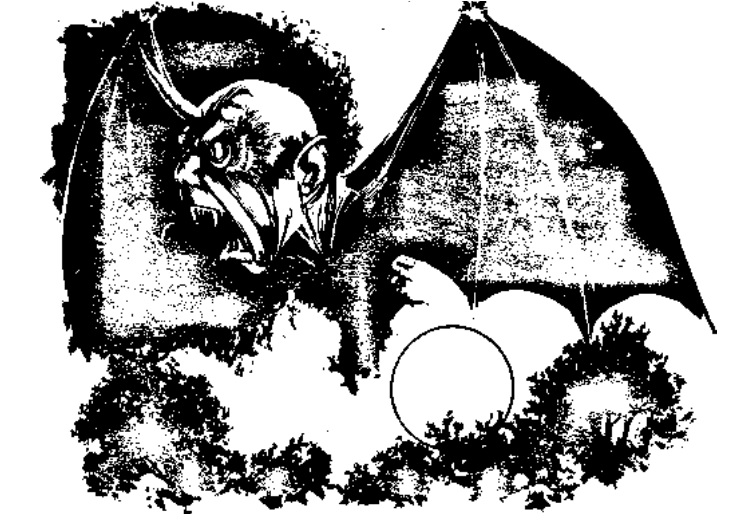
Image: Horned, winged and fanged head flying on a moonlit night.
Bob Harvey.

Death's Head.

Head with bat wings and a horn - these vanish during the day; devours head from a body and reanimates it as a Zombie host to pretend to be a Normal Human.

Dragonwarriors, p. 80-81

AC bonus +7*     BAB +5     HD 1.7 (1+4/ 1+7/ 2)     att. horn d10 (or d8)
  • * AC +3 for DW Armour Factor, +4 for very high DEFENCE
  • flies as well as a Bat +50%
  • spellbind, once per night, range 30', save vs. spells or stand in place while the Death's Head kills you (if you think this is too much, rule that a non-fatal attack ends the spell)
  • Zombie host fights as appropriate for setting/system
  • Zombie host 90% passable as human, but deteriorates 10% per day; 
  • 10% chance/ hit rolls of 19-20 strike the Death's Head, not the Zombie host
  • Death's Head cannot detach from Zombie host until night falls; horn and wings immediately appear
  • the host can be Turned; the Death's Head itself cannot - it is not undead
  • can see in the dark

Obsidiak | Dragon warrior, Skull tattoo, Artwork
Image: a crude human face with three tentacles.
The only pic of an Obsidiak I could find.
Don't know who it's by, and it's not how I imagine the monster.

Obsidiak.

Bizarre dungeon monster; 'a slain Obsidiak will quickly decompose into a damp and evil-smelling ash.'

Dragonwarriors, p. 105-106

AC +3     BAB +3     HD 3.1 (3/ 3+1)     att. bite d8 (or d6) or constrict
  • flies half as well as a Bat (floating)
  • 70% likely it bites in a combat round
  • 30% it makes an attack vs. base AC & Dex mod to grasp & constrict
  • target must make 3 Dex checks or arms are pinned and cannot fight back
  • constrict damage die starts at d4 and advances each round (max. d20)
  • constricting Obsidiak cannot do anything else, but misses against it hit the victim unless attacker makes a Dex check
  • can see in the dark; dazzled by light
The Temple of Flame by Dave Morris
Image: cover of Golden Dragon gamebook 'The Temple of Flame';
a parade of flame-wreathed skulls emerge from a stepped pyramid.
Bruno Elettori.

Skullghast.

Dormant, they just look like old skulls, but burst into pale-gold flame and fly after you when activated.

Out of the Shadows, p. 132-133

AC +4*     BAB +5     HD 0.6 (d4/ 1-1/ 1/ 3hp)     att. flames d10 (or d6) + special
  • *+4 for very high DEFENCE
  • flies as well as a Bat +50%
  • gaze attack: save vs. spells or weakened by fear (-3 STR & DEX for duration of encounter)
  • damage from flames cannot be healed by magic below 3rd level
  • spell-casters must save vs. spells per hit or lose one spell from memory, lowest level first
  • 'fly in pursuit, even if the chase leads them out of the temple': Morale 12
  • cannot be Turned (not true undead, by my reading of the text)
  • can see in the dark

AD&D and D&D adjacent to Call of Cthulhu/BRP: Vargouille and Skullghast.


Vargouille (Monstrous Manual)
Image: two monstrous winged heads.
DiTerlizzi (Planescape MC 1994)

Vargouille, Shrieking Horrors.

Hideous fanged heads, maned with writhing tentacles, and carried aloft on a 3' span of bat-like wings. Otherwise voiceless, they give vent to bone-chilling shrieks as they surge up from the lightless gulfs they lair in.

Bright light, including the sun, blinds them, and they hate light, attempting to extinguish sources during an encounter. They are able to see (and track) the heat signature of living creatures in darkness, and may have an undocumented ultrasonic echo-location sense (explaining how they navigate caves and catacombs). Their eyes reflect green in low light.

Special abilities from 2nd edition AD&D also given as options, if you don't think they're Mythos enough as is.


STR 3d6 (av.10.5)     CON 3d6 (av.10.5)     SIZ 2d4 (av.5)     INT 2d6 (av.7)     POW 3d6 (av.10.5)

DEX 3d6 (av.10.5)     

Hit Points 7-8                                                Damage Bonus nil     Move 12 (flying)

Weapons:
  • Bite 35%, 1-4 (d4)
  • Bite damage is permanent and does not respond to natural healing, First Aid, or medical care; healing is only possible through magic or the ministrations of (say) Mi-Go, Eldritch Things, or time-travellers
  • (2e) Shriek, POW vs. POW (or maybe a SAN test with no loss) or victim is paralysed with fright until the Vargouille has taken a free attack
  • (2e) Kiss, POW vs. POW or begin transforming into a Vargouille:
    • only on paralysed victims
    • +d6 hours, all hair on head falls out
    • +d6 hours, pointed ears and fangs, tentacles sprout from head and chin; lose d6 INT & 2d6 APP
    • +d6 hours, body dies - the new Vargouille will unfurl its wings and detach next time it is in darkness
    • very bright light halts the process, but cannot end or reverse it
Armour: 2 points of rubbery hide

Skills: Dodge DEX x4; Track by Heat 60%

Sanity Loss: 0/d6 to see a Vargouille; same again at each stage of transformation if subject to the Kiss, or to see another transformed.

Skullghast, Eerie Temple Guardians.

For when you need a rest from tentacles and something a little bit Indiana Jones to relax.

Wreathed in cold, otherworldly flames and utterly silent, these are earthly nightmares but nightmares nonetheless. Enchanted by sorcerers living or long dead, they are set as guards. They will pursue intruders to a distance designated during their creation, but will always return to their original resting places.

They render victims helpless, who are then prey to other denizens of the location (usually a tomb or temple), or to dehydration and exposure, as the Skullghasts will swoop every time a helpless victim recovers enough to try and escape.

Converted using the D&D adjacent stats above, some Mythos licence, and referencing the CoC Skeleton.

STR 2d6 (av. 7)     CON n/a     SIZ d4 (av. 2-3)     INT n/a     POW 1     DEX 2d6+6 (av. 13)

Hit Points n/a        Damage bonus nil                    Move 12 (flying)

Weapons:
  • Touch, 50% (or DEX x 3 - your choice), 1 STR, 1 DEX and 1 magic point
  • lost characteristic points recover at the same rate as magic points
Armour: none, but only harmed if destroyed (% chance = damage scored x4; x2 for impaling weapons, including firearms)

Skills: Dodge (DEX x 4); Relentless Pursuit 60%

Sanity loss: 0/d6 to see a Skullghast; 1/1d6+1 to spend any significant time helpless in a Skullghast lair, without apparent hope of escape or rescue, slipping in and out of unconsciousness at the unearthly touch of the pale-gold flame, as the rats and beetles crawl across your shivering body.


Monster Ratings for Tunnels & Trolls 5e, too.

  • Chonchon: MR 28; on doubles casts a spell of level 1-6.
  • Death's Head: MR 17; spellbind, 2nd level IQ save to resist; 2nd level DEX save to hit in flight; one or more Zombies nearby.
  • Obsidiak: MR 31; on doubles constricts you for unopposed damage (armour counts for 1st round only), cumulatively more difficult STR save to escape each round and you can't do anything else.
  • Skullghast: MR 6; damage comes off STR, too (or whatever wizards use in later editions); 2nd level DEX save to hit in flight; come in flocks of 2-12, even on the first dungeon level.
  • Vargouille: MR 21; on doubles 1 point of your CON never comes back, except by gaining a level. 
Increase the MR the deeper into the tunnels you delve. Obviously.