Showing posts with label skeletons. Show all posts

Thursday, March 26, 2020

3rd and 4th Flavours of Skeleton: Runequest III and Tunnels & Trolls 5e to D&D adjacent.

https://i.pinimg.com/736x/0b/80/a0/0b80a00210496f864cf1a05fad3f5736--tunnels-doodle-art.jpg
Image: mixed heap of armed and armoured Skeletons.
Josh Kirby for Tunnels & Trolls.


Runequest III.

The Runequest 3rd Edition (Games Workshop took out almost all the Glorantha) Skeleton is very close to the 5e Call of Cthulhu Skeleton.

It has 2d6+6 SIZ (same as a Normal Human) and no POW, but is otherwise much the same simple thing. This gives it, by my reckoning, a hit point equivalent of 13 (the average of SIZ 13 + CON 0).

They are much stronger fighters than CoC Skeletons(because of the expectations of the game?), with DEX x 5% for weapon attacks and Dodge ability (10.5 x 5 = 52.5%).

In RQIII, Skeletons are animated objects, 'magical artifacts, not true undead', and can be given much greater STR and DEX (and presumably SIZ) if the creator is willing to expend the POW to do so. There are no specified limits.

The creator can also put Magic Points into the Skeleton so it can resist spells cast against it; there is no specified limit.

If hit through their armour, that hit location is destroyed. Skull and/or ribcage hits destroy the Skeleton, and they are even more resistant to piercing weapons than in CoC.

Skeletons with a Damage Bonus (those with high combined STR and SIZ) get 1 armour point per +d6 db.


Conversion.

There will be more involved RQ specific conversion methods out there, but I'm for old school simplicity, so I'll use the same one as I did previously.

  • (HP 13)/5 = 2.6 HD
  • Attack/10 = 52.5/10 = 5.25 = BAB +5


Abilities.

  • destroyed on a single hit, but can save vs. dragon breath to dodge a successful hit, or +1 or more AC bonus to reflect Dodge/DEX
    • larger specimens might not dodge, but are intrinsically more robust
  • immune to piercing weapons, unless critical hit
  • immune to fatigue
  • mindless
  • option: immune to Turning (if you decide they are not undead)
  • option: +1 or more bonus to save vs. spells


d6 Flavours of Skeleton:

  1. Multi-Armed: extra pairs of arms were added at creation (max. 6); at least one extra attack and can split between two targets. Probably really good at parrying as well as dodging.
  2. Skeletaur: if there are no Centaurs in your setting, this was constructed from parts; could be as strong as an Ogre/Bull. Could have a horned animal skull. Often used for heavy work as much as a guardian.
  3. Bone Colossus: dozens, hundreds of corpses have been rendered down and reformed into a towering Skeleton. A necromantic siege engine. Can throw boulders and make stomp attacks. Not destroyed on a single hit, unless it's from a trebuchet or a cannon.
  4. Catacomb Byte: constructions more bizarre than the Skeletaur, bursting out of the massed bones and skulls of ossuaries. Scorpion forms with biting skulls instead of stinger and pincers; lengths of vertebrae coiling like serpents (or Necrophidius); sentries that look and reach in all directions at once; finger bone tentacles etc. The animating force is not confined and infuses the whole catacomb.
  5. Skeleton Kettle Drummers: they keep excellent time, march in formation and won't betray you; de rigueur for necromancer triremes and armies of darkness.
  6. Prehistoric Skeleton: some colossus of the past. Mammoth, Woolly Rhinoceros, Styracosaurus and Tyrannosaurus Rex are all good choices

Tunnels & Trolls 5e.

There's no Monster Rated Skeleton in my/the UK Corgi edition, but reversing the MR to Prime Attributes conversion (assuming average rolls) in section 2.41 Personalizing Monsters you get a 10 MR monster (2 dice + 5 adds - this is pretty close to the RQ hp to Hit Dice conversion, so might work for RQ/CoC to T&T; I'll explore later).

Against the table in section 1.6 Creating Monsters, the Skeleton above would fall between Rats (MR 8; 1d +4) and Black Hobbits (MR 12; 2d +6).

Because there is no simple established threat hierarchy in T&T (other than deeper dungeon level = deadlier monsters), comparisons are not always useful. For example, the same table has (1st dungeon level) Centaurs, Ghouls, Goblins, Vampires and Werewolves all on c. 30 MR, and Ogres (MR 26) are weaker than Orcs (40), which are weaker than Half-Orcs (74).

I can't be sure that these are not typos, but I tend towards them being a quirk of T&T (by the 6th dungeon level, Ogres are almost 8 times tougher than the Orcs sharing the space, and Trolls end up tougher than Balrogs).

Conversion.

T&T, I think, defies conversion methods because things are not so set as they are in other systems (or at least, this is how I saw/see it with what is available to me). And for those who would poo-poo MR as too simplistic, I argue that mechanically tying so much to HD is an obvious old school parallel.

I'm also stymied by the lack of a 'canonical' MR for Skeletons, as I'd been thinking of using combat dice = HD or MR/10 = HD.

In sections 2.41 and 3.6 (Alternative Humanoid Characters), we do get multipliers to apply to Prime Attributes to generate monsters like you would a character.

The Living Skeleton gets x1 for everything (except in 3.6, where it gets x2 for negative Charisma, so twice as scary, I suppose): it's comparable to a Normal Human, including INT and LUCK.

d6 Flavours of Skeleton:

  1. Skeleton Gambler: walks the earth with a brace of bone dice, one black, one white; test your luck against it; rumoured to have been thrown out of the Skeleton Army. Might have two pistols and a cheroot, depending on the setting.
  2. Flesh Collector: at least twice as terrifying - reduced to bare bones, this ghoulish thing stalks and murders to fill its emptiness with organs, rub its dry bones with blood and fat, and drapes itself in skin; it can talk, does not think of itself as evil, just unfortunate and deserving. Persistent. Obsessive. Intermittently reasonable.
  3. Winged Skeleton: (d6) feathered; bat/dragon; butterfly/moth; bee/fly/wasp; paper fans; knives (2nd d6: bronze; flint; obsidian; iron; steel; special).
  4. Dragonfolk Skeletons: armed, armoured, winged skeletons of a species that does not exist and has never existed, or just dragonborn - if you like that sort of thing. Can't breath fire, but maybe an inky cloud, cold as death.
  5. Danse Macabre: a host of Skeletons dancing their sinister secret dance; (d6) 1-2 invite or force you to join in, 3-4 dance on as if you aren't there, 5-6 stop and stare with empty eyes. The dance is (d6) 1-2 antic, 3-4 stately, 5-6 interpretative. There may or may not be music you can hear.
  6. Nobody: polite and confused Skeleton; it has lost its body and its identity with it, and would like help getting it back, thank you. Roll d6, and on a 1, it's lying about some or all of this. This might be how Flesh Collectors start out.



Tuesday, March 24, 2020

2nd Flavour of Skeleton: Dragonwarriors Conversion to D&D Adjacent.

https://projects.inklesspen.com/fatal-and-friends/images/d79553a5b0e7df405f42da780b04c4e9eee63b37d79e4f5651a9f68e9f97cb49.jpeg
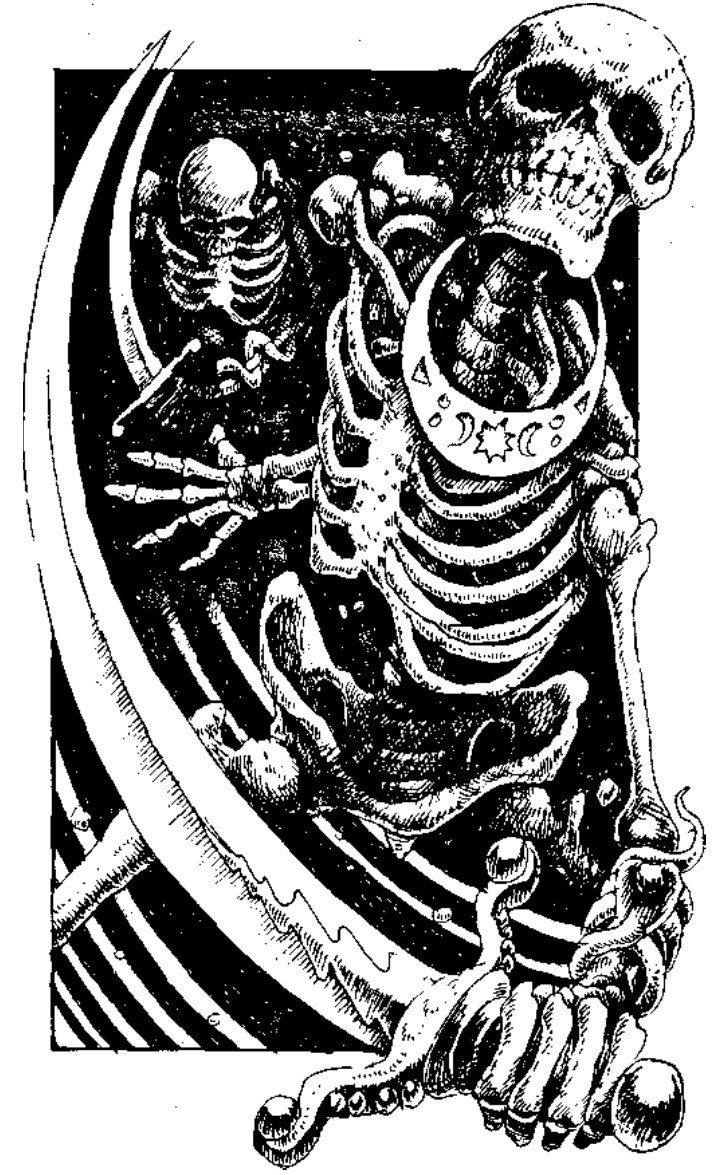
Image: two Skeletons with scimitars and snake-bracelets; one wears an inscribed torc.

Leo Hartas, from Dragonwarriors Book Two: The Way of Wizardry


Next up, Skeletons and some of their chums from Dragonwarriors - the best of the British old school.

Statistically, DW Skeletons are a bit weaker than Normal Humans (d6+1 rather than d6+3 Health Points), but have an Armour Factor of 2 vs. piercing weapons and half-damage from fire attacks. 3d6 Reflexes as normal.

The description implies they are mindless, programmable and loyal to their creator. It states that they sometimes use shields.

Conversion.

I've found nothing else to add to DW/D&D conversion since my original post, so I'm sticking with those methods.

Under the Max. HP/4.5=HD method, they are 1.5 HD monsters (1+ to 2 HD); under the Shared Hit Roll method, they have a BAB of 0 (so either 1-1 or 1 HD, depending on your preference).

Abilities.

  • +2 AC bonus vs. piercing weapons (or -2 damage from them, min. 0; either works)
  • half damage from fire attacks (and none if there is a save for half damage)

Chum Number 1: Barnacle Man.

As named in DW Book 3, The Elven Crystals; I'd probably go with Barnacle Folk or Barnacle Dead or Crusty Old Sea Bastards.

Statblock:
  • BAB +1 (they are slightly stronger fighters than Skeletons)
  • HD 1.5 (same Health Points as a Skeleton)
  • AC +4 (they're completely encrusted with barnacles, as well as plundered gold and jewels)
  • they wield weapons, something nautical - like a cutlass, harpoon, or belaying pin
  • they're Skeletons underneath their barnacle-and-treasure crust, so you could give them an additional +2 AC vs. piercing weapons, or give them the damage reduction instead
  • keep the fire resistance, too; they're wet as well as bony
  • turn as Skeletons (same Rank Equivalent) or based on their HD
From the description, these appear to be self-motivated and possibly intelligent undead that cooperate to achieve their goals. During storms they attack ships from underneath, breaking them open to obtain the treasure they adorn themselves with, and even explore wrecks in case they missed something.

DW has them as ghost pirates, but you could just as easily make them hosts for necromantic hivemind barnacles.

Chum Number 2: Fungus Man.

From DW Book 4, Out of the Shadows; also known as Black Caps, you could use Folk (though these are no Myconids) or Dead instead of Men, or something else you prefer.

Statblock:
  • BAB +2
  • HD 3.1
  • AC +1 (with additional +2 vs. piercing weapons)
  • wields a weapon
  • 'sickly, yellow-green phosphoresence and... sweet, musky odour' halves chance of surprise (for d6 subsystems, this could be either 1 on d12 as it is in DW or 2 on 2d6)
  • constant sinister whispers will disturb the sensitive: 
    • fail a WIS check/save or suffer -2 to Hit and AC -1 while fighting the Fungus Dead
    • penalty of 1 to roll for being a Magic-User or a psionic (cumulative)
  • each round in combat/presence, 10% chance ochre spores take root in your flesh:
    • each day (until dead or cured) you must make (suited to setting/system) one of the following: CON check, STR check, poison save, petrification save
    • otherwise d6, d6+1 or d8 damage (suited to setting/system)
    • damage responds to magical but not natural healing
    • total cure is by cure disease or heal (suited to setting/system)
    • if you die, you are consumed by fungus and rise as a new Fungus Dead within a week (same happens to any other corpses in lair)
  • immune to mind control, either as a fungus or as undead
Skeletal hosts of a fungus colony that has consumed and replaced the flesh, it's not specified that Hold Off The Dead will not work on them. 

And because 'the soft, unemotional voice of the dead host whispers of the torments and terrible delights of the grave', I'm more than comfortable saying that these are truly undead. 

In fact, I'd say a muttering undead monster is more appropriate to the DW milieu than an own-brand variant of something like the Yellow Musk Creeper or the Zygom.


d6 Flavours of Skeleton:

  1. Skeleton of Dark and Lonely Water: reskinned Wraith; touch does no damage but drains WIS, not levels; at 0 WIS, you will let it lead you into the dark and lonely waters until they close over your head.
  2. Galley Beggar: shrieking, antic, skeletal ghost; loud, terrifying and throws things.
  3. Crowned Skeleton: undead aristocracy; reskin a more powerful undead. 
  4. Death Angel's Shadow: implacable creeping shadow, cast by no object and no light; inescapable; in days=STR+level it will superimpose on you and reduce you to a withered husk.
  5. Rawhead and Bloody Bones: in tatters of blood-soaked flesh, a Skeleton as strong as an Ogre and as stealthy as a Thief that can live in the dark nooks of your house without you realising it. Surprises like a Bugbear if you don't want to give it Thief skills.
  6. General Death: solemn leader(s) of the Skeleton Army; naked bones and carries three deadly darts - one red, one black, one white (finger of death, slay livingsymbol of death); often mistaken for Death Itself.

Commentary.

The d6 Flavours are less variants on the basic DW Skeleton than the monster-type within the old school British folk horror/fantasy milieu.

Monday, March 23, 2020

1st Flavour of Skeleton: Call of Cthulhu 5e & 2e Conversion to D&D Adjacent.

Skeletons seem appropriate right now, and anyway I'm a fan.

The HD conversions below are probably more useful for old school settings; the BAB conversions make for a much tougher monster in the lower bonus game.

Image: Retro Horror Top Trumps Skeleton Card
A Skeleton holding a hangman's noose.

Image pasted from Hypnogoria's Tomb of the Trumps, which is worth checking out if you either held on to your original packs (I'm glad I did, plus my sister got me a reissue for Christmas) or regret ever letting them go.

Call of Cthulhu 5e.


Skeletons are statistically close to Normal Humans in CoC, though rolling their SIZ on 3d6 not 2d6+6 and having a fixed POW of 1. They have no CON.

Strength 3d6, Size 3d6, Intelligence 3d6, Power 1, Dexterity 3d6. 

The lower possible SIZ implies non-human (animal?) Skeletons and/or animated fragments (bony crawling hands, flying/rolling skulls, inchworm vertebrae etc.).

The single point of POW is their animating force, but within the system means they are vulnerable to magical attacks (POW vs. POW). Even though SAN and Luck are not normally applied to monsters, these Skeletons are neither Sane nor Lucky.

Lacking CON, Skeletons are mechanically immune to poison, drowning and so on. As hit points are normally (CON+SIZ)/2, I'll say they have 10 hit points for conversion purposes (but see below).

Average hit probability is 31.5% (DEX x3) - better than a Deep One, Ghoul, Mi-Go, Nightgaunt or Moonbeast.

Conversion.


The simplest conversion method I found is from Cthulhu d20 - % to d20 and close enough for what I'm after: CoC hp/5= Hit Dice, and highest attack %/10=BAB.

This gives a 2 HD Skeleton, and/or a  +3 BAB, which is 1+ HD (count from lowest to hit AC 10) or 2 to 3+ HD (count from 1 HD to hit AC 10) in AD&D and 3+ to 4 in Mentzer).

Abilities.

  • no hit points so take no damage, but are destroyed/shattered % chance = damage rolled x4
  • impaling/weapons half as effective (or only on a crit, but at regular damage)
  • immune to poison, drowning/suffocation, KO
  • Clatter Ominously (45%): NPCs of equal or less HD must make a Morale check
  • Rise Unexpectedly (60%): either
    • surprise 1-3 on d6, or
    • reform 1-3 on d6
  • optionally, they could save at -4 vs. all magic (because of their v. low POW)

Intelligence & Dexterity.


You can play these Skeletons like any other mindless, clumsy undead, but they've got 10.5 INT and DEX on the statblock, and could have everything this implies:
  • understanding multiple languages (whether they are physically able to talk or not)
  • possessing specialist learning (sages/experts)
  • casting spells from scrolls and using magic items (1 POW wouldn't convert to an actual Magic-User, but there's no reason they couldn't use pre-loaded stuff)
  • fine motor skills (archers, locksmiths, pick-pockets, crafters, scribes)


d6 Flavours of Skeleton:

  1. Tomb Robber: what you do, but in reverse; emerge from their sepulchres to execute planned heists/ bloody banditry.
  2. Bone Imp: an undead Pixie or Sprite (CoC 2e: STR 2d4, SIZ 1d6, DEX 4d6 = D&D Strength penalty, Dexterity bonus, lower HD or hp per die). Probably lose any natural magical powers/ ability to fly, but get a whole new perspective on the ceaseless, centuried Pixie-Sprite war.
  3. Dry Bones: the animating force is in every piece of the Skeleton, and it is able to discorporate and reform at will, sending bits off on sinister little errands. It can also recover from destruction several times (suggest 1 per HD + 1). Notoriously vengeful.
  4. Animated Skull: (d6) rolls along; carried about; too much like a demi-lich for comfort (appearance, powers and/or behaviour); shadowy wings sprout from temples; attaches to a recently beheaded corpse; happy to just sit there and chat.
  5. My Pet Skeleton: (d6) bird; cat; dog; monkey; serpent; deer/goat. Behaves much like you'd expect.
  6. Revenant Adventurer: either seeking to avenge their death, or has found that doing so did not give them blessed release. Has the abilities of their class-in-life. Very likely favours concealing robes, masks, gloves, big scarves, and/or full suits of armour with closed helms.

Call of Cthulhu 2e.


The Skeleton is in A Sourcebook for the 1920s and suffers from some typos. 

(Of peripheral interest is that several statblocks include CHA instead of APP, showing the link back to D&D via the Perrin Conventions)

Specifically, the Skeleton as written has POW 3d6, but in the Zombie description later we read:

'Like skeletons, the 1 point of POW motivates the entity.'

Which I think is clear enough.

It also lacks INT; clearly intentional. From the description:

'Skeletons need triggering to be animated... Once set in motion, skeletons fight to the death.'

Unless it's also a typo, 2e Skeletons get 2d6+6 DEX (average 13), making them even more Harryhausen than 5e CoC.

Given 9 Hit Points, but they can only be harmed through the same sub-system as affects the 5e version.

They are equipped with a variety of melee weapons, have 1d6 armour points and their habitat is 'anywhere that magicians have worked.'

They're also the only monster in the sourcebook to get a 'Number Appearing' statline: 3d6.

Conversion.

  • 9hp/5 = 1.8 HD (1, 1+4, 1+8 or 2 HD)
  • Best attack (DEX x 4=52%)/10 = 5.2 (+5 BAB)

Abilities.

  • destroyed/shattered (as above), but half-chance for impaling/piercing weapons (or also as above)
  • nothing else is explicitly mentioned in the description or stats, but everything for 5e could be applied here.
  • these Skeletons are armed and armoured and encountered in groups: not really abilities, but the certainty of armour puts them apart from other system basic Skeletons.


d6 Flavours of Skeleton:

  1. Skeleton Army: a military unit waiting patiently for the Triumph of Death; fully kitted out and looking to recruit if you start messing around with them and their stuff. Otherwise, just still, silent, eerie and intimidating.
  2. Fang Warriors: sprout from the enchanted teeth of monsters; they may have an affinity with the source creature. Animated by Ray Harryhausen, of course.
  3. Exoskeletons: undead giant arthropods; think of them as spooky robots; lose many of their natural abilities (eg. venom, silk, stingers). Natural armour.
  4. Flaming Skull: when activated, bursts into flame and flies at you; at least as likely to set a fire as a flaming torch, but the flames are supernatural so things could be worse. No armour.
  5. Skeleton Archers: two shots per round; they're as good as, if not better than, a Normal Human with a bow.
  6. Drowners: weed-draped and spongy-boned, saturated and heavy with water (fresh or salt); attack is grapple and hold under water. Only destroyed/shattered on a x3 due to being less brittle; impale/piercing weapons still x2. They can swim if unarmoured.


Commentary.


This was originally going to be a much bigger single post, converting Skeletons to D&D adjacent from the systems I have available. But because of COVID-19, I have the questionable leisure to break it up into smaller pieces and put it out more frequently.

Tom Moldvay's article 'The Ungrateful Dead' (Dragon Magazine #138) is very much worth the read, and had a significant influence on how I think about the undead.

Eileen Lucas's 'The End of the World' from the same issue is also a good read, though whether you're as keen to have a global pandemic as your campaign background as you were at the beginning of the year, I couldn't possibly say.