Showing posts with label werewolf. Show all posts

Monday, June 12, 2023

The Human Werewolf.

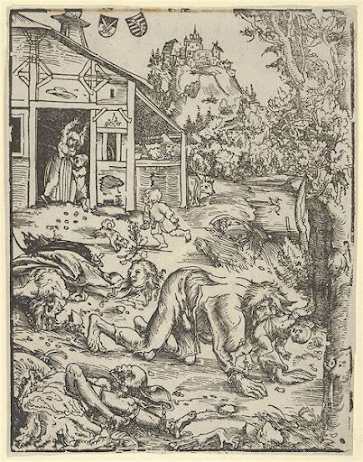
art by Lucas Cranach the Elder

In a fantastic world where people can turn into animals for real, is there room for this version? Maybe.

Fear them, pity them, hate them, utterly misjudge them - this is the werewolf of human suffering. Their transformation is a property of their own minds and/or the accusations against them (not mutually exclusive).

This werewolf could be a beggar, a shepherd, a grand prince, a king, an unconventional therapist, a dressmaker, a wealthy farmer, a pedlar, a tailor, a mad duke, you, a lonely old woman, a grandiose peasant, a babe in the woods, a mooncalf, an eminent psychiatrist, a dishonourably discharged soldier, a noble baron, a creepy little kid.

As well as people who believe themselves to be monsters, it also includes monsters who claim to be human, and unfortunates being mistaken for monsters.

Human werewolves behave like humans, and wolves, and how they think wolves and werewolves behave, and how other people think wolves and werewolves behave. And sometimes they do this to a timetable, or for an audience, or when triggered. Can be gradual (even over weeks) or abrupt.

For example, the mad duke might go out howling at night, digging up graves and telling people he's a wolf, but spend the day doing his ducal duties and political scheming. He might act as if he is (or genuinely be) unaware of his nocturnal personality.

Remember also, some people only realise they're a werewolf when told they are by the bloke with the red-hot pincers and thumbscrews. You can roll d12 on this table to determine how someone thinks the transformation is accomplished.

Genres: crapsack, historical, (folk) horror, low-level, modern, mystery.

Basic profile: a Normal Human, a Berserker, any NPC, a PC.

I'm writing in ye olde D&D-adjacent, but it's all system agnostic really.

Nebuchadnezzar, eating grass not babies, being retrospectively diagnosed with porphyria

Combat: improvised weapons, in the mechanical and the narrative sense. They'll beat, bite, grapple, scratch and strangle as needed, even reach for a handy rock, broken bottle or piece of cutlery (if they're not too deep in the wolf delusion).

There's nothing but their own beliefs, delusions and preferences to stop them using any armour or weapon, even firearms.

In less casually violent settings, it might just be their willingness to do damage without worrying about the consequences that makes them dangerous.

Optional: Infected Wounds, whether their teeth and nails are tainted with grave-earth and rotten viscera, or just because the human mouth is apparently a filthy place. Treat as in your setting/system, but with an increased chance (+1% per point of damage, for instance).

Double 1s on 2d6 and victim thinks they're turning into a werewolf too.

Optional: Ferocity. Attack as a Giant Shrew - you can have the Initiative bonus, double attacks, the whole stat block if you like.

Optional: Battle Rage. If you aren't already using the Berserker stat block, you get the +2 attack bonus, +1 hp and 12 Morale - plus the deranged behaviour.

Special Qualities: Pick, or roll d12; not compulsory.
  1. +d2 AC for thick hair, toughened skin, pain tolerance etc.
  2. -1 to all rolls in normal daylight; -2 in bright sunlight.
  3. take 2 hp damage per time unit (pick or randomise) in direct sunlight; this does not heal naturally, unless recovery time spent in darkness. Bits will eventually drop off.
  4. Animals (mammals) - initial Reaction is Unfriendly.
  5. Cats and Dogs - initial Reaction is Hostile.
  6. Ghouls - initial Reaction is Neutral.
  7. Wolves and Werewolves - initial Reaction is Neutral.
  8. Wolves and Werewolves - initial Reaction is Hostile.
  9. Wolves - initial Reaction is Friendly.
  10. Appearance, behaviour, reputation and/or unsettling presence reduce Charisma by 3 (or a Reaction Roll penalty).
  11. Appearance, behaviour, reputation and/or unsettling presence reduce Charisma to 3.
  12. Can eat raw meat, spoiled food, cadavers and assorted carrion without (debilitating/significant) ill effects; +4 save vs. ingested poisons & diseases, and a save of 16+ if one is not normally allowed.

As well as having a higher than normal chance of spontaneously rising from the grave as a vampire, human werewolves are likely more susceptible to a vampire's charm/mesmeric ability (even becoming Pawns to their Liege).

Their circumstances and/or habits make them ideal candidates for ghouldom or ghasthood, as well as making them attractive to bad spirits and demons.

And their fellow humans might shove them in a cage and tour them, charging a silver piece to see the captive werewolf, and giving them only meagre, stinking provender to eat and a worn, filthy blanket against the chill.

Commentary.

Historical werewolves have been medically ascribed:

  • Hypertrichosis. Petrus Gonsalvus (1537-1618) was educated and toured the courts of Europe within the same time frame as the Gandillon family, Gilles Garnier and Peter Stubbe were being executed for werewolfism. Even though Petrus wasn't seen as completely human (he was also a slave), he wasn't subjected to torture and put to death for it.
    They didn't think he was a werewolf, or his hairy children, either.

  • Porphyria. This article from 1964 seems to be the source for this gaining popularity. But porphyria was recognised as far back as Hippocrates, and the disfigurement it causes is not unlike that of other diseases, such as leprosy. Sensitivity to garlic and sunlight as symptoms apply more to vampires; more to our modern ideas, in any case. And porphyria gives you superpowers in much the same way as an origin-story dose of radiation doesn't.
  • Rabies. Well known to the ancients (4000 year old laws about dealing with rabid animals) and contagion by bite is characteristic of the 20th Century werewolf.
  • And, crucially, Lycanthropy as a disease of the mind (a form of melancholy) was recognised as early as the 7th Century. See also the case of wee Jean Grenier, who was tried as a werewolf but judged to be suffering from lycanthropy - at a time (c.1604) when similar cases resulted in sensational confessions and brutal executions.

Thursday, May 25, 2023

Back to Basic - Werewolf.

Our traditional (D&D-adjacent) rpg werewolf is the child of science-fiction, so I'll use a variant of the Mandela Effect to remove it from (my) Basic D&D and start again.

Ultimately system agnostic, because I have faith in your abilities.

Reminder, because I've not written anything like this in a while, that I don't really recognise any hard lines between the pre-3e systems and their simulacra. And it probably shows.

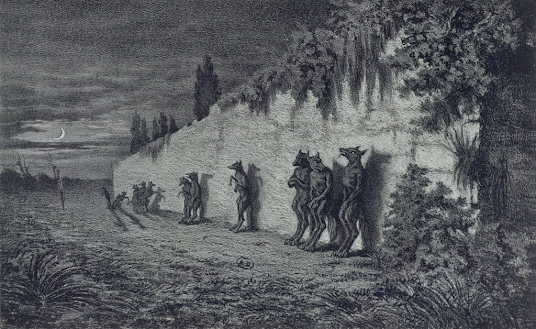
One of my absolute favourite pics, of werewolves on a were-break.
Note the crescent moon.

What is a Werewolf?

A werewolf is a human able/compelled to transform into a wolf, and/or an at-least-wolf-headed humanoid, usually at night.

Neither form need be unusual, but tradition suggests there are behavioural and physical markers to identify werewolves in human form. The were-form may have some unusual feature that marks it as more than 'just a wolf' - unusual colouring, human eyes, (literally) flaming eyes and maw, no tail, clothing (intact and neatly piled up nearby), that kind of thing.

Use stats for a Normal Human, levelled character, Berserker etc. in human form, and a Wolf (vanilla) or a Dire Wolf (the wolf as archetype/symbol) when they drop on all fours and start howling.

Use any suitable animal/monster for the were-form, but for purposes here we'll call it the wolf.

Not intrinsically good or evil; choose either path or none. Motivation behind becoming a werewolf can be a desire for power, vengeance and unaccountability, but also a sacred rite of your people or faith, or something that is done to you against your will. These things are tangled in context.

Usually a loner, but not always. Can run with a pack of real wolves, often as their leader. Might have a family, who can also be werewolves.

Invulnerability and Injuries - Armour Class and Hit Points.

Wolf and human have separate hit point totals. Wounds to one shape are healed on changing to the other. This might not apply to a forced change.

Armour Class is at least as good as the animal form, and possibly better: treat as Chain/Medium amour, or an equivalent bonus.

A werewolf in wolf form can be an Invulnerable Monster. They have no uniform special vulnerabilities (but see below), but are often difficult or seemingly impossible to harm/kill.

Traditionally, if you chop off the wolf's paw, the human form will be missing the corresponding extremity. You can extend this to other narratively appropriate, disfiguring, wounds. So werewolves might be vulnerable to crits and severing hits, however tough they might be.

Also, if brought to casualty state (0 hp), the werewolf reverts to human form, helpless but stable. 

Powers of the Werewolf.

Even without invulnerability, bite damage and HD sets you above a Normal Human in terms of a D&D combat. Possibly the wolf's ability scores, if they factor in. Track by smell, see in the dark, stealth etc. The Dragon Warriors Wolf can't be surprised.

With your human intelligence, or under diabolical influence, you can behave in ways that an animal would not, even if that's just making a choice whether to flee from fire or gunshot.

You're a wolf, and can do the kind of things that wolves can that humans can't. It might be enough that you can survive the cold night and fill up on raw meat, rather than freeze and starve in your hovel.

Being in a different form part of the time means that they don't know it's you doing the things you do. Try and get away with murder, or do anonymous philanthropy.

When you die, you are apparently more likely to rise again as a vampire.

Some werewolves have hands, and I've seen dogs turn door handles with their jaws.

Turning Into a Werewolf.

You can normally only turn into a wolf when night falls, and some won't be able to change while observed; neither is absolute.

How long does it take? Let's say up to 2 combat rounds, during which you're effectively helpless. Some transformation methods lend themselves better to a less (even instantaneous) or more leisurely rate of change.

Pact with the Devil; sunset to sunrise, last day of the month.
Spends the time running around and knocking things over, that's Wagner the Wehr-Wolf (use AD&D MM2 Cooshee for the wolf form).

Here are d12 methods for play, and they need not be exclusive of each other:

  1. Magic belt. Only you can take if off; roll 2d6 when you do. Double 1, you can't find it next time. Often made of human or wolf skin.
  2. Wolf mask. Anyone can put it on, but only you retain your reason. Can be blown, snatched or splashed off, so take care. If you're masked and alone with a victim, they must save or be helpless/deluded - even up to you starting to eat them.
  3. Hairy on the Inside. Turn your skin inside out (or simply take it off) to transform. Morale Checks, if not fear/sanity saves for witnesses. A significant wound (crits/impales, judicial torture, max. damage etc) reveals your secret.
  4. Wolf Skin. Even sleeping on/under it means you dream of wolves and the hunt, possibly even generating a wolf tulpa. Put it on to transform.
  5. Divine Punishment. Cannibal pranks vs. customs of hospitality, or just not going to enough Mass? It's possible that you will be permanently in wolf form, but a feat of strength or willpower lets you to pull off your wolf head to reveal your human form and allow you to speak. There is sometimes a time limit, but immortality and/or heredity can be part of the package.
  6. Potion of Lycanthropy. Ingredients are blasphemous, criminal, poisonous, unsavoury. Could be an unknown impurity in the salt that lends efficacy to the draught. Drink it to turn into wolf; effect expires at daybreak.
  7. Werewolf Salve. Ingredients are blasphemous, criminal, poisonous, unsavoury. The smell clings to you like the stench of a skunk, a Troglodyte, a stinking cloud, and witches (and/or witch hunters) will recognise it because it shares a profile with their flying ointment.
  8. Ritual/Spell. Equivalent 1st level, or a ritual anyone can learn/teach. Might have material components, but the power is in the performance. Can be interrupted.
  9. Bandit Wolf Cult. You get recruited to be a Werewolf, and your patron/leader gets the XP from the treasure you steal as well as +1 spell slot per current recruit. NPCs don't notice they're not getting XP for gold.
  10. A (not-inevitable) consequence of Practicing Magic - might even be your goal. Spell level % chance every time you cast a spell, then also your cumulative level each advance (1% at 1st level, 3% 2nd, 6% 3rd, 10% 4th and so on). Or Powers Checks as for Masque of the Red Death.
  11. Ancestry/Puberty. Hereditary lycanthropy. Might be something people know/say about you and your family. Puberty, tasting (certain types of) meat, or initiation triggers The Change. Might also be reflected in your human life.
  12. Enchantment. As a blessing/mission or as a curse, you take the form of a wolf. As a curse, you might behave as an animal but retain your awareness of what you do.  As a blessing/mission, you probably have a special enemy you are expected to hunt (eg. witches, vampires, ghouls, other werewolves, actual wolves).

The first (or every) time you transform, roll 2d6 (or make a Morale Check). 

On a 12 (or a double 1 if you prefer low=bad) or a failed check, you're dominated by your animal/demonic nature for the period of transformation and act accordingly. Otherwise, you retain mastery of self.

Curing the Werewolf - Vulnerabilities.

You don't cure the werewolf, because (this) lycanthropy isn't a disease. 

You might be able to use remove curse/ dispel evil to render it wholly human, if that seems appropriate, and dispel magic (or similar) might disrupt a magic item or spell-based transformation. It really depends on how 'magical' a werewolf's transformation is compared to (say) the spells your characters cast - this will also tell you something about the setting, if you haven't already decided on it. 

Atonement might work, or the un-italicised, non-spell version. Likewise, werewolves may be vulnerable to holy relics, consecrated ground, prayers, priests, virgins, and so on, depending on the milieu. 

Certain substances - eg. iron, but including silver - are traditionally effective vs. supernatural entities so could beat a werewolf's invulnerability, or the touch could force the werewolf back to human form, or work to ward them off as a cross does a vampire. Blessed and holy weapons could also fall into this category.

While not strictly speaking a vulnerability, day/sun-light turns the wolf back to a human, so if you can find a way to weaponise this, good for you. Maybe you can fool a werewolf into thinking the sun is coming up? 

Consider these Unholy Attributes as material for this sub-section.

If potions and salves of lycanthropy exist, then antidotes to counter them are likely. Good luck greasing up your wolf or forcing it to drink.

Possessing the werewolf's clothes (or skin) gives you power over it. At least, according to tradition and the magical laws of sympathy. The same applies, more or less, to getting hold of its belt, mask, salve or potion, though this is mundane coercion, not magical.

Killing the master werewolf (or the Devil or the Lord of the Forest or what/whoever), if such a thing exists, should also dis-empower subservient werewolves.

The werewolf ability could be a possessing spirit that can be driven out, exorcised, or defeated on the astral plane. And psionics, if that's the way you want to play (suitably advanced bio-technology being indistinguishable from magic, and all that).

Werewolves in human shape can also expect the following: burning, beheading, garrotting, impalement, nailing to a tree, removing the heart (and burning it, for good measure), staking down in a grave, driving a pitchfork into the forehead three times, crushing under stones, walling up alive, breaking on a wheel, feeding to the wolves, ripped apart by horses. 

Reverse Werewolves and Others.

Wolves that turn into humans are also werewolves for our purposes, and much of the above applies. 

However, the reverse werewolf is not strictly human but something other - faerie folk, beast folk/Cynocephali, wendigo, spirits of the dead, elementals, ancestors and ancestral spirits, demon-possessed animals and actual demons. The human form is the more dangerous one in these cases. Extra abilities to taste.

The werewolf as given here can be adapted to the broader category of animal shapeshifters. 

To the standard rpg weres- and -weres, you can also add the selkies, hawk men and swan maidens, arachnes, harlequin worm people and vespiform space vampires - as long as you've got the stat block for the animal (or giant animal or archetype) form, you're golden. Like I said, I have faith in your abilities.

Commentary.

I've tried to keep pre-20th century for my werewolf, but not absolutely - just leaving out what I think are the three main signifiers of the 20th century/pre-Universal werewolf:

Do a quick search for silver, wolfsbane and contagious lycanthropy in the three main (accessible, popular) sources for the modern (Western) werewolf tradition: Sabine Baring-Gould, ('Reverend') Augustus Montague Summers, and Elliot O'Donnell. (Now compare these three to your favourite were-books growing up).

O'Donnell (who could be accused of just making stuff up) published in 1912. The werewolf as we know it was prototyped in 1935, then fully realised in 1941.

For all the trappings of ancient tradition, The Werewolf of London and Curt Siodmak's Wolf Man were meant to be an all-new, modern monster archetype. 

I've also left out/for later, the astral/psychic and delusional/illusory werewolves, plus the moon stuff, because I felt that's more strongly associated with the 20th century monster - it feels incidental to the older one.

Tangentially, compare the statblocks for the Werewolf, Ogre, and Dire Wolf. I used OSE because of the SRD.