Tuesday, March 24, 2020

2nd Flavour of Skeleton: Dragonwarriors Conversion to D&D Adjacent.

https://projects.inklesspen.com/fatal-and-friends/images/d79553a5b0e7df405f42da780b04c4e9eee63b37d79e4f5651a9f68e9f97cb49.jpeg
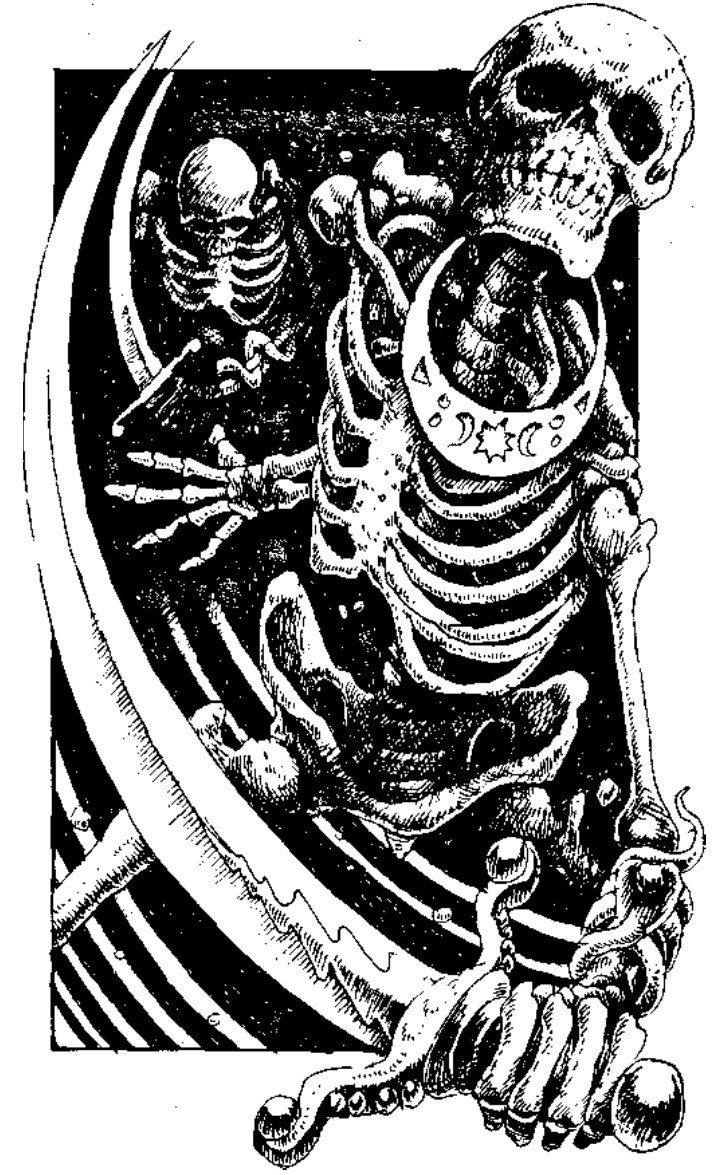
Image: two Skeletons with scimitars and snake-bracelets; one wears an inscribed torc.

Leo Hartas, from Dragonwarriors Book Two: The Way of Wizardry


Next up, Skeletons and some of their chums from Dragonwarriors - the best of the British old school.

Statistically, DW Skeletons are a bit weaker than Normal Humans (d6+1 rather than d6+3 Health Points), but have an Armour Factor of 2 vs. piercing weapons and half-damage from fire attacks. 3d6 Reflexes as normal.

The description implies they are mindless, programmable and loyal to their creator. It states that they sometimes use shields.

Conversion.

I've found nothing else to add to DW/D&D conversion since my original post, so I'm sticking with those methods.

Under the Max. HP/4.5=HD method, they are 1.5 HD monsters (1+ to 2 HD); under the Shared Hit Roll method, they have a BAB of 0 (so either 1-1 or 1 HD, depending on your preference).

Abilities.

  • +2 AC bonus vs. piercing weapons (or -2 damage from them, min. 0; either works)
  • half damage from fire attacks (and none if there is a save for half damage)

Chum Number 1: Barnacle Man.

As named in DW Book 3, The Elven Crystals; I'd probably go with Barnacle Folk or Barnacle Dead or Crusty Old Sea Bastards.

Statblock:
  • BAB +1 (they are slightly stronger fighters than Skeletons)
  • HD 1.5 (same Health Points as a Skeleton)
  • AC +4 (they're completely encrusted with barnacles, as well as plundered gold and jewels)
  • they wield weapons, something nautical - like a cutlass, harpoon, or belaying pin
  • they're Skeletons underneath their barnacle-and-treasure crust, so you could give them an additional +2 AC vs. piercing weapons, or give them the damage reduction instead
  • keep the fire resistance, too; they're wet as well as bony
  • turn as Skeletons (same Rank Equivalent) or based on their HD
From the description, these appear to be self-motivated and possibly intelligent undead that cooperate to achieve their goals. During storms they attack ships from underneath, breaking them open to obtain the treasure they adorn themselves with, and even explore wrecks in case they missed something.

DW has them as ghost pirates, but you could just as easily make them hosts for necromantic hivemind barnacles.

Chum Number 2: Fungus Man.

From DW Book 4, Out of the Shadows; also known as Black Caps, you could use Folk (though these are no Myconids) or Dead instead of Men, or something else you prefer.

Statblock:
  • BAB +2
  • HD 3.1
  • AC +1 (with additional +2 vs. piercing weapons)
  • wields a weapon
  • 'sickly, yellow-green phosphoresence and... sweet, musky odour' halves chance of surprise (for d6 subsystems, this could be either 1 on d12 as it is in DW or 2 on 2d6)
  • constant sinister whispers will disturb the sensitive: 
    • fail a WIS check/save or suffer -2 to Hit and AC -1 while fighting the Fungus Dead
    • penalty of 1 to roll for being a Magic-User or a psionic (cumulative)
  • each round in combat/presence, 10% chance ochre spores take root in your flesh:
    • each day (until dead or cured) you must make (suited to setting/system) one of the following: CON check, STR check, poison save, petrification save
    • otherwise d6, d6+1 or d8 damage (suited to setting/system)
    • damage responds to magical but not natural healing
    • total cure is by cure disease or heal (suited to setting/system)
    • if you die, you are consumed by fungus and rise as a new Fungus Dead within a week (same happens to any other corpses in lair)
  • immune to mind control, either as a fungus or as undead
Skeletal hosts of a fungus colony that has consumed and replaced the flesh, it's not specified that Hold Off The Dead will not work on them. 

And because 'the soft, unemotional voice of the dead host whispers of the torments and terrible delights of the grave', I'm more than comfortable saying that these are truly undead. 

In fact, I'd say a muttering undead monster is more appropriate to the DW milieu than an own-brand variant of something like the Yellow Musk Creeper or the Zygom.


d6 Flavours of Skeleton:

  1. Skeleton of Dark and Lonely Water: reskinned Wraith; touch does no damage but drains WIS, not levels; at 0 WIS, you will let it lead you into the dark and lonely waters until they close over your head.
  2. Galley Beggar: shrieking, antic, skeletal ghost; loud, terrifying and throws things.
  3. Crowned Skeleton: undead aristocracy; reskin a more powerful undead. 
  4. Death Angel's Shadow: implacable creeping shadow, cast by no object and no light; inescapable; in days=STR+level it will superimpose on you and reduce you to a withered husk.
  5. Rawhead and Bloody Bones: in tatters of blood-soaked flesh, a Skeleton as strong as an Ogre and as stealthy as a Thief that can live in the dark nooks of your house without you realising it. Surprises like a Bugbear if you don't want to give it Thief skills.
  6. General Death: solemn leader(s) of the Skeleton Army; naked bones and carries three deadly darts - one red, one black, one white (finger of death, slay livingsymbol of death); often mistaken for Death Itself.

Commentary.

The d6 Flavours are less variants on the basic DW Skeleton than the monster-type within the old school British folk horror/fantasy milieu.

Monday, March 23, 2020

1st Flavour of Skeleton: Call of Cthulhu 5e & 2e Conversion to D&D Adjacent.

Skeletons seem appropriate right now, and anyway I'm a fan.

The HD conversions below are probably more useful for old school settings; the BAB conversions make for a much tougher monster in the lower bonus game.

Image: Retro Horror Top Trumps Skeleton Card
A Skeleton holding a hangman's noose.

Image pasted from Hypnogoria's Tomb of the Trumps, which is worth checking out if you either held on to your original packs (I'm glad I did, plus my sister got me a reissue for Christmas) or regret ever letting them go.

Call of Cthulhu 5e.


Skeletons are statistically close to Normal Humans in CoC, though rolling their SIZ on 3d6 not 2d6+6 and having a fixed POW of 1. They have no CON.

Strength 3d6, Size 3d6, Intelligence 3d6, Power 1, Dexterity 3d6. 

The lower possible SIZ implies non-human (animal?) Skeletons and/or animated fragments (bony crawling hands, flying/rolling skulls, inchworm vertebrae etc.).

The single point of POW is their animating force, but within the system means they are vulnerable to magical attacks (POW vs. POW). Even though SAN and Luck are not normally applied to monsters, these Skeletons are neither Sane nor Lucky.

Lacking CON, Skeletons are mechanically immune to poison, drowning and so on. As hit points are normally (CON+SIZ)/2, I'll say they have 10 hit points for conversion purposes (but see below).

Average hit probability is 31.5% (DEX x3) - better than a Deep One, Ghoul, Mi-Go, Nightgaunt or Moonbeast.

Conversion.


The simplest conversion method I found is from Cthulhu d20 - % to d20 and close enough for what I'm after: CoC hp/5= Hit Dice, and highest attack %/10=BAB.

This gives a 2 HD Skeleton, and/or a  +3 BAB, which is 1+ HD (count from lowest to hit AC 10) or 2 to 3+ HD (count from 1 HD to hit AC 10) in AD&D and 3+ to 4 in Mentzer).

Abilities.

  • no hit points so take no damage, but are destroyed/shattered % chance = damage rolled x4
  • impaling/weapons half as effective (or only on a crit, but at regular damage)
  • immune to poison, drowning/suffocation, KO
  • Clatter Ominously (45%): NPCs of equal or less HD must make a Morale check
  • Rise Unexpectedly (60%): either
    • surprise 1-3 on d6, or
    • reform 1-3 on d6
  • optionally, they could save at -4 vs. all magic (because of their v. low POW)

Intelligence & Dexterity.


You can play these Skeletons like any other mindless, clumsy undead, but they've got 10.5 INT and DEX on the statblock, and could have everything this implies:
  • understanding multiple languages (whether they are physically able to talk or not)
  • possessing specialist learning (sages/experts)
  • casting spells from scrolls and using magic items (1 POW wouldn't convert to an actual Magic-User, but there's no reason they couldn't use pre-loaded stuff)
  • fine motor skills (archers, locksmiths, pick-pockets, crafters, scribes)


d6 Flavours of Skeleton:

  1. Tomb Robber: what you do, but in reverse; emerge from their sepulchres to execute planned heists/ bloody banditry.
  2. Bone Imp: an undead Pixie or Sprite (CoC 2e: STR 2d4, SIZ 1d6, DEX 4d6 = D&D Strength penalty, Dexterity bonus, lower HD or hp per die). Probably lose any natural magical powers/ ability to fly, but get a whole new perspective on the ceaseless, centuried Pixie-Sprite war.
  3. Dry Bones: the animating force is in every piece of the Skeleton, and it is able to discorporate and reform at will, sending bits off on sinister little errands. It can also recover from destruction several times (suggest 1 per HD + 1). Notoriously vengeful.
  4. Animated Skull: (d6) rolls along; carried about; too much like a demi-lich for comfort (appearance, powers and/or behaviour); shadowy wings sprout from temples; attaches to a recently beheaded corpse; happy to just sit there and chat.
  5. My Pet Skeleton: (d6) bird; cat; dog; monkey; serpent; deer/goat. Behaves much like you'd expect.
  6. Revenant Adventurer: either seeking to avenge their death, or has found that doing so did not give them blessed release. Has the abilities of their class-in-life. Very likely favours concealing robes, masks, gloves, big scarves, and/or full suits of armour with closed helms.

Call of Cthulhu 2e.


The Skeleton is in A Sourcebook for the 1920s and suffers from some typos. 

(Of peripheral interest is that several statblocks include CHA instead of APP, showing the link back to D&D via the Perrin Conventions)

Specifically, the Skeleton as written has POW 3d6, but in the Zombie description later we read:

'Like skeletons, the 1 point of POW motivates the entity.'

Which I think is clear enough.

It also lacks INT; clearly intentional. From the description:

'Skeletons need triggering to be animated... Once set in motion, skeletons fight to the death.'

Unless it's also a typo, 2e Skeletons get 2d6+6 DEX (average 13), making them even more Harryhausen than 5e CoC.

Given 9 Hit Points, but they can only be harmed through the same sub-system as affects the 5e version.

They are equipped with a variety of melee weapons, have 1d6 armour points and their habitat is 'anywhere that magicians have worked.'

They're also the only monster in the sourcebook to get a 'Number Appearing' statline: 3d6.

Conversion.

  • 9hp/5 = 1.8 HD (1, 1+4, 1+8 or 2 HD)
  • Best attack (DEX x 4=52%)/10 = 5.2 (+5 BAB)

Abilities.

  • destroyed/shattered (as above), but half-chance for impaling/piercing weapons (or also as above)
  • nothing else is explicitly mentioned in the description or stats, but everything for 5e could be applied here.
  • these Skeletons are armed and armoured and encountered in groups: not really abilities, but the certainty of armour puts them apart from other system basic Skeletons.


d6 Flavours of Skeleton:

  1. Skeleton Army: a military unit waiting patiently for the Triumph of Death; fully kitted out and looking to recruit if you start messing around with them and their stuff. Otherwise, just still, silent, eerie and intimidating.
  2. Fang Warriors: sprout from the enchanted teeth of monsters; they may have an affinity with the source creature. Animated by Ray Harryhausen, of course.
  3. Exoskeletons: undead giant arthropods; think of them as spooky robots; lose many of their natural abilities (eg. venom, silk, stingers). Natural armour.
  4. Flaming Skull: when activated, bursts into flame and flies at you; at least as likely to set a fire as a flaming torch, but the flames are supernatural so things could be worse. No armour.
  5. Skeleton Archers: two shots per round; they're as good as, if not better than, a Normal Human with a bow.
  6. Drowners: weed-draped and spongy-boned, saturated and heavy with water (fresh or salt); attack is grapple and hold under water. Only destroyed/shattered on a x3 due to being less brittle; impale/piercing weapons still x2. They can swim if unarmoured.


Commentary.


This was originally going to be a much bigger single post, converting Skeletons to D&D adjacent from the systems I have available. But because of COVID-19, I have the questionable leisure to break it up into smaller pieces and put it out more frequently.

Tom Moldvay's article 'The Ungrateful Dead' (Dragon Magazine #138) is very much worth the read, and had a significant influence on how I think about the undead.

Eileen Lucas's 'The End of the World' from the same issue is also a good read, though whether you're as keen to have a global pandemic as your campaign background as you were at the beginning of the year, I couldn't possibly say.


Thursday, March 12, 2020

Old School Monster Conversions: Dragonwarriors to D&D adjacent

[Edit 21/06/2021 - replaced table with list]

I've not been able to find much online about converting Dragonwarriors monsters to D&D adjacent systems.


There's a document by Ian Sturrock for converting d20 characters to DW, which helps a little.

Part of this process has been a frustrating exercise in mathematics that I haven't enjoyed, lacked the skills to streamline and could be looked at as a waste of everyone's time, but it's resulted in a method for conversion that seems to work.


What I Would Normally Do.


Make it up. Does it feel right? Okay!

Why Not Just Substitute?


Because the monsters in Dragonwarriors don't occupy the same threat niches as their counterparts in other systems.

Based on statistics alone, in D&D the traditional/classic ascending threat hierarchy is Goblin, Normal Human/Orc, Hobgoblin, Ogre, Troll, but for DW it is Normal Human, Orc, Goblin, Hobgoblin, Troll, Ogre. This disregards the spell-casting abilities of the Hobgoblin.

By not substituting, but converting, I'm hoping to transfer some of essence of DW.

Why Dungeons and Dragons?


Rightly or wrongly, D&D is the Common Tongue or Rosetta Stone of old school systems.

A lot of the conversion guides I came across while researching this thing tended to be D&D to some other system, so finding Hit Dice and d20 Hit Probabilities will probably help when converting to further distant systems later.

It's not as freeform as T&T's Monster Rating system, but having just the HD of a monster allows you to work out quite a lot about it.

Shared Hit Roll Method.


D&D and DW both use a d20 Hit Roll, and as Hit Probability relates to HD/levels this seems a good place to start.

DW aims to roll under a target number, but converted to % chances there's not much difference.
  1. Work out the hit probability for a Normal Human in DW (vs. another Normal Human); call this the equivalent of 0-level character vs. unarmoured AC. 
  2. Work out the hit probability for a DW monster vs. a Normal Human.
  3. Use the difference between the two numbers as an attack bonus; count on from 0-level vs. unarmoured AC and then read back to get an approximate HD/level for the monster.
IMPORTANT: This takes no account of the DW Defence score (generally higher in more powerful monsters/ higher ranked fighters), nor the Armour Bypass roll. Somebody with more patience and mathematical imagination can attempt to reconcile them.

You can also apply this to Magical Attack vs. Magical Defence and Speed vs. Evasion to work out approximate saving throws, but there's the added complication of these being resolved with 2d10 in DW.

Under this method, the monsters very quickly outstrip their D&D counterparts: I wouldn't use it, but I did explore it. 

HP/4.5 Method.

  1. Find the maximum Health Points for the Dragonwarriors monster.
  2. Divide this number by 4.5 (the average roll for a d8: the default for monster HD between 0e and 3e).
  3. This is the monster's HD; two options with any remainder:
    1. First decimal place rounds down or up to nearest whole number.
    2. First decimal place can be used as +hp (you might want to cap at +4, but it's up to you).

This method was pretty much plucked out of the blue as an experiment, but I like the results and they don't get as outrageous as with the Shared Hit Roll Method (BAB and HD/4.5 both given in table for your choice and as demonstration of this).

DW Monster Conversion Examples:

  • Normal Human.
    • BAB 0 HD 2 Armour n/a Damage n/a STR mod. n/a Rank Equivalent 1st
  • 1st Rank Knight.
    • BAB +2 HD 2.8 Armour n/a Damage n/a STR mod. n/a Rank Equivalent 1st
  • Bear.
    • BAB +6 HD 7.1 Armour +1 Damage d8/d10 STR mod. n/a Rank Equivalent 6th
  • Dragon.
    • BAB +19 HD 19.1 Armour +5/special Damage d12/d16 STR mod. n/a Rank Equivalent 20th
  • Ghoul.
    • BAB +6 HD 3.5 Armour n/a Damage n/a STR mod. n/a Rank Equivalent 4th
  • Goblin.
    • BAB +2 HD 2.2 Armour +1 Damage d8/d6 STR mod. n/a Rank Equivalent 1st
  • Hobgoblin.
    • BAB +5 HD 3.3 Armour +1 Damage d8/d6 STR mod. n/a Rank Equivalent 4th
  • Ogre.
    • BAB +9 HD 6.6 Armour +1 Damage d8/d12 STR mod. +2 Rank Equivalent 7th
  • Orc.
    • BAB +1 HD 2 Armour n/a Damage n/a STR mod. n/a Rank Equivalent 1st
  • Skeleton.
    • BAB n/a HD 1.5 Armour special Damage n/a STR mod. n/a Rank Equivalent 1st
  • Troll.
    • BAB +7 HD 4.6 Armour +2 Damage d6/d8 STR mod. +2 Rank Equivalent 5th
  • Wight.
    • BAB +6 HD 4.6 Armour special Damage special STR mod. n/a Rank Equivalent 7th
  • Wolf.
    • BAB +4 HD 2.2 Armour n/a Damage d4/d10 STR mod. n/a Rank Equivalent 1st
  • Zombie.
    • BAB -1 HD 5.5 Armour n/a Damage n/a STR mod. +1 (16) Rank Equivalent 1st

Armour.

By accident or by design, Armour Factor in DW is not far off D&D AC adjustment for armour type: where an Armour Factor is given as natural armour, you can just use the figure as an AC bonus.

In the table above, the specials are:
  • Dragons are immune to non-magical weapons
  • Skeletons get +2 bonus vs. piercing weapons (spears, daggers and short swords)
  • Non-magical and/or non-silver weapons score only half-damage vs. Wights (and then 'shatter as though from centuries of rust', Dragonwarriors p.124)

Damage.

Similarly, fixed damage for common weapons in DW floats close to the average rolled damage for a comparable D&D weapon, and the dice for Armour Bypass rolls is pretty much bang on, so you could use either without upsetting things.

In older edition D&D, of course, damage is d6 regardless.

On the table, the first d# is Armour Bypass; the second is extrapolated from fixed damage.

Using fixed damage to generate the damage die is likely to result in a harder potential hit than the D&D counterpart.
  • Wights wield two-handed swords, but have a touch attack that ignores armour and drains 2d6+1 STR from the victim (at 2 they are helpless unless taken into the sunshine); call it save vs. spells, or paralysis, or even a Strength check - whatever you prefer.

STR mod.

  • Ogres get +2 to Armour Bypass and damage; in DW terms, this is a Strength of 19, which you could port straight over or just keep the bonus.
  • Trolls get +1; in DW terms, this is Strength 16-18.
  • Zombies get +1, and are stated to have Strength 16 in the DW rulebook. 

Rank Equivalent.

A measure of threat and experience award for killing in DW, included here for you to compare with the d20/DW conversion document, other monsters and the D&D adjacent stats.

Bear.

In DW, on a crit (Hit roll of 1) the Bear hugs for 10 hits, ignoring armour. 

I'd suggest using the hug attack of a comparable HD/Rank Equivalent Bear from D&D, or it scores an additional (10/4.5=2.2) 2d+2 hits (use whatever dice you think are appropriate).

Dragon.

Spell-casting as a 10th Rank Sorcerer (see d20/DW conversion doc) and breathes fire every fifth combat round.

Damage is 2d6+12 (less Armour Factor), which converts via max. damage/4.5 to 5.3, which could be 5d+3 (d8 would be suitable for this mega-bastard). In DW, the 'save' would be a hit or a miss, so just treat this as an old school dragon breath save for half damage.

Ghoul.

DW Ghouls don't cause paralysis, but they do panic NPCs (because they are so horrible - from the description "...shrivelled forms loping from the shadows, their olive-hued flesh puckered and leprous, yellow eyes glinting with the fever-light of insane hunger, mouths gaping to reveal the chipped uneven fangs with which they rend their prey...").

The rulebook calls for NPCs of 1st and 2nd Rank to roll under Int on d20 or flee in panic. According to the d20/DW conversion document this would be NPCs up to 6th level!

As the d20 document is based on 3e D&D (my source is the manual for The Temple of Elemental Evil PC game), we can take the XP for 6th level (15,000) and compare to AD&D and Mentzer D&D Fighters. In both, 15,000 gives you 4th level (Hero), and being panicked by Ghouls doesn't sound very heroic, so I'm going to say that only 3rd level or lower NPCs need to test Int (or save vs. paralysis).

Or you could just substitute the special ability of the Giant Shrew, which affects 3 HD/levels or lower and seems thematically appropriate.

Goblin.

No defined special abilities as such, but the DW description suggests they have minor spell casting powers: cantrips, prestidigitation, maybe. Nothing dealing proper damage. Darkvision/ infravision.

Personally, 'my' Goblins would always have the D&D vulnerability to sunlight and the power of invisibility to mere mortals (0-level NPCs). This invisibility can be maintained without concentration, and can be dropped and renewed at will. Ability flavoured as faerie glamour.

Hobgoblin.

Surprise 1-4 on d6; easy. Darkvision/ infravision. Might ride a wolf, direct a wolfpack, or lead a band of Goblins.

Invisibility to mortals; RAW it's the same as I've given to Goblins, but I'd personally let it extend to at least 1st level characters (and maybe as high as 3rd level).

Spells: putrefy food & water; cause/remove warts; bats (7 Bats attack target for 1 round); grease (as slippery, icy patch on ground); chill touch (frost-based reskinned burning hands probably more appropriate); cure light wounds (these are only D&D adjacent suggestions; you might make other choices).

5%/ 1 on d20 chance of being a 3rd level Sorcerer (see d20/DW conversion doc).

Special weapons: cobweb: as a net or as web spell; throw poison puffball: treat as Yellow Mould attack.

Orc.

At -1 to Hit and Morale in sunlight.

Skeleton.

It's implied they're mindless and must be commanded. I think this is worth noting, as Skeletons are not so across all systems (T&T, for instance, they have normal 3-18 Intelligence range).

Troll.

Immune to non-metallic weapons. Be as strict as you like, but I think in this context they mean blunt wooden weapons.

Petrified by sunlight, no save.

They are described as being resistant to magic. How about save vs. spells at +3, because: Troll Magical Defence of 11 - 5 (Troll's Rank equivalent; you get +1 Magical Defence/Rank) for 6, and the difference between that and a Normal Human's Magical Defence of 3 is 3. Or you could go further and use that figure to give them Magic Resistance of up to 15%.

Wight.

The DW Wight is more folk horror/ Tolkienesque than in D&D, and is the one against which I measure all others.

In addition to those already noted above, DW Wight's have four spell-like abilities: hold portal (or it's reverse), mephitic breath (a very fatal poison cloud that rots your corpse; maybe reskinned Gorgon breath?), apparitions (nightmare illusions of 7th Rank equivalent), and raise fog (a 9th Rank spell in DW).

It's stated that Wights 'venture forth... under cover of the freezing fog they can summon up from the bleak moors', which I think implies the raise fog ability may be superior to the given spell.

The DW Wight is also a 5th level Mystic (see d20/DW conversion doc).

Flavourfully, depleted powers are recharged at moonrise.

Zombie.

It's clear from its DW stats that the Zombie is meant to be a poor fighter but with plenty of hit points, so for this conversion I would consider using the Health Points to Hit Dice method for its hp and saves, but the attack roll conversion for its Hit Probability.

In this case, if you're using the DW Strength of 16, you might want to ignore any bonuses to Hit, or abstract them as already factored in.

Or, just use the 5 HD version and call them Surprise! Zombies! Whether they can be Turned as regular Zombies or as 5 HD undead is up to you.

DW initiative is simply in order of Reflexes scores, and Zombies only get d6 Reflexes. Converted to Dexterity, you could rule it gives them an AC/ Initiative penalty or just go with these lumbering brutes attack last in a round.

Commentary.

This was a messy process; I'm not terribly mathematically minded and have only come to properly appreciate how dice work since I got back into ttrpg. This also means that I'm happy to be corrected, and I would love to see alternative methods - particularly if they have been tried and tested.

It has been interesting to see how different the two systems are, even though it meant discarding lots of work on the way here. I don't consider it wasted time, even though I had to sacrifice my sparse writing time to do pen-and-paper calculations, which has meant that I've got a backlog of unfinished d66 tables and the blog's gone a bit quiet.

I'm planning to follow this post up with conversions of my favourite DW monsters (the choice above does not reflect that), and then maybe look at CoC/RQ and T&T conversions (there are, at least, more attempts available to compare with/ pirate).


Monday, February 24, 2020

d66/d18 Flails

Image result for flail striking over a shield

You should look at Mork Borg if you don't already know about it; it was because of a Twitter exchange with them that I've thrown together this table of random flails.

Bear in mind, the flail familiar to us from consumable media is not necessarily a replicable historical object (see The Curious Case of the Weapon That Didn't Exist* and The Case Against the Medieval Ball and Chain).

I'm not an expert, nor a mall ninja, so I'm not making any claims to historicity, to realism or to simulationism.

Flails in Game.
  • will have a feature like Awkward, Clumsy, Heavy or even all three
  • primary special: ignore shields (flails strike over or round them)
  • optional/secondary special: chains can be used to snare & disarm 
  • on a fumble, you definitely hit yourself

1st d6 (1-2) 2nd d6:

  1. Death Tolls Twice: double-ended flail; wield it like a quarterstaff, if your Strength is 15+.
  2. Whirligig: triple-headed throwing flail; whirl to wind it up, then hit the release.
  3. Flagellant’s Friend: three slungshot on a rod; subdual damage.
  4. Flagellant’s Favourite: nine hooked chains on a haft.
  5. Flagellant’s Fine Fellow: spiked iron paddle on a short chain, heated red hot; stout, two-handed haft.
  6. Star of Dawn: not a morning star.

1st d6 (3-4) 2nd d6:

  1. Hunter’s Belt: not a triple-headed morning star.
  2. Goddess of Love: not a morning star with a hollow head for burning sulphur; three-headed version is The Triple Goddess.
  3. Tresses of Medusa: three, six or nine chains on a haft; spiked balls are hollow as venom reservoirs.
  4. Throne of Skulls: triple-headed skull flail with spring-loaded snapping jaws.
  5. Dragon’s Neck: flanged/spiked head on a telescopic chain; reach weapon or actual hookshot-from-Zelda, depending on your campaign.
  6. Meteor Hammer: double-headed long fighting chain; flanged/spiked heads forged of starmetal/meteoric iron; cage heads for combustible material.

1st d6 (5-6) 2nd d6:

  1. Ogre’s Choice: 3+ sword/axe blades on short chains; two-handed haft, Str 15+ to wield. Stupid idea; looks intimidating.
  2. Murther of Crows: double- or triple-headed straight-bladed sickle flail; two-handed haft.
  3. Gentleman’s Flail: bafflingly petite quadruple-headed spiked flail; hollow handle for drinky-poos or secret notes from/to your beloved.
  4. Shooting Star: unassuming single-headed one-handed flail with a pistol built into the haft.
  5. Shield Splitter: enormous two-handed single-headed spiked flail, Str 15+ to wield; anytime a shield foils an attack from this, it has to save vs. crushing blow.
  6. People’s Friend: repurposed agricultural flail; studded with nails; dipped in shit.

*The Weapon That Didn't Exist.

  • Only available in post-medieval time periods, this is an apparently ordinary flail, morning star or chain weapon.
  • Once claimed, it can only be relinquished on your death or by a quest, remove curse or similar.
  • It does not exist, has no encumbrance value and is completely undetectable except when you are wielding it in combat; it is always your primary melee weapon and appears in your hand. You can still wield other weapons in your off-hand.
  • If you attempt to put it down or pass it to someone else, it vanishes until you next wield it in combat.
  • If you are disarmed, it vanishes as it leaves your grip but will be in hand at the start of the next combat round.
Edit: Table removed for wider browser compatibility.


Wednesday, February 12, 2020

Rangers are Bugbears and/or Halflings

Here are two different Rangers for Old School D&D adjacent games [edit: three, there's two Bugbear Rangers]. They owe a debt to two posts, both from B/X Blackrazor. The first I've already linked to in my recent post on halflings. The second, I just read yesterday and it helped condense some Ranger-based thoughts brought on by finding out about the pioneer sergeant/assault pioneers (beards, axes, clearing the way ahead).

Image result for coldstream guards pioneer sergeant

None of these gets any spell-casting ability; that's on you if that's what you need.

[edit: Sorry they're not actually Halflings or Bugbears, either; that's also on you if that's what you need]

Old School Ranger as Halfling.


Halflings are stealthy, swift and hardy, so are Rangers.
  • Use the Halfling class, but call it a Ranger. That's it. 
  • AC bonus vs. larger-than-human covers AD&D 1e/2e bonuses vs. 'giant-class'/favoured enemy.
  • Missile and Initiative bonuses are Ranger appropriate.
  • Outdoor stealth is a no-brainer.
  • Armour choices map to AD&D 1e.
  • Weapon restrictions would fit with the environment of crowded trees and tangled undergrowth.

Further Elaboration (untested).

  • Use Cleric or Thief saves instead, to offset the following.
  • Give 2d6D1 hp at 1st level.
  • Track as find secret doors/traps (or INT/WIS check).
  • No XP bonus for high Ability Scores.

Old School Ranger as Bugbear.


(The B/X Blackrazor post explains what I mean better than me re-hashing it)

A bit more difficult, as there isn't a core class that can be directly reskinned.

Dwarf Hack (untested).

  • Use the Dwarf class as the base, but regular Fighter saves.
  • Feature swap: instead of infravision, they get the Bugbear's ability to surprise 1-3 on d6.
  • Feature swap: instead of languages, they get 2d8D1 hp at 1st level.
  • Feature swap: instead of detection, they can track 1-2 on d6.
  • Same reasons for their weapon restrictions as Old School Ranger as Halfling.

Orcs of Thar Bugbear Hack (untested).

  • Use the Bugbear class as the base.
  • Do not apply Ability Score adjustments at chargen.
  • Do not use negative XP levels (Youngster, Teenager).
  • No infravision.
  • Surprise 1-3 on d6.
  • Start with 3d8+1 hp; no additional hp at 3rd & 7th level.
  • Tracks as find secret doors/traps (or INT/WIS check).
  • No XP bonus for high Ability Scores.


Commentary.


Rural folk hero, incognito king, brutal forester, unsociable monster hunter, practical bandit, hippy with a bow...

The Ranger is one of my all-time favourite* D&D classes (more accurately 1e/2e AD&D), and one that was conspicuously missing from the archetypes presented to me in my earliest game materials (the version in MERP didn't inspire much, but that was for me a wider problem with the setting and system).

1e Ranger was interesting; 2e was more like how I thought a Ranger should/would be (dual-wielding seemed right, though I wasn't aware of the influence of Drizzt Do'Urden on this). The modified Ranger of 1e Lankhmar setting, attaching to Fafhrd and assorted berserkers, and lacking alignment constraints, was a stepping stone between the two. 

My conception of the ranger was influenced more by reading the statblocks in White Dwarf, the brief description in What Is Dungeons & Dragons?, and hot-pants-and-face-like-a-crumpled-apple Aragorn of Ralph Bakshi's LOTR (first voice crush was likely John Hurt, though could just as easily be from Watership Down), than it was by what was intended in 1e AD&D. 

This conception has been updated since I came off ttrpg hiatus.


* My favourite is multi-class Fighter/Druid.


Wednesday, February 5, 2020

Abstract Hit Points and the Casualty Table.

If you're not familiar with at least some of the various arguments, controversies and problems D&D-adjacent, inflationary hit points raise, or you want a refresher, top of Google is The Alexandrian; a bit further down and more recently (it still goes on), Kabouter Games with Gygax quotes and (oh!) a link to The Alexandrian as well. And this at Mythlands of Erce from in between.

I'm assuming combat or at least bodily injury are going to be aspects of the game I make/play; at the moment, I'm using Hit Dice and hit points to keep track of wounds in and out of combat for familiarity/ease of use.

One of the first D&D adjacent 'fixes' I can remember thinking about was how to make 1st level characters less squishy; particularly the magic-user and thief. I'm not so old school that my first introduction to ttrpg wasn't framed as hero-on-a-quest; our alternative personas did not feel disposable, we had somewhat different ideas to Gygax et al about how the game was to be played, and we were not interested enough in system implications and intricacies to see them.

CON hp.


The simplest fix, and one that sprang to mind when I was thinking about mortal, mundane characters surviving in my Stranger Aeons setting, is to give starting characters hit points equal to their Constitution score.

Characters still accumulate Hit Dice as they advance levels, but will only increase their max./total hp once they are able to roll more than their CON. A Mentzer Red Box Fighter might do this by 2nd level (2d8); a corresponding MU or Thief might not do the same until 4th (4d4).

Adjustments for high/low CON can be applied as normal, at your option; the 'extra' hit points are only meant to help the character survive the first phase of the campaign, so it goes back to normal in the end.

The Casualty Table.


The Casualty Table is an alternative to death at 0hp. The spread of 2d6 means that a Serious Wound is a likely outcome, but that's better than instant death, isn't it?

The table's at the end because I kept messing up the formatting of the post.

  • At 0 hp or below, you roll 2d6 and consult the Casualty Table;
  • Casualty = prone, helpless, vulnerable to coup de grace/all hits are critical;
  • Recovery Roll at the end of each round; if you succeed, back to 1 hp at the beginning of the next (3d6 vs. modified CON or just a d6 vs. TN - one or the other);
  • Mortal wound, you need help from someone else to recover;
  • Graze, you automatically recover at the beginning of the next round with at least 1 hit point (roll d6, maybe even with CON mod).

Further Elaboration.

  • Damage in excess of 0 hp means instant death at a certain total. I've seen and used -3 and -10, as well as a total equal to your level. I'm planning to use CON as the threshold.
  • Bleeding Casualties: use the d6 Recovery Roll to determine if you're bleeding; lose 1 hp at the end of each round, and then roll d6 Recovery Roll to see if it stops by itself. Mortal wounds always bleed and do not stop on their own. Recovery Roll and Bleeding rolls are separate.
  • Automatic Recovery Option: either in round 7 or at the end of the encounter; only Mortal Wounds are exempt.
  • CON hp are sort-of your 'body' hp and anything in excess is abstracted (see above).
  • Once you drop below CON hp in an adventure, CON hp becomes your maximum until you properly rest up, recover and reroll your hit points (if applicable). Usually means 'return to town'; some spells, potions, miracles overrule this.
  • Until properly treated, Wounds could either cap your CON hp at a reduced level until properly treated, or could come straight off your CON if you soldier on.

Logical Progression from Abstract hp?

  • Theoretical, planning to try next time I run a one-shot, and assuming only d6 HD.
  • If hp are abstractions, representing things like divine favour, skill at arms, blind luck, stamina, morale etc., then maybe we can use them dynamically? Or, at least HD.
  • Instead of just rolling up a starting pot of hp, expend them for rerolls on the Casualty Table, Recovery Roll or Bleeding rolls: you could do both with enough HD; you already have at least CON hp.
  • Unused HD can be expended in combat to reduce damage taken or after a successful Recovery Roll to roll some new hp so you can jump straight back into the fray.
  • Once used, you only get your HD back through proper rest and recovery, even if you somehow get hp over your CON hp before this.

2d6
Wound
Recovery Roll (3d6)
Bleeding/ Recovery Roll (d6)
Max. Con hp
2
Mortal
help only
help only
3
3-5
Critical
Con -6
6
Con -6
6-8
Serious
Con -3
4+
Con -3
9-11
Light
Con -1
2+
Con -1
12
Graze
automatic
automatic
Con