Thursday, July 8, 2021

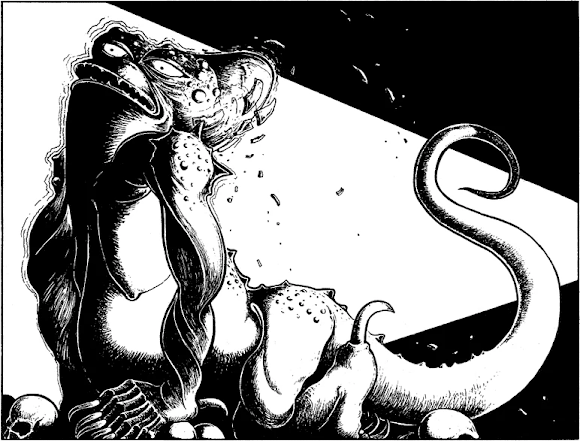
THE WALKER ALONE - Monster for Old School Fantasy & Horror.

Don' Look Now/ Nicholas Roeg/ 1973

Armour Class +5     Hit Dice 4+3     Move Normal Human     Morale 11

Neutral (evil) with Unratable Intelligence

It's a ghost. A haunt. It walks where it walks, alone. 

Sort of.

It abides in the places that you'd think there'd to be ghosts, places to which stories accrue. Sometimes it makes those stories, other times it slips in and fits within a pre-existing tradition. Give it an identity and it won't disabuse you of that notion, allowing you to interpret its acts as typical to that personality, that history.

It appears as a young woman, a gargantuan spider, a hoofed shaggy beast, two little girls, a man without skin, a child with no face and its feet on backwards, you, a carpet of creeping things, a dog with a human head, a rat with human hands, a celestial radiance just around the corner, her, something twitching and gobbling behind the curtain, a spinning top whistling at the top of the stairs, the shadow of a bird dying in its cage, him, a boneless thing of plaited hair, a spectral horse, a historical villain, a headless bear rolled thin like pastry, a column of glowing gas, an empty wedding dress, a dear little pig, them, a bulky cigar-smoking shape in an upholstered chair, a hanging judge, long-nailed children with a dark ragged hole in their breasts, a tide of blood, the shifting pareidolia of the fittings and furniture.

It has no personality of its own, but accumulates characteristics from the living and the dead things, the things said and the things written in and about its locus. It does not read minds, but it can know secret thoughts.

In sunlight, it is intangible, invisible, powerless and silent, but may hint its presence in dense fog or smoke, interior gloom, or subterranean spaces. 

Those with the second sight will also catch glimpses, whispers, suggestions of a scent, a breathe of air in passing, raised hairs on the arms and neck, the sense of being stared at.

If you are surprised, then you see slightly more than you want to and must make a fear save or let go of whatever you are holding. On a critical failure, you are frightened and make ability checks and attacks at disadvantage until you have a had a good night's sleep.

When a new person arrives at the Walker's locus, make a Reaction Roll to see if it takes a particular shine to them.

A Hostile result means they will be the focus of a campaign of terror and torment.

A Friendly result means that they will be the recipient of unsettling gifts and eerie attempts at affection/ sympathy, and there will be outrageous retributions against those who harm, upset or otherwise inconvenience them.

It can have one of each mortal focus at a time, and can sense their presence and general location within d4 miles. It will remember/remain faithful to them for d6+1 months if they leave and no one new replaces them.

During the hours of darkness, the presence becomes more active and more tangible. 

It can become invisible at will and can appear in any form it wishes (see above). It can use any language spoken or written within d4 miles of the locus, including ancient and dead languages.

You are unable to look at it directly as it roams the locus, so you can never be truly sure what you are seeing (use mechanics for avoiding a gaze attack). Because of this, the Walker hides and sneaks with advantage (when it is not invisible). It cannot be targeted directly by spells.

If it surprises you, then you see much more than you bargained for and must make a fear save. Failure means you let go of whatever you were holding and are frightened until you get a good night's sleep.

It is able to use the following spell-like abilities, each with a cooldown of d4 hours each:

  • continual darkness.
  • hallucinatory terrain: more robust than the named spell and not cancelled by touch; INT checks to disbelieve, CHA checks to convince others; as well as the usual applications, can be used to make doors, windows and other exits vanish or seem barricaded, or overlay what is already there so you miss your footing.
  • hold person: can be applied RAW, but can also be used to contain those affected at the locus for the rest of the night, a subdivision of this for d3 hours, or specific sub-location for d6 ten minute turns. Or use spell duration.
  • phantasmal force.
  • web (ectoplasm, if you like).

It can use audible glamour, and ventriloquism at will. 

If not otherwise dispelled, all these effects end at daybreak.

The Walker can cause d6 non-lethal damage, striking vs. unarmoured, per attack (STR or DEX check not to be stunned, knocked down or pushed). It can also suffocate/strangle to unconsciousness, but not to death - save vs. spells/paralysis to resist/break free.

If not before, then lost hit points and/or ability scores are recovered at daybreak.

You can treat it as an Invulnerable Monster for purposes of trying to fight it but its ability is immunity is non-magical damage, rather than magic weapon to hit, so you could treat this damage as non-lethal - good only for driving off its immediate manifestation or giving you the false feeling that you're achieving something by violence.

Even magical damage will only drive it away for a time (d6+1 months).

Something exists within d4 miles of the central locus that when confronted with, the Walker will instantly vanish forever. Most likely would be associated mortal remains, but it could be a hard truth or historical fact, buried treasures or legal documents.

Commentary.

Vancian magic and regenerating Trolls were something I could easily get on board with when starting out with D&D, even if they did not reflect the fiction I was expecting.

But Ghosts, I think, were my first big disappointment. 

Firstly, they were not in the Basic set. Second, the stats I saw for AD&D were clearly a monster challenge.

They did not really reflect the ghosts (fiction and non-fiction) I'd already been exposed to and their place on the undead threat scale meant they weren't going to feature as much as I'd want.

It felt like a flaw in the system.

BECMI still had the power scale problem, but the Companion set Haunts, Phantoms and Spirits made for interesting reading/thinking.

The Ghost as presented in Call of Cthulhu and Dragonwarriors (and then the Barudath in Book 4) were much more what I was looking for. So I had those to work with.

Things like the Ravenloft setting introduced more options for shaking up the standard undead (Van Richten's Guides).

The Walker Alone, though, is actually mostly a Wight, as detailed in Dragon magazine 180. The 27th part of The Voyage of the Princess Ark gives details of what happens when you die (other than rolling a new character, undeath or being raised).

When a Wight kills you, it then goes into a nightly trance to hunt your soul and devour it on the plane of Limbo - and it's got special powers! That's the mechanical basis for the Walker, with a little bit of the Fiend Folio Astral Searcher, and a lot of ghost traditions (experience, folklore, fiction, spiritualism and parapsychology).

The Walker Alone (and all ghosts) is not necessarily a spirit of the dead, but it may act like it is and you may believe it is. It is a haunting, in the same way as the Drummer of Tedworth or the Amityville Horror or Hill House and the Overlook Hotel and will seem to respond as such. Until it doesn't.

If you 'invite it in' (and this is deliberately ambiguous), it is able to cause physical harm: 2d3 lethal damage claw attack + fright attack as if it had surprised you. Claw damage blocked by armour, but not the fright attack. Maybe inviting it in also allows possession.

I've left lots of gaps, because the milieu this draws on is more M.R. James than Robert E. Howard. For heroic direct action, I think we're looking at things like oil of etherealness, truesight and fighting it on the Astral Plane - in which case, why not make it a RAW Ghost when you get there?

Monday, June 28, 2021

Alternatives to Poison/Venom Save-or-Die.

Save or die is an Old School marker and by way of poison/venom a commonplace.

Some suggestions for devastating toxic effects that aren't just game over.

If you're not already using delayed effect mechanics, then: d6 time units (as appropriate) from the poison/venom being administered until it starts to do something. 

Decide whether the save is made at delivery or onset.

Recovery from poisoning could be entirely reliant on medical or magical treatment, or could be dealt with in a similar way to natural recovery from disease.

Until the character receives cure poison or comparable:

  1. Must make a death save every day or die in their sleep.
  2. Disadvantage/auto-fail all STR and CON checks (odds/evens).
  3. Disadvantage/auto-fail all saves (odds/evens).
  4. No magical/natural healing (odds/evens).
  5. Lose 1 point from each Ability Score per day (until cured or dead).
  6. Minimum hit points for class, level and CON.
  7. If you're exposed to the same poison/venom again, you will die.
  8. Sickness/Nausea (like a Troglodyte's stench or Giant Centipede's venom).
  9. Weakness/Fatigue (as a spell or subsystem).
  10. All your Ability Scores reduced to 3 (or minimum for your system).
  11. Natural healing rate uses next longest time unit (e.g. day to week, week to month).
  12. Must make a death save every time you have to roll any other dice.

Retain any non-fatal special effects of a particular toxin, for distinction and flavour.

A fatal poison/venom can have ongoing effects as above, but be ultimately deadly within d6 time units (the shorter, the deadlier) after onset unless properly treated. There's drama here.

In addition, poisoned NPCs and monsters could have disadvantage/auto-fail on Morale/Loyalty checks and saves against fear due to the trauma of thinking they're going to die.

STR or CON minus a flat or random number can also be used as a measure of time units for onset/ fatality/ recovery.


Tuesday, June 15, 2021

"Demons To Some; Angels To Others" - The Order of the Gash for Old School.

We'll stick with Cenobites for convenience, but they're called other things by those outside the Order: Cold Ones, Flesh Mechanics, Inquisitors, Surgeons, Theologians, Hell Priests, Clinicians, Engineers, Keepers, Sensates etc. 

Cenobite/ Clive Barker/ 1986.

You know what they are and what they do, right?

"It is not hands that call us... it is desire".

They come when called and will not willingly go back unaccompanied. They can be bargained with, but are instinctively proprietorial. While pain-and-pleasure indivisible is their meat and drink, they are not compulsive missionaries to the innocent/ignorant.

Solving the Puzzle opens the Schism, allowing d6 Cenobites to pass through, but it is the obsession for a solution or desire to contact the Order that summons them.

You must figuratively or literally...

  1. open the Box
  2. count the Stones
  3. walk the Labyrinth
  4. cross the Threshold
  5. escape the Maze
  6. set the Clock
  7. debug the Program
  8. crack the Code
  9. play the Music
  10. cast the Spell
  11. grow the Tree
  12. deliver the Child
  13. honour the Mother/Father
  14. slay the Dragon/ defeat the Minotaur
  15. get the Joke
  16. draw down the Moon
  17. navigate the River
  18. transcend the Flesh
  19. raise the Cathedral
  20. plumb the Depths
You can be tricked into solving the Puzzle on behalf of another, and the Order is willing to educate the innocent even though they prefer to reward the guilty. Your desire to contact the Order can be subconscious.

The Schism allows traffic both ways.

What is it Wearing?

Cenobite/ Clive Barker/ 1986.

  1. Gory Skin Suit (Unarmoured)
  2. Naked Marmoreal Perfection (Unarmoured)
  3. Butcher’s Apron and Gauntlets (Leather)
  4. Full S&M (Leather)
  5. Full S&M with Extreme Implants (Scale)
  6. Hooked and Spiked Chains (Chain)

Bod mod, ornament, masks, jewellery, helmets, gloves, boots, uniforms, cosplay etc., to taste.

What is it Wielding?

Cenobite/ Clive Barker/ 1986.

  1. Antique Hand Weapon (sword, mace, warhammer etc.)
  2. Notched Heavy Cutting Blade
  3. Nothing, Apparently
  4. Tools of a Trade (surgeon, butcher, whaler, taxidermist, lepidopterist etc.)
  5. Whip/ Scourge
  6. Brutal Flail

That a Cenobite wouldn't be carrying a wicked knife somewhere about its person is almost unthinkable, but a spike, hook, blade, strangling line or cudgel are all startlingly easily improvised from everyday objects and body parts. 

Stats/Mechanics.

Cenobites are ascended/corrupted mortals, but are neither demonic nor undead despite their strong affinities.

Some of my choices for suitable reskins:

  1. Bugbear
  2. Shadow
  3. Troglodyte
  4. Golem, Wood
  5. Mummy
  6. Troll

Early Cenobite/ Clive Barker/ 1986.

Per combat round, one attack can be reskinned as an animated hooked/spiked chain. In addition to damage, this will constrict/entangle/grapple as a whip, tentacle or similar.

If they are not already immune to normal weapons, consider treating them as Invulnerable Monsters anyway - particularly if you're using them for horror purposes.

Cenobite/ Clive Barker/ 1986.

Personality:

  1. Absent-minded Professor/ Eager Physician
  2. Pompous Martinet/ Avant Garde Vivisectionist
  3. Jaded Aesthete/ Jovial Sadomasochist
  4. Aching to Fill the Hollow/ Transdimensional Jobsworth
  5. True Believer/ Imaginative Taxonomist
  6. Brutal Sycophant/ Fallen Avenger
Roll 2d6; read one as odds/evens.

Generally, only one Cenobite in a party will have a personality distinct from the others.and will probably but not always be both the leader and most powerful. All subservient Cenobites will be either/or of result 4.

Alignment: Lawful Evil Neutral.

The Order styles/ claims itself to be beyond human morality and outside the mainstream cosmology of your setting, beholden only to themselves. 

Protection from evil and the like works against them because they're summoned monsters.

Intelligence: Human scale, though with the advantage of forbidden knowledge and weird experience across an immortal existence.

Acedia.

Having explored the furthest regions of experience, some Cenobites get bored with being Cenobites (double ones on 2d6, either no more than one in a group or it's all of them) and behave uncharacteristically: 

  • showing mercy
  • studying and practising magic
  • planar adventuring
  • attempting to kill God
  • attempting the dethrone the Adversary
  • generally upsetting the balance of the cosmos
  • indirectly opposing the Order
  • falling in love
  • offering to trade places with mortals
  • remembering their lost humanity
  • seeking glory or redemption
  • taking up mundane hobbies
  • directly opposing the Order
  • trying to divide and conquer the Order
  • seeking Ascension
  • slumming it as an earthbound haunting spirit

Cenobite/ Clive Barker/ 1986.

Don't Just Use Kytons.

D&D adjacent, the most obvious choice is to reskin a Kyton, as the Chain Devil is already an off-brand Cenobite anyway. 

This isn't meant as absolute proscription.

What Was Left Out/ Further Reading.

There's a lot of conflicting canon out there. How much lore do you want?

Compare and contrast the Cenobites in The Hellbound Heart, the first two Hellraiser movies, and The Scarlet Gospels - Clive Barker himself takes them from weird sort-of-sexy mystery, through Lovecraft-adjacent menace, to rather conventional demons in an apparently Judeo-Christian cosmology. 

Plus, there are some minor references across his other works, and prototypes in The Books of Blood.

Then consider the later films, the unrealised projects, the comic books (which in particular extend them into history and myth), and pseudo-cameos in Extreme Ghostbusters, Dark City, Event Horizon and The Cabin in the Woods (maybe The Void, too).

There're at least two Hellraiser Wikis on Fandom.

Not more than passing familiar with either, but The Machine Orthodoxy (MTG) and the Kyton monster type (Pathfinder) set their tents out on Cenobite territory. 

Via EN World - Hellraiser for d20 Call of Cthulhu (so 3e compatible, I suppose).

On Tumblr, Hellbound for 5e D&D at The 5th Edition Foundry.


Friday, May 28, 2021

Old School Thief Variant - Adventurer, Ranger, Rogue.

There comes a time in all our lives when we have to 'fix' the Old School Thief.

Considering they're part of the core text of D&D, they needed a lot of modding.

Description: Thief, adventurer, ranger, rogue, ruffian, swashbuckler, scoundrel, hero.

Whatever they call you, your traditional ancestors are still Cugel and the Grey Mouser. But roll high STR/ CON and you're also Conan or Fafhrd without having to multiclass or otherwise bend/break the rules.

You might want this kind of Thief to specify if they're more inclined to the rural, the urban or the dungeon environment, and tweak their abilities accordingly.

XP, Saving Throws, & Attacks: All as Thief.

Hit Dice: Depending on the base system, you start with 2d4 or 2d6 hit points, but gain only 1d4 or 1d6 per level as normal thereafter.

Prime Requisite: Dexterity.

Armour: Any, but as Thief only when you want to do Thief stuff.

Weapons: Any, but you prefer the lighter/smaller hand weapons for special ability reasons.

Alignment Restrictions: None, unless that's important for in your setting/system.

Special Abilities.

Thief Skills: Everything a Thief can normally do, but agree which of either Hear Noise probabilities or boosted percentiles you use before play begins.

If you have a CHA, INT or WIS bonus (highest applies), you can start casting from scrolls that many levels earlier but chances of failure do not change until your levels catch up.

Snipe: You can Backstab using a missile weapon if this is not already allowed.

Dual Wield: When fighting with two weapons, you get +1 to Hit or AC. This also applies to unarmed strikes. You cannot Dual Wield while performing a Backstab.

Choose which bonus to use at the beginning of each combat round, before you roll any dice. 

If you hit, use the higher rolled damage or choose which weapon inflicted the wound (for magic and poisoned weapons, for example)

If you have 18 STR, you can wield a max. d8 and d6 weapon simultaneously; STR 15, 16 or 17, a max. d8 and d4 or d6 and d6; all other STR scores, the max. is d6 and d4.

(This presumes you don't already have Dual Wielding going on anyway)

Cleave: If Fighters get extra attacks vs. <1HD opponents, so do you but only when Dual Wielding.

Surprise: If you are alone or with no more than three other Thieves in leather or no armour, your first surprise attacks count as Backstabs.


Tuesday, May 25, 2021

Survival Horror - Fighting Invulnerable Monsters

CW: spoilers for Dog Soldiers, a c. 20 year old film.

There's a genre convention (survival horror or otherwise) that The Monster is near or totally invulnerable (but only until the final act). In D&D terms, we say 'magic weapon to hit' and that's near enough.

From BECMI, Basic level monsters that you can't harm with normal weapons include Gargoyles, Lycanthropes and Wights. AD&D has 1-4 Manes demons as a 1st level dungeon random encounter.  These are all things you might have to contend with on your first delve, let alone in the recognisable modern world.

Most of the mechanics presented here have been adapted/ lifted wholesale from Night Howlers by Ann Dupuis, which allows you to play as werecreatures - though it's more heroic fantasy than World of Darkness.

Whether or not The Monster can survive being hit by a car or driven over by a steamroller or being dropped off a cliff  or shot by a tank cannon will be a judgement call. 

Special specific immunity/vulnerability is just that: The Rules differ from iteration-to-iteration of The Monster - compare Buffy's Vampires to 30 Days of Night to Hammer Horror to Twilight, for example - so nothing here is absolute, just information to get things going.

As a general rule, firearms are normal weapons, from the humble musket to the sub-machine gun. 

Send An Elephant To Catch A Werewolf.

Monsters themselves immune to normal weapons or of sufficient size/power can harm nominally invulnerable monsters. My sources do not draw a distinction between natural and weapon attacks, but do stress that it's HD that count, not character levels.

Night Howlers gives the threshold as 8 HD+, so all Giants (but not all Dragons). 

AD&D starts at 4+1 HD (Ogres) and then climbs the magical bonus equivalent scale.

Alongside or instead of this, >15 hp from a single source/attack (in one combat round) causes the excess in damage, and >30 hp from multiple sources/attacks. Which potentially covers monsters missed out by the HD thresholds, as well as torch-and-pitchfork mobs. 

Adjust down to 10/20 hp thresholds if this suits your game better.

Falling damage (excuse me) falls into this category, too, either as number of dice rolled or damage inflicted.

Bolts & Boulders.

Even if not covered by the HD or hp values above, boulders (catapult or Giant thrown) and siege engines could harm invulnerable monsters - I guess they are not normal weapons.

You could extend this to any devices that cause hull or structural damage, if there are such things in your system.

Fire & Brimstone.

Unless explicitly or logically resistant, The Monster can be expected to be afraid of/vulnerable to fire, and takes normal damage from it.

As an option, successful fire attacks can force a Morale Check or block/parry/spoil The Monster's attack that round.

The Monster may overcome its fear of fire, or go berserk as a response, depending on how you see the fiction.

And, if not fire, why not acid, electricity, radiation and/or cold? These would normally be magical in heroic fantasy, but are certainly available in some form in other milieu.

Sticks of dynamite, kegs of gunpowder and/or vials of nitro-glycerine feature in the Gothic/Victorian horror setting The Masque of Red Death. Damage output is d6 per unit, with increasing explosion size. Whether thrown or just piled high and blown up, do they count as normal weapons (subject to damage thresholds), as fire or as siege weapons (capable of hull/structural damage)?

Non-Abstract Damage/ Special Effects.

(I'm planning to cover something along these lines in more depth as a separate post, so I'll edit in a link to that when I do)

The special and secondary effects of weapons and unarmed attacks are effective against invulnerable monsters, within reason: you can't tangle a Ghost in a net, you can't drown a Vampire, you can't snap John Carpenter's The Thing's neck (or whatever it's using at the time).

Decisions need to be made about the extent of invulnerability. Can you strangle a Werewolf, or would you have to use enchanted gauntlets to do so? Is a monster immune to poison gas because it does not need to breath at all or because it is unharmed by the toxins? What if instead of poison gas, it was dunked underwater? If shot with a tank cannon, does a Manes demon take no damage from the missile but get thrown back/ knocked over or does it bounce of them/ drop to the ground?

Hercules throttling the Nemean Lion is a guiding precedent.

In an abstract hit point system with few special/secondary effects, you could use subdual damage - although I'm not entirely sure whether or not you actually can beat (say) Pyramid Head into submission, or what you would do with them if you could.

Dog Soldiers (2002).

This film is an extended example of fighting invulnerable monsters that illustrates a lot of what I've covered here - to answer or raise questions.

Silver is still the traditional vulnerability, but (spoiler) this is backed up with a head shot, raising the possibility that The Monster can be rendered vulnerable to normal weapons, to be dealt with using more traditional fantasy rpg violence.

Werewolves are punched, scalded with boiling water, struck with frying pans. They aren't killed (no damage), but they are affected - call it a stun or a blocking of their attacks in game terms. Same with a camera flash, it dazzles them but does no equivalent of hp damage.

They survive being impaled on a normal metal sword. And there has been discussion as to whether a limb is severed - though what this means in our context, I don't know (unless these Werewolves are Trolls).

They survive sustained automatic gunfire, which may or may not have been enough to beat the 15/30 thresholds. Do you measure damage output as each bullet being a single attack, the gun being a single source, the burst being a single or multiple source? 

Are the Werewolves taking no damage or minimal damage from gunfire? Because (spoiler) they're all killed when the house is blown up, so maybe it was just that there weren't enough dice being rolled.

How Does Invulnerability Work?

Some pseudo-scientific terms for how immunity to non-magical weapons (etc.) manifests. Sci-fi and superhero sources are handy for things like this if you want to extend it.

Roll d6:

  1. Contact energy conversion
  2. Tactile psycho/telekinesis
  3. Superhealing
  4. Lubricant forcefield
  5. Object/subject specific immateriality
  6. Unconscious superdensity

Trying to root The Monster too much in reality will lead to plot holes and heated debate. How does Superman shave? Which midnight should a Gremlin not eat after and for how long should they abstain?

Option: Heroes & Superheroes.

This probably won't crop up in survival horror scenarios, but it derives from what I've been thinking about here.

Older edition D&D titles for 4th and 8th level Fighters, approximately matching the HD qualifications given above. I can't say if that's design or coincidence.

Anyway, how about:

Heroes can hit monsters that are otherwise immune to non-magical weapons, as if they were armed with a +1 weapon; Superheroes as if with +2. This gives no bonuses and does not stack with any actual enchantment - it's just about what you can hit whether or not you are armed with a magic weapon.

Use for low-magic settings and/or systems where you think Fighters get a poor deal.

Raises the possibility that a weapon might take on some enchantment from the heroism of the bearer, so the number of random +1 and +2 swords in a setting is related to the number of Heroes and Superheroes who have passed away or invested their arms in others.

Thursday, May 13, 2021

Survival Horror - Just Use Trolls

A Troll.

For old school adjacent play in the survival horror genre, rather than a specific setting or system.

It's already established that, mechanically, you can just use Bears to represent unknown monsters, with a spread of threat to suit adventurer level. No problem with that.

However:

Trolls are ready-made horror monsters, by statline and mechanics - especially the 2e AD&D iteration with detachable body parts. Older edition RAW, it can't be killed unless fire or acid is applied, and regenerates from 0 hp. It's not always specified if each severed piece could or could not regenerate into a whole, either.

A Troll.

Flavour the bare statblock to taste and serve, burning hot or freezing cold.

In the scenario I envisage, it doesn't matter that a 6 HD monster is going up against 0/1st level characters. In fact, that's the point - the threat is absolute rather than relative. The characters are up against The Monster (or Monsters), not representatives of a global type.

Troll Variants, Too.

These are from 1e AD&D Fiend Folio.

Because it's only the variation rather than the actual monster I'm interested in, keeping the basic Troll statline is no big deal. Exception being the Ice Troll, which can be used RAW as something other than a lone monster.

Are they all vulnerable to fire and acid in the same way as the base Troll? It wasn't always specified in the text. If you've got access to 2e stats, they all get a damage boost.

Giant Troll.

  • AC +6, Move Normal Human, HD 8, Attacks 2-16 (weapon) or 2x 2-7 (can split between opponents)
    • regenerates 2 hp/round, cannot reattach limbs, but will regenerate from 0 hp unless 10+ fire damage has been inflicted
    • if you're using the sever on critical hit option for Trolls, it doesn't work on these
    • catch missiles 25% chance
  • 2e AD&D says it will grab opponents and use them as a weapon


Ice Troll.

  • AC +2, Move 75% Normal Human, HD 2, Attacks 2x 1-8 (can split between opponents)
    • regenerates 2 hp/round if in contact with water; detached limbs will travel up to 30' towards water
    • magic weapon to hit
    • immune to cold
    • double damage from fire
    • critical hits break off brittle parts rather than sever/slice


Spirit Troll.

  • AC +8 (invisible), Move 125% Normal Human, HD 5+5, Attacks claw/claw/bite for 1-3/1-3/1-6 (can split between opponents)
    • regenerate 3 hp/round
    • magic weapon to hit
    • immune to cold
    • adds bite damage to its hit points
    • claw damage comes off STR, too - recovery in 2-8 turns
  • 2e Spirit Troll is AC +10, HD 8 and claw/claw/bite for 2x 3-6 (1d4+2)/ 4-10 (2d4+2)


Two-headed Troll.


  • AC +6, Move Normal Human, HD 10, Attacks claw/claw/bite/bite for 1-6/1-6/1-10/1-10 (can split between opponents, but both bites must have same target)
    • regenerate 1 hp/ round, cannot reattach limbs
    • if you're using the sever on critical hit option for Trolls, it doesn't work on these
    • surprised only on 1 on d6


Sunday, May 2, 2021

Lactate of Great Mother Vore.

The Dakomyd. Gary Chalk, The Kingdoms of Terror.

Yes, it does sound a bit death metal, doesn't it?

No mechanics. System agnostic. Fit to your system/setting. Black Milk and Black Ichor have canon status elsewhere, but don't you worry about that.

Odds/evens, Great Mother Vore is a physical entity you can encounter/ a symbolic phenomenon.

Odds/evens, the Lactate is only effective from the source (breaking down if exposed to the air/taken away)/ can be stored and distributed.

Roll d6:

  1. Black Milk: a powerful mutagen - blessing to some, corruption to others.
  2. Black Ichor: as you undertake your dismal delves thereafter, you are compelled to whisper thanks and imprecations to the Mother.
  3. Yellow Acid: lethal poison - save or die; permanent damage even if save made; burns through flesh and metal, bone and stone somewhat resistant; considered Holy Water.
  4. Amber Oil: soporific, stupefying, highly volatile, highly flammable, addictive.
  5. Ghostmilk: local term for ectoplasm; reacts to magical, psychic and powerful emotional stimuli; capable of possession and being possessed.
  6. Lactate Incarnadine: like no other high you have ever experienced; supercharges aura, body and mind; ultimately destroys mortal vessels - they were not made to contain it.