Showing posts with label system agnostic. Show all posts

Tuesday, November 28, 2023

Three Foods of The Land Beyond The Great Forest

There's three dishes that really stand out.

Blood Soup.

Rich, red and warming. Packed with paprika. Normally made without blood, but a concentrated base of pork (or less commonly, beef) stock. 

Recommended to build you back up when you're a bit pale and drained from sleeping badly the last few nights. Traditionally a remedy for anaemia - hence the name.

Variations include floating chunks of pickled beetroot, much much more garlic, or absolutely no garlic at all. Sometimes served in a hollowed-out stale loaf.

When served chilled and congealed, it is sliced like sausage as an accompaniment to strong drink in the open air. The gelatinous texture is an acquired taste.

Hunter's Broth.

A simple soup of bone broth, salt and a mix of alliums. Traditional peasant dish, to be enriched with leftovers. 

It is thought that it gets its name from being fed to those injured in hunting accidents to determine the severity of stomach wounds. The distinctive smell would indicate internal perforation, and the poor soul would prepare for death. 

This may also be reflected in the tradition of adding a symbolic drop of crushed belladonna to the soup as it is served.

Another theory is that it's an example of ironic peasant humour. Surely no hunter would attempt to stalk animals after eating something so heavily seasoned with garlic that it scents your sweat.

The tourist recipe is significantly milder with edible berries in place of the belladonna, and served with toasted (or stale) bread floating on top. Sprinkled with cheese, and/or shredded dried meat.

Red Velvet Chicken.

According to folklore, a meal personally prepared and served by the head of a noble household to a guest of more humble station. 

Red and glossy. A powerful symbol of hospitality, it is purported to encourage restful sleep and agreeable conviviality.

Originally a simple, rustic chicken dish, the recipe now includes expensive imported spices - the different combinations and proportions said to reflect the characters of both past and current armigerous clans.

The brightly-coloured example in the nicer coaching inns is more affordable. Contains lots of paprika (and sometimes garlic), instead of the rare and precious spices.

The most authentic-looking (and expensive) tourist version contains cumulatively poisonous (but surprisingly palatable) metallic dyes. The locals aren't fooled, by appearance or by taste, but the adulteration is overlooked by less-conscientious authorities as long as adverse reactions are few, rare and restricted to tourists. 

System Agnostic Mechanics.

Blood Soup: double-rate recovery from health and attribute damage from blood-loss, blood-disease and assorted haemovores and energy drainers, living and (un)dead.

Hunter's Broth: belladonna for bonus vs. surprise by vampires/minions, and resistance to lycanthropy; stench vs. vampires as (eg) Troglodyte, and penalty to surprise/stealth.

The tourist version has no mechanical effects.

Red Velvet Chicken: disadvantage/penalty on saves vs. sleep, charm and hold. Can be specific to the villain, or more generally. 

The tourist version lacks the psychoactive compounds - it's tasty but usually overpriced. 

Tainted meals give a cumulative 1% chance of getting really sick per portion consumed. The poison is purged at a rate of up to 5% per week after last dose.

Commentary.

Thanks to what is now Strange Studies of Strange Stories for the idea/image of the Count making Jonathan Harker his supper.

The soups seemed thematically appropriate without being too light-hearted.


Friday, April 8, 2022

Secret Jackalope 2022: Mythical/Dreamlike Islands Generator

Suitably piratical adventures. Shades of Harryhausen.
Fantastical, maybe mythic, probably not very dreamlike.

Secret Jackalope 2022 prompt via the OSR Discord: "A Mythical (dreamlike) island generator" for PaperMagus#9478.

I love an island (or an archipelago) as a setting, so this was right up my street. I've kept things setting and system agnostic.

Roll a mixed handful of d6, d8, d10 and d12, then consult the numbered lists below. 

Some of the outcomes contradict others. Ignore anything that doesn't make enough sense and/or you don't like. Climate and terrain as appropriate to the milieu/mythos. Sorry to leave so much of the work to you, but filling in gaps and making connections can be fun.

If you want, roll those dice onto hex paper and use the spread to map the island or surrounding archipelago (highest roll is the most important location, however you define it). Chuck in some d4s to represent volcanos, mountains and mysterious mounds/pyramids (no tables for them).

The island can be found only:

  1. At the crack of dawn.
  2. When the sun first touches the horizon at dusk.
  3. Under the light of a full moon.
  4. Only when the sun is at its highest and hottest, with no breath of wind and the sea like a pane of glass.
  5. When everyone is asleep (or otherwise unconscious).
  6. When you are at the very end of your supplies.
  7. By those under a curse or enchantment.
  8. By those responding to an omen (good or ill).
  9. By those castaway from their vessel.
  10. If someone onboard is dead or dying.
  11. When your vessel is adrift, at the mercy of the currents and the winds.
  12. Once you have already resorted to drinking piss and sea water, cannibalism or the Bear Grylls hydration-enema (kind of CW/NSFW YT link).

The island lies:

  1. At the heart of a vast float of sargassum/deadly maze of icebergs/expansive gyre of the rubbish of civilisations.
  2. In dense fog, looming up suddenly and unavoidably.
  3. To starboard, glimpsed through the slashing rain, towering waves and dazzling flashes of an uncommon storm
  4. To port, just at the edge of peripheral visibility.
  5. Confoundingly astern, where you were but a short time since.
  6. Dead ahead, unexpected and uncharted.
  7. As 2, but when the fog clears it is revealed to have been cloud and the island is in the sky.
  8. Where the sea plunges over the Edge into endless space. You might see the effects of this long before you spy the island.

The island is full of lights:

  1. Corpse candles illuminating the faces of undead that are invisible by day.
  2. Sheets, sparks, and crackles of electricity/plasma.
  3. A sickly green glow suffuses everything, intense by night but just visible by day. It spreads to objects brought to the island and carried away from the island. 
  4. The lit windows of dwellings where there are none.
  5. Parading jack-o-lanterns, punkies, spunkies and will-o-the-wisps.
  6. Cannibal/Ogre cooking fires.
  7. The lamps of search parties, distress flares and signal fires. A general sense of urgency.
  8. Multitudes of eyes glimmering in the face of the dark.
  9. The ghost of a lighthouse. Does it signal doom or safety? Is its blaze even meant for something of this world?
  10. As if the constellations themselves have stepped down from the sky to roam the earth. May be accompanied by stark dark patches in the heavens.

Any of these lights can also be in the water.

The (super)nature of the island:

  1. Like a pop-up picture book, 2D within a 3D space, and either realistic or in a particular style of art/illustration. Time and distance are redefined as if by flips of a page. Whether those arriving or leaving update to fit the environment they are entering is up to you. Possibly everything is extremely vulnerable to fire.
  2. Under an enchantment/perception filter that hides its true nature. It appears like a paradise when it is a hellhole, or a fortification bristling with cannon and swarming with armoured mechanical warriors when it is in fact the peaceful convent of lycanthropic vampire nuns. And vice versa. It is possible to be able to perceive both aspects under the right conditions.
  3. A dream construct, with dream logic, and sustained by a specific Dreamer. It is real unless/until the Dreamer is awakened. The Dreamer is not always aware of their status, nor necessarily a participant in the dream.
  4. An actual illusion/telepathic-feedback-dependent hard light construct. It is vulnerable to a particular weight of disbelief, from an individual (including only a specific individual) to the whole sapient population. Awareness of the illusion/simulation does not necessarily aid active disbelief. Is there an island under it, or just the swallowing sea?
  5. A nightmare construct, as if produced by the Dragon Warriors Nightmare. You are probably all lying shivering on a beach surrounded by fragments of your wrecked vessel while this is going on.
  6. Everything on the island is alive/awakened, and survival here is dependent on accepting an animist worldview and communing with the genius loci of the place. I recommend PARIAH.
  7. Cinderella/Circe transformation - everything is something polymorphed into something else and vulnerable to counter-spell, disbelief and/or effect expiry. Leaving the island may or may not reverse any unfortunate changes.
  8. The Shores of Death. If the island is not actually the realm of the dead, or contain an entrance to the realm of the dead, it is the last mortal staging post on the journey to said realm. 
  9. Groundhog Day. The island is on repeat, resetting at intervals. The reset can be a regular occurrence, or be based on collective or individual acts. Agency, awareness and memory may persist (for inhabitants and/or outsiders), or the effect may be a trap, turning you into puppets in someone else's play.
  10. Altered Reality, whether by nature of its substance or the power of one (or more) of its inhabitants. This is something like an illusion, but is persistent and real if it is not disbelieved (or if there is no-one there to disbelieve it).
  11. Persistent shared dream-space. The island can be reached by sea, but is better reached by plunging into the collective unconsciousness of those who dream it. If the dream-substance does not resist it, potentially all dreamers/visitors can alter and influence the unreality.
  12. Non-Euclidean. However wholesome or horrible the island is, it defies conventional mortal geometry, making getting around and getting away both difficult and nauseating. 

Going ashore:

  1. Safe, sheltered bay/cove and easy trails to the interior
  2. Narrow tracks and/or crude steps zig-zag vertiginously up cliffs/crags from the sparse spit of land at their base
  3. Seemingly impregnable walls of rock/ice circumscribe the island, broken suddenly by a concealed passage, scraping low overhead your vessel
  4. Treacherous reefs/rocks/sandbars that necessitate a stay while repairs are carried out
  5. The silent quayside of an apparently abruptly and recently abandoned settlement (from trading post to sprawling metropolis, as appropriate)
  6. As you approach the shore, the sea suddenly retreats - impossibly fast and far, leaving you within walking distance of the island but with miles of stinking mud and dying aquatic creatures in all other directions.

The island is full of noises:

  1. Regular muffled thump like a great machine (or enormous heart) underground.
  2. Hummadruz. Not necessarily debilitating.
  3. The sand in the hourglass of your life running inexorably down.
  4. Distant raucous birds and the mournful honking of sea mammals that almost sound like comprehensible language.
  5. Shrill discordant notes and runs that you can't be sure aren't caused by the wind.
  6. As if the entire island was underwater. There may be an accompanying visual effect, or the island is actually underwater.
  7. Regular ticking, like a clock counting down or hot metal cooling.
  8. More and more elaborate and louder and louder fart noises, followed by barely human juvenile tittering.
  9. Wordless songs and sweet plangent notes.
  10. Industry appropriate to the technological level of the adventure.
  11. Muttering and cursing, meeping and gibbering.
  12. The sounds of a contemporary (or any preferred historical period or cultural variation) IRL shopping mall, airport, stock trading floor, space shuttle launch control - anything alien and incongruous to the milieu and the characters.

The islanders are:

  1. Curiously/suspiciously like your home culture.
  2. Dead (whether they are also talking and walking around is up to you)
  3. Diseased, obviously or otherwise.
  4. Echoes of the future/the past. Not quite real, a little alien, uncanny.
  5. The last remnant of a famously long-vanished civilisation
  6. Beastfolk: talking animals, Moreauvian vivisects, werewolves, satyrs, sirens, people wearing animal masks or acting like beasts.
  7. Merfolk, obviously or otherwise.
  8. Immortals. Possibly (weakly) godlike, or maybe vampires or elves.
  9. Easily exploitable; extremely vulnerable.
  10. Living statues (or other sapient elemental substance).
  11. Cannibals, obviously or otherwise.
  12. Completely surprised that there are other living beings beyond the island.

Reaction Roll to determine their general disposition towards outsiders.

The island doesn't need to be heavily populated - it might even work better for atmosphere if it isn't.

Just the one island, but it's pretty fucking cool.

The island's big personality/main character:

  1. Enchanter. Charms and transformations.
  2. Elementalist. Storms and weather magic.
  3. Sorcerer. Usually scholarly, with magical minions. 
  4. Scientician. Conducting private experiments far from interference.
  5. Necromancer. Their own fiefdom of the undead.
  6. Giant Humanoid. Strong enough to threaten shipping.
  7. Prehistoric Colossus. A Lost World survival or recently resurrected.
  8. Monster of Legend. One with the definite article and capitalisation.
  9. Cannibal. Not necessarily a compulsive gourmand, nor a cultural caricature.
  10. Forgotten God. Might want to reverse or preserve this situation.

Reaction Roll to determine their general disposition towards outsiders. There doesn't need to be one of these, but there often is. 

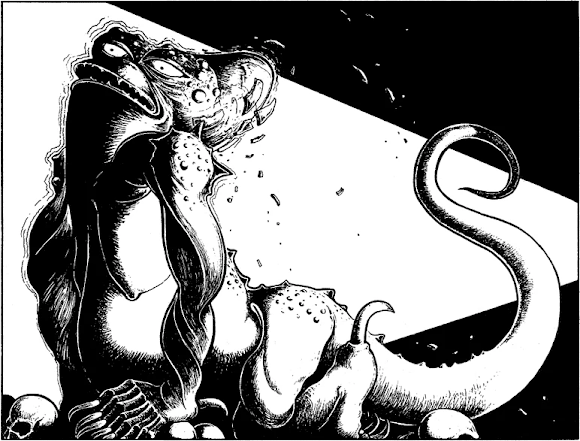
Don't know where the Lizard King (or the Gonchong on their head) fits on the list.

The island's gift, the island's prize:

  1. Sanctuary. No harm may befall those who abide here, as long as the legal and/or magical terms are not violated. 
  2. Healing. Bodily, emotional and/or mental good health arise from the conditions, substance or inhabitants of the island. The effect cannot be transported elsewhere, but there are always those who will try.
  3. Longevity. A condition of the island means that lifespan is extended. Often only as long as you remain there, the years catching up with you in an instant should you leave. Youthfulness and good health not always part of the deal.
  4. Knowledge. Could be magitech, could be psionics, could be the truth you were unwilling to hear. Includes mythical sages and the libraries of lost civilisations.
  5. Wealth. Whether it's lucrative trade links, rare materials or simply treasure vaults bursting with gold, there is always a price and it's usually blood and doom.
  6. Victory. The ally, the weapon, the mentor that you seek is here. There will be unforeseen consequences, even if you believe your motive is righteous.

All these islands have a Doom and will likely suffer it while the PCs are at hand, or even because of them (by accident or design):

  1. The Dreamer awakens and prosaic brute Reality comes rushing back in.
  2. The nemesis musters overpowering forces and invades. Unbridled massacre and pillage.
  3. The Sleeper stirs and the island tumbles from its back. Or it's just an earthquake/tsunami.
  4. The inexorable sea consumes the island, by inches but completely and forever.
  5. The slumbering volcano that raised the island bursts back to destructive life, affecting the climate even on the other side of the world.
  6. The spell that holds back the bitter cosmic cold breaks at last; perpetual winter crushes the island in ever-thickening snow and ice.
  7. Starts to fade away, either to nothing or to another dimension. 
  8. Contagious combustion/disintegration/liquefaction/petrification.

Somewhat zany, but it's got islands and a bit of Graeco-Roman mythological flavour.

Also take a look at:

A Strange Voyage Twitter account.

The section on randomly generating magical islands with a fairytale/mythic flavour in 2e AD&D HR3 Celts Campaign Sourcebook by Graeme Davis. 


Monday, June 28, 2021

Alternatives to Poison/Venom Save-or-Die.

Save or die is an Old School marker and by way of poison/venom a commonplace.

Some suggestions for devastating toxic effects that aren't just game over.

If you're not already using delayed effect mechanics, then: d6 time units (as appropriate) from the poison/venom being administered until it starts to do something. 

Decide whether the save is made at delivery or onset.

Recovery from poisoning could be entirely reliant on medical or magical treatment, or could be dealt with in a similar way to natural recovery from disease.

Until the character receives cure poison or comparable:

  1. Must make a death save every day or die in their sleep.
  2. Disadvantage/auto-fail all STR and CON checks (odds/evens).
  3. Disadvantage/auto-fail all saves (odds/evens).
  4. No magical/natural healing (odds/evens).
  5. Lose 1 point from each Ability Score per day (until cured or dead).
  6. Minimum hit points for class, level and CON.
  7. If you're exposed to the same poison/venom again, you will die.
  8. Sickness/Nausea (like a Troglodyte's stench or Giant Centipede's venom).
  9. Weakness/Fatigue (as a spell or subsystem).
  10. All your Ability Scores reduced to 3 (or minimum for your system).
  11. Natural healing rate uses next longest time unit (e.g. day to week, week to month).
  12. Must make a death save every time you have to roll any other dice.

Retain any non-fatal special effects of a particular toxin, for distinction and flavour.

A fatal poison/venom can have ongoing effects as above, but be ultimately deadly within d6 time units (the shorter, the deadlier) after onset unless properly treated. There's drama here.

In addition, poisoned NPCs and monsters could have disadvantage/auto-fail on Morale/Loyalty checks and saves against fear due to the trauma of thinking they're going to die.

STR or CON minus a flat or random number can also be used as a measure of time units for onset/ fatality/ recovery.


Tuesday, June 15, 2021

"Demons To Some; Angels To Others" - The Order of the Gash for Old School.

We'll stick with Cenobites for convenience, but they're called other things by those outside the Order: Cold Ones, Flesh Mechanics, Inquisitors, Surgeons, Theologians, Hell Priests, Clinicians, Engineers, Keepers, Sensates etc. 

Cenobite/ Clive Barker/ 1986.

You know what they are and what they do, right?

"It is not hands that call us... it is desire".

They come when called and will not willingly go back unaccompanied. They can be bargained with, but are instinctively proprietorial. While pain-and-pleasure indivisible is their meat and drink, they are not compulsive missionaries to the innocent/ignorant.

Solving the Puzzle opens the Schism, allowing d6 Cenobites to pass through, but it is the obsession for a solution or desire to contact the Order that summons them.

You must figuratively or literally...

  1. open the Box
  2. count the Stones
  3. walk the Labyrinth
  4. cross the Threshold
  5. escape the Maze
  6. set the Clock
  7. debug the Program
  8. crack the Code
  9. play the Music
  10. cast the Spell
  11. grow the Tree
  12. deliver the Child
  13. honour the Mother/Father
  14. slay the Dragon/ defeat the Minotaur
  15. get the Joke
  16. draw down the Moon
  17. navigate the River
  18. transcend the Flesh
  19. raise the Cathedral
  20. plumb the Depths
You can be tricked into solving the Puzzle on behalf of another, and the Order is willing to educate the innocent even though they prefer to reward the guilty. Your desire to contact the Order can be subconscious.

The Schism allows traffic both ways.

What is it Wearing?

Cenobite/ Clive Barker/ 1986.

  1. Gory Skin Suit (Unarmoured)
  2. Naked Marmoreal Perfection (Unarmoured)
  3. Butcher’s Apron and Gauntlets (Leather)
  4. Full S&M (Leather)
  5. Full S&M with Extreme Implants (Scale)
  6. Hooked and Spiked Chains (Chain)

Bod mod, ornament, masks, jewellery, helmets, gloves, boots, uniforms, cosplay etc., to taste.

What is it Wielding?

Cenobite/ Clive Barker/ 1986.

  1. Antique Hand Weapon (sword, mace, warhammer etc.)
  2. Notched Heavy Cutting Blade
  3. Nothing, Apparently
  4. Tools of a Trade (surgeon, butcher, whaler, taxidermist, lepidopterist etc.)
  5. Whip/ Scourge
  6. Brutal Flail

That a Cenobite wouldn't be carrying a wicked knife somewhere about its person is almost unthinkable, but a spike, hook, blade, strangling line or cudgel are all startlingly easily improvised from everyday objects and body parts. 

Stats/Mechanics.

Cenobites are ascended/corrupted mortals, but are neither demonic nor undead despite their strong affinities.

Some of my choices for suitable reskins:

  1. Bugbear
  2. Shadow
  3. Troglodyte
  4. Golem, Wood
  5. Mummy
  6. Troll

Early Cenobite/ Clive Barker/ 1986.

Per combat round, one attack can be reskinned as an animated hooked/spiked chain. In addition to damage, this will constrict/entangle/grapple as a whip, tentacle or similar.

If they are not already immune to normal weapons, consider treating them as Invulnerable Monsters anyway - particularly if you're using them for horror purposes.

Cenobite/ Clive Barker/ 1986.

Personality:

  1. Absent-minded Professor/ Eager Physician
  2. Pompous Martinet/ Avant Garde Vivisectionist
  3. Jaded Aesthete/ Jovial Sadomasochist
  4. Aching to Fill the Hollow/ Transdimensional Jobsworth
  5. True Believer/ Imaginative Taxonomist
  6. Brutal Sycophant/ Fallen Avenger
Roll 2d6; read one as odds/evens.

Generally, only one Cenobite in a party will have a personality distinct from the others.and will probably but not always be both the leader and most powerful. All subservient Cenobites will be either/or of result 4.

Alignment: Lawful Evil Neutral.

The Order styles/ claims itself to be beyond human morality and outside the mainstream cosmology of your setting, beholden only to themselves. 

Protection from evil and the like works against them because they're summoned monsters.

Intelligence: Human scale, though with the advantage of forbidden knowledge and weird experience across an immortal existence.

Acedia.

Having explored the furthest regions of experience, some Cenobites get bored with being Cenobites (double ones on 2d6, either no more than one in a group or it's all of them) and behave uncharacteristically: 

  • showing mercy
  • studying and practising magic
  • planar adventuring
  • attempting to kill God
  • attempting the dethrone the Adversary
  • generally upsetting the balance of the cosmos
  • indirectly opposing the Order
  • falling in love
  • offering to trade places with mortals
  • remembering their lost humanity
  • seeking glory or redemption
  • taking up mundane hobbies
  • directly opposing the Order
  • trying to divide and conquer the Order
  • seeking Ascension
  • slumming it as an earthbound haunting spirit

Cenobite/ Clive Barker/ 1986.

Don't Just Use Kytons.

D&D adjacent, the most obvious choice is to reskin a Kyton, as the Chain Devil is already an off-brand Cenobite anyway. 

This isn't meant as absolute proscription.

What Was Left Out/ Further Reading.

There's a lot of conflicting canon out there. How much lore do you want?

Compare and contrast the Cenobites in The Hellbound Heart, the first two Hellraiser movies, and The Scarlet Gospels - Clive Barker himself takes them from weird sort-of-sexy mystery, through Lovecraft-adjacent menace, to rather conventional demons in an apparently Judeo-Christian cosmology. 

Plus, there are some minor references across his other works, and prototypes in The Books of Blood.

Then consider the later films, the unrealised projects, the comic books (which in particular extend them into history and myth), and pseudo-cameos in Extreme Ghostbusters, Dark City, Event Horizon and The Cabin in the Woods (maybe The Void, too).

There're at least two Hellraiser Wikis on Fandom.

Not more than passing familiar with either, but The Machine Orthodoxy (MTG) and the Kyton monster type (Pathfinder) set their tents out on Cenobite territory. 

Via EN World - Hellraiser for d20 Call of Cthulhu (so 3e compatible, I suppose).

On Tumblr, Hellbound for 5e D&D at The 5th Edition Foundry.


Tuesday, May 25, 2021

Survival Horror - Fighting Invulnerable Monsters

CW: spoilers for Dog Soldiers, a c. 20 year old film.

There's a genre convention (survival horror or otherwise) that The Monster is near or totally invulnerable (but only until the final act). In D&D terms, we say 'magic weapon to hit' and that's near enough.

From BECMI, Basic level monsters that you can't harm with normal weapons include Gargoyles, Lycanthropes and Wights. AD&D has 1-4 Manes demons as a 1st level dungeon random encounter.  These are all things you might have to contend with on your first delve, let alone in the recognisable modern world.

Most of the mechanics presented here have been adapted/ lifted wholesale from Night Howlers by Ann Dupuis, which allows you to play as werecreatures - though it's more heroic fantasy than World of Darkness.

Whether or not The Monster can survive being hit by a car or driven over by a steamroller or being dropped off a cliff  or shot by a tank cannon will be a judgement call. 

Special specific immunity/vulnerability is just that: The Rules differ from iteration-to-iteration of The Monster - compare Buffy's Vampires to 30 Days of Night to Hammer Horror to Twilight, for example - so nothing here is absolute, just information to get things going.

As a general rule, firearms are normal weapons, from the humble musket to the sub-machine gun. 

Send An Elephant To Catch A Werewolf.

Monsters themselves immune to normal weapons or of sufficient size/power can harm nominally invulnerable monsters. My sources do not draw a distinction between natural and weapon attacks, but do stress that it's HD that count, not character levels.

Night Howlers gives the threshold as 8 HD+, so all Giants (but not all Dragons). 

AD&D starts at 4+1 HD (Ogres) and then climbs the magical bonus equivalent scale.

Alongside or instead of this, >15 hp from a single source/attack (in one combat round) causes the excess in damage, and >30 hp from multiple sources/attacks. Which potentially covers monsters missed out by the HD thresholds, as well as torch-and-pitchfork mobs. 

Adjust down to 10/20 hp thresholds if this suits your game better.

Falling damage (excuse me) falls into this category, too, either as number of dice rolled or damage inflicted.

Bolts & Boulders.

Even if not covered by the HD or hp values above, boulders (catapult or Giant thrown) and siege engines could harm invulnerable monsters - I guess they are not normal weapons.

You could extend this to any devices that cause hull or structural damage, if there are such things in your system.

Fire & Brimstone.

Unless explicitly or logically resistant, The Monster can be expected to be afraid of/vulnerable to fire, and takes normal damage from it.

As an option, successful fire attacks can force a Morale Check or block/parry/spoil The Monster's attack that round.

The Monster may overcome its fear of fire, or go berserk as a response, depending on how you see the fiction.

And, if not fire, why not acid, electricity, radiation and/or cold? These would normally be magical in heroic fantasy, but are certainly available in some form in other milieu.

Sticks of dynamite, kegs of gunpowder and/or vials of nitro-glycerine feature in the Gothic/Victorian horror setting The Masque of Red Death. Damage output is d6 per unit, with increasing explosion size. Whether thrown or just piled high and blown up, do they count as normal weapons (subject to damage thresholds), as fire or as siege weapons (capable of hull/structural damage)?

Non-Abstract Damage/ Special Effects.

(I'm planning to cover something along these lines in more depth as a separate post, so I'll edit in a link to that when I do)

The special and secondary effects of weapons and unarmed attacks are effective against invulnerable monsters, within reason: you can't tangle a Ghost in a net, you can't drown a Vampire, you can't snap John Carpenter's The Thing's neck (or whatever it's using at the time).

Decisions need to be made about the extent of invulnerability. Can you strangle a Werewolf, or would you have to use enchanted gauntlets to do so? Is a monster immune to poison gas because it does not need to breath at all or because it is unharmed by the toxins? What if instead of poison gas, it was dunked underwater? If shot with a tank cannon, does a Manes demon take no damage from the missile but get thrown back/ knocked over or does it bounce of them/ drop to the ground?

Hercules throttling the Nemean Lion is a guiding precedent.

In an abstract hit point system with few special/secondary effects, you could use subdual damage - although I'm not entirely sure whether or not you actually can beat (say) Pyramid Head into submission, or what you would do with them if you could.

Dog Soldiers (2002).

This film is an extended example of fighting invulnerable monsters that illustrates a lot of what I've covered here - to answer or raise questions.

Silver is still the traditional vulnerability, but (spoiler) this is backed up with a head shot, raising the possibility that The Monster can be rendered vulnerable to normal weapons, to be dealt with using more traditional fantasy rpg violence.

Werewolves are punched, scalded with boiling water, struck with frying pans. They aren't killed (no damage), but they are affected - call it a stun or a blocking of their attacks in game terms. Same with a camera flash, it dazzles them but does no equivalent of hp damage.

They survive being impaled on a normal metal sword. And there has been discussion as to whether a limb is severed - though what this means in our context, I don't know (unless these Werewolves are Trolls).

They survive sustained automatic gunfire, which may or may not have been enough to beat the 15/30 thresholds. Do you measure damage output as each bullet being a single attack, the gun being a single source, the burst being a single or multiple source? 

Are the Werewolves taking no damage or minimal damage from gunfire? Because (spoiler) they're all killed when the house is blown up, so maybe it was just that there weren't enough dice being rolled.

How Does Invulnerability Work?

Some pseudo-scientific terms for how immunity to non-magical weapons (etc.) manifests. Sci-fi and superhero sources are handy for things like this if you want to extend it.

Roll d6:

  1. Contact energy conversion
  2. Tactile psycho/telekinesis
  3. Superhealing
  4. Lubricant forcefield
  5. Object/subject specific immateriality
  6. Unconscious superdensity

Trying to root The Monster too much in reality will lead to plot holes and heated debate. How does Superman shave? Which midnight should a Gremlin not eat after and for how long should they abstain?

Option: Heroes & Superheroes.

This probably won't crop up in survival horror scenarios, but it derives from what I've been thinking about here.

Older edition D&D titles for 4th and 8th level Fighters, approximately matching the HD qualifications given above. I can't say if that's design or coincidence.

Anyway, how about:

Heroes can hit monsters that are otherwise immune to non-magical weapons, as if they were armed with a +1 weapon; Superheroes as if with +2. This gives no bonuses and does not stack with any actual enchantment - it's just about what you can hit whether or not you are armed with a magic weapon.

Use for low-magic settings and/or systems where you think Fighters get a poor deal.

Raises the possibility that a weapon might take on some enchantment from the heroism of the bearer, so the number of random +1 and +2 swords in a setting is related to the number of Heroes and Superheroes who have passed away or invested their arms in others.

Thursday, May 13, 2021

Survival Horror - Just Use Trolls

A Troll.

For old school adjacent play in the survival horror genre, rather than a specific setting or system.

It's already established that, mechanically, you can just use Bears to represent unknown monsters, with a spread of threat to suit adventurer level. No problem with that.

However:

Trolls are ready-made horror monsters, by statline and mechanics - especially the 2e AD&D iteration with detachable body parts. Older edition RAW, it can't be killed unless fire or acid is applied, and regenerates from 0 hp. It's not always specified if each severed piece could or could not regenerate into a whole, either.

A Troll.

Flavour the bare statblock to taste and serve, burning hot or freezing cold.

In the scenario I envisage, it doesn't matter that a 6 HD monster is going up against 0/1st level characters. In fact, that's the point - the threat is absolute rather than relative. The characters are up against The Monster (or Monsters), not representatives of a global type.

Troll Variants, Too.

These are from 1e AD&D Fiend Folio.

Because it's only the variation rather than the actual monster I'm interested in, keeping the basic Troll statline is no big deal. Exception being the Ice Troll, which can be used RAW as something other than a lone monster.

Are they all vulnerable to fire and acid in the same way as the base Troll? It wasn't always specified in the text. If you've got access to 2e stats, they all get a damage boost.

Giant Troll.

  • AC +6, Move Normal Human, HD 8, Attacks 2-16 (weapon) or 2x 2-7 (can split between opponents)
    • regenerates 2 hp/round, cannot reattach limbs, but will regenerate from 0 hp unless 10+ fire damage has been inflicted
    • if you're using the sever on critical hit option for Trolls, it doesn't work on these
    • catch missiles 25% chance
  • 2e AD&D says it will grab opponents and use them as a weapon


Ice Troll.

  • AC +2, Move 75% Normal Human, HD 2, Attacks 2x 1-8 (can split between opponents)
    • regenerates 2 hp/round if in contact with water; detached limbs will travel up to 30' towards water
    • magic weapon to hit
    • immune to cold
    • double damage from fire
    • critical hits break off brittle parts rather than sever/slice


Spirit Troll.

  • AC +8 (invisible), Move 125% Normal Human, HD 5+5, Attacks claw/claw/bite for 1-3/1-3/1-6 (can split between opponents)
    • regenerate 3 hp/round
    • magic weapon to hit
    • immune to cold
    • adds bite damage to its hit points
    • claw damage comes off STR, too - recovery in 2-8 turns
  • 2e Spirit Troll is AC +10, HD 8 and claw/claw/bite for 2x 3-6 (1d4+2)/ 4-10 (2d4+2)


Two-headed Troll.


  • AC +6, Move Normal Human, HD 10, Attacks claw/claw/bite/bite for 1-6/1-6/1-10/1-10 (can split between opponents, but both bites must have same target)
    • regenerate 1 hp/ round, cannot reattach limbs
    • if you're using the sever on critical hit option for Trolls, it doesn't work on these
    • surprised only on 1 on d6


Sunday, May 2, 2021

Lactate of Great Mother Vore.

The Dakomyd. Gary Chalk, The Kingdoms of Terror.

Yes, it does sound a bit death metal, doesn't it?

No mechanics. System agnostic. Fit to your system/setting. Black Milk and Black Ichor have canon status elsewhere, but don't you worry about that.

Odds/evens, Great Mother Vore is a physical entity you can encounter/ a symbolic phenomenon.

Odds/evens, the Lactate is only effective from the source (breaking down if exposed to the air/taken away)/ can be stored and distributed.

Roll d6:

  1. Black Milk: a powerful mutagen - blessing to some, corruption to others.
  2. Black Ichor: as you undertake your dismal delves thereafter, you are compelled to whisper thanks and imprecations to the Mother.
  3. Yellow Acid: lethal poison - save or die; permanent damage even if save made; burns through flesh and metal, bone and stone somewhat resistant; considered Holy Water.
  4. Amber Oil: soporific, stupefying, highly volatile, highly flammable, addictive.
  5. Ghostmilk: local term for ectoplasm; reacts to magical, psychic and powerful emotional stimuli; capable of possession and being possessed.
  6. Lactate Incarnadine: like no other high you have ever experienced; supercharges aura, body and mind; ultimately destroys mortal vessels - they were not made to contain it.


Thursday, April 8, 2021

GHOST OF A DEATH WATCH BEETLE - Monster for Old School Fantasy & Horror

From some thoughts I had while reading Monster Manual 2 and thinking about survival horror. Feels a bit of a work in progress and I wish I could find a suitable pic.

By stun, confusion, save, advantage and damage etc, I don't necessarily mean what's in any particular rulebook, but they should be familiar/generic enough terms for this to be system agnostic.

Decide if it's unique or a monster species. Prevention and/or cure of special effects as for your system and setting, or a blessing from the right priest.

  • Armour Class: as leather, scale or plate (your choice)
  • Move: 9 - it can climb walls, cling to ceilings, move through treetops and across webs, but usually just squats in place
  • Hit Dice: 5 (but it's got damage resistance, too)
  • Attacks: 2 (which you can treat as whips) + special
  • Intelligence: it can have Unratable with Neutral (evil) Alignment, which seems to be the default for alien intelligences (at least in AD&D MM2) - it's probably immune to charm.
It looks like a tarpaulin has been thrown over a squatting or cross-legged figure, and the tarpaulin has been festooned in rubbish and old bits of tree. Mushrooms sprout here and there, amongst the mosses and slime moulds. It rarely looks out of place or out of the ordinary.

When it shifts position - which it does so only seldom and slightly - a hint of its hidden form might peek out from beneath the debris - glistening chitinous claw, slender antennae, wan submarine glow of featureless orb, hairy tips of dozens of bony feet. The tarp is not a tarp but a skirt of tough fungus.

The Ghost of a Death Watch Beetle can only be harmed by magic, silver weapons and fire. It takes only 1 hit plus any magic bonus from weapons, and only 1 hit per damage die from fire because it is so wet and slimy (it does not always appear so due to a clinging layer of dust, debris and powdery spores).

It cannot see but can sense all movement around it (to 120', if you're measuring), and when it does it will start to click quietly - so quietly you'll need to roll Hear Noise to detect it with only 10% chance of pinpointing the source.

After 2 rounds, save or suffer Fatigue. It's audible as background noise, like the ticking of a clock or a Geiger counter.

After 4 rounds, save or suffer confusion. By now you can hear it all around you, nearly impossible to pinpoint the source (only 10%, and a critical fumble means you blunder straight into it's clutches, automatically surprised).

After 6 rounds, it's booming and cracking and tolling like a catastrophe - Morale and Loyalty Checks for everyone who has to make them. No communication is possible - even mind-to-mind requires both parties to do nothing else but concentrate on doing so. Spell casting is at disadvantage, however you rule that (chance of failure, mishap, corruption, cost in energy is increased etc).

The clicking abruptly ceases on the 7th round and everyone still in range must save or be inflicted with the Quivering Palm - in 5 days, anyone who succumbs will suddenly and gruesomely vibrate to death. Up until then, they will seem to have a slightly fuzzy outline, a metallic timbre to their voice and mild delusional parasitosis - they don't feel the cold as much, either (advantage to saves, reduction to damage).

The Ghost of a Death Watch Beetle is stunned by exposure to light, delaying or interrupting its clicking for 1-6 rounds depending on the brightness. Being exposed to daylight prevents it clicking at all until it has retreated into the darkness to recover.

Anything that gets close enough will be attacked with two long and slender fishing rod-like antennae that shoot from beneath (or through holes in) the tarp. These drain 2 Dexterity per hit by otherworldly chill (or use an alternative - even classic Energy Drain), and on a natural 20 whip around the throat of a victim and strangle for automatic damage - use your preferred mechanic for this (there are plenty). Treat the antennae as actual whips if you prefer.

Living beings reduced to 0 Dexterity (or slain) are released, having become the shambling servants of the Ghost of a Death Watch Beetle. They are will-less zombies and can only attack by strangling (again, use a preferred method). Servitors also produce a clicking noise not unlike that of the Ghost itself, though only causing confusion at most and over turns, not rounds - penalise saves for multiple clickers. Multiple clicking servitors makes it even harder to locate the Ghost.

All Ghost servitors will eventually die of natural causes, but will survive as some kind of fungoid undead until they rot to uselessness or are completely colonised. Fungoid monsters will associate with the Ghost, and there is communication between them.

The Ghost of a Death Watch Beetle is neither undead, nor arthropod, nor plant - but speak with dead and speak with plants allow communication, though there is still the gulf of incomprehension between minds so alien to each other. It can sometimes speak through its servitors.

If slain, it collapses into a pile of fungus-infested rubbish and liquefying slime, but will reform in a week if not exorcised - it can also be destroyed for good by spells such as dismissal, plane shift and dispel evil. 

The Ghost of a Death Watch Beetle and its servitors are unable to cross a protection from evil circle.


Monday, March 29, 2021

"First Goddamn Week Of Winter..." - Snow-Bound.

Misery (1990).

This is entirely intended to be used for survival scenarios - it might not be suitable for ongoing, in-game weather.

It's a blunt instrument that treats a night in the desert the same as a season at McMurdo Sound or an hour on the frozen lake around Satan's genitals or a bad day on the mountainside.

Unspecified variables of shelter, clothing, equipment and morale-sapping accident can adjust dice rolls, damage suffered, time needed to recover etc.

Gaming terms are generic - disadvantage could mean roll-twice-keep-worst or a penalty to the roll; saves are actual saving throws or relevant ability checks; 'Classic Six' Ability Scores should be easy enough to interpret; same for 'proper' names of conditions and spells.

My starting point was 1e AD&D Wilderness Survival Guide, but that's heavy on the tables, the variables and the Fahrenheit. It's there if you want it. Working on the Outer Space hazards gave me some ideas that I've applied here.

As an option, Hypothermia (or just being cold enough) or being in a Whiteout could be Altered States, if that sort of thing is part of your game.

Cold Conditions - An Easy Way.

Fold everything in together and abstract it as follows.

When it's cold, you take 1 (or more) temporary damage to CON, DEX and WIS every time you fail a save - and you make a save every time unit you spend in those conditions, with adjustments to the roll for wearing the proper clothes, or being soaked to the skin, or being a bare-chested barbarian.

The frequency of the save determines the severity of the cold: shorter time between saves is worse.

If any Ability Score hits 0, you collapse and take d6 hits per time unit until you are rescued or you die. 

Ability Scores recover at a rate of 1/hour in warmth and shelter.

(You could also mod this for hot conditions - temporary damage to DEX, INT and STR, and recovery requires shade and water)

Cold Conditions - Further Elaboration.

Severity is based on the length of the time units that trigger a save or are counted against your CON (or fraction of CON).

Failing a save or hitting the limit means you suffer harm: -1, -3 then -6 to STR, CON and DEX (does not stack).

Ability Scores recover at 1/hour in warmth and shelter.

Hypothermia.

If you fail 3 cold saves in a row or hit a pre-determined CON threshold, you will begin suffering from Hypothermia.

For each time unit you suffer Hypothermia, you advance levels of harm:

  • Disadvantage on attacks and manipulation (or -2 attack penalty).
  • Move rate halved, always lose Initiative, disadvantage on movements and manoeuvres (or slowed).
  • Disoriented, disadvantage on CHA, INT and WIS (or confusion).
  • Save per time unit or pass out (or damage per time unit).
  • Save per time unit or die (or damage per time unit).

Recovery is at the rate of 1 hour per level of harm once you're out of danger - regaining Ability Scores can stack with this if you're being properly looked after, otherwise it all happens in reverse order.

(This only slightly modified subsystem has been cheerfully pillaged from Leicester's Ramble because Vance's is better than the one I was trying to construct from the Wilderness Survival Guide)

Frostbite.

Hypothermia and Frostbite do not necessarily go together, but you can use the 3 failed saves in a row or CON threshold methods to determine when Frostbite sets in (or model it after chill metal). 

Frostbite has three stages:

  • Painful: disadvantage on attacks and manipulation if it's your hands; half move and disadvantage on movements and manoeuvres if it's your feet; treat in 2 turns or it becomes Severe.
  • Severe (Numb): take non-lethal hit point damage; treat in 2 turns or it becomes Permanent.
  • Permanent: take lethal hit point damage and you lose the body part. Risk of infection doubled until treated, plus new parts of the body are exposed.

Base hp damage on the severity of the cold and the size of the body part.

Timely treatment stops harm advancing. Recovery is 3 turns of proper treatment per level of harm, but that's not going to bring your nose back.

Snow Glare/ Snow Blindness.

When subjected to Snow Glare without eye-protection, it's like you are trying to avoid a gaze attack - apply the appropriate penalties (you at -1 to hit, enemy at +2 to hit you and no DEX, if you don't have something already).

You might still have to take the penalties even with eye protection, as it could obscure your vision in an equivalent manner, but at least you won't have to make a save every time unit (again, the shorter the more severe) or suffer Snow Blindness.

Snow Blindness means you are Blind, but you recover in exploding d6 hours once you are no longer exposed to the glare. Proper rest and treatment can reduce this to exploding d6 turns.

Blizzards.

Chances of getting lost are rolled with disadvantage or are rolled twice as often. You must also rest twice as often or twice as long, and you can only move at half rate.

Encounter distance is reduced to minimum. Surprise chances are doubled.

For melee and missile attacks, it's as if you are trying to avoid a gaze attack - apply the appropriate penalties. Missile attacks are at disadvantage (option for crossbows and firearms to be the exception).

In a Whiteout, it's as if everything is invisible and everyone is Blind. Save vs. confusion every time unit you attempt to do anything other than hunker down and wait it out.

30 Days of Night (2007).

Other People's Stuff.

These are self-contained systems I've mentioned before, but can be bolted onto any scenario with similar winter survival concerns - as alternative or supplement.

There's Something in the Ice.

Electricity and Heat in your base is yes/no - for each day you don't have Heat, you take damage or an Injury. Every time you take an Injury, roll over your total on 2d6 or you die.

(Food and Water is counted in units per person per day, with the same result if you go without)

Do Not Let Us Die in the Dark Night of This Cold Winter.

Cold vs. Fuel, measured as units, and Fuel is consumed even if there isn't enough to beat the Cold.

Someone dies every game turn (could be a day, could be a week) when Cold beats Fuel - or you could have a death with no Fuel, but with not enough a person gets Sick.

(Also covers Hungry? vs. Food and Sick? vs. Medicine, but it's only the NPCs that suffer in this mini-game)


Saturday, March 27, 2021

"I Can't Lie To You About Your Chances..." - Air, Gravity, Hard Vacuum & Radiation.

Inseminoid (1981) - I've read the novelisation.
It's someone dying in a space suit - for illustrative purposes.

Outer space is one of the ideal survival horror settings, but it's not just about aliens, robots or remote corporate decisions.

This post has sci fi in mind, though I've used fantasy as the base - AD&D Spelljammer and Dungeoneer's Survival Guide were source material. Nothing is meant to accurately reflect IRL conditions, but to approximate genre expectations - your needs may differ.

Intended as system agnostic, it's all clearly D&D adjacent - I'm sure 'save' and 'STR' (etc) map easily enough.

Air.

Fresh Air.

Fine to breathe, even if it is a bit stale and smelly - there is no mechanical effect.

Thin Air.

Still good to breathe, but you need to rest twice as often or twice as long. 

Using BECMI dungeon exploration as a guide, so this is 1 turn of rest after 2.5 (or round in either direction) turns of activity, or 2 turns of rest after 5. 

BECMI has combat take up 1 turn, even when it only lasts a few rounds, so maybe the remainder is a rest/recovery period - total of 2 turns in a Thin Air environment or take fatigue penalties.

Strenuous activity can be treated in a similar way to combat.

Foul Air.

Not fine. Ability Checks and attack rolls are -2 (or disadvantage) until you get some Fresh Air (immediate recovery) or Thin Air (need to rest 1 turn to get the benefit).

As an option, treat Foul Air and Thin Air the same mechanically.

Depleted Air.

Big problem that could kill you.

Same properties as Foul and Thin Air, plus you need to make a save each turn (twice or at disadvantage if you're not taking proper rest) or pass out.

Then, if you don't receive breathable air, save each turn or die. 

Noxious Air.

Polluted with gas, particulate or smoke.

Save each time unit (the smaller, the more noxious) or cumulative -3 Ability Scores and attack rolls.

If any Ability Score hits 0, you collapse helpless. If it's smoke making the air noxious, you start taking lethal damage (or treat as Depleted Air).

You can use Noxious Air for tear gas. 

Recovery rate is 3 points per turn with Fresh Air, half that rate if it's Foul or Thin.

Stench of Death/Rotting Flesh.

Can be treated as any of the other air-types for effect, but won't kill you under normal circumstances. 

As an option, can have the same effect as being Sick (as from Radiation, see below) or any other handy sickness/nausea mechanic you have knocking around.

A sudden rush of air can have a short effect (as little as 1 round) and then dissipate - for when you open damaged hibernation chambers and failed-to-escape pods, for instance.

Gravity.

In High, Low and Zero Gravity you:

  • Need to rest twice as long or twice as often.
  • Roll for attacks, movement and stability at disadvantage.

High Gravity halves your movement and you cannot jump; fall damage is doubled; you can only act every other round; your encumbrance allowance is halved; STR check to get back on your feet or perform a fancy manoeuvre.

Low Gravity halves fall damage and doubles jump distance; you need a movement/stability check to move at more than half rate; you act last in a round; DEX check to get back on your feet or perform a fancy manoeuvre. Natural healing rate halved. 

Zero Gravity means you cannot fall but you cannot move without something to hold on to; you can only act every other round; you are Sick (as from Radiation, see below); WIS check to right yourself or perform a fancy manoeuvre. Natural healing rate only 10%.

Spending extended periods (more than a week) in Low and Zero Gravity will Weaken you (as from Radiation, see below) and requires x2 time spent in Low Gravity (x4 in Zero Gravity) for recovery in Normal Gravity. A suitable rehabilitation regime can reduce this.

Proper training, special equipment and experience can reduce/eliminate penalties.

Hard Vacuum.

Realistically, you die - no save. But genre and drama have different requirements.

No air, no flame, no sound, no winged flight.

You can use suffocation/drowning rules, or Depleted Air (save per round) if you want airlessness to be the main hazard of Hard Vacuum.

If you want people to boil away into space: fixed or rolled damage per round, but it's un-soakable, permanent hp loss. Saves for half-damage optional. 

Explosive Decompression is save or die, followed by suffocating or boiling away.

Hard Vacuum can also expose you to temperature extremes and Radiation.

Radiation.

The intensity of the Radiation is measured by the length of time it takes to affect you - the shorter, the more intense.

You suffer a unit of harm if you fail a save per time period, or you are exposed to Radiation for time periods equal to your CON (or a fraction of your CON).

  1. Poisoned: save & attack at disadvantage
  2. Weakened: half move, half damage, STR & CON at disadvantage
  3. Sick: disadvantage all Ability Scores, cannot eat/drink without making a save
  4. No natural healing
  5. No magical healing*
  6. Fail all fatigue, disease and poison saves

Units of harm are cumulative but do not stack. You can get them in any order.

For each unit of harm you take, you must also save or your condition is terminal in d6+1 weeks: -1 level/HD and -2 all Ability Scores per week you survive. 

Taking all 6 units of harm is always fatal. In a setting without magical healing, treat the * result as being terminal.

As an option, depending on genre considerations, a crit save (fail or success) gives you a mutation or you can check for psionics/wild talents.

Radiation damage direct to hit points cannot be healed naturally, and magical healing only counts as temporary hit points with regard to these wounds.

Non-sci fi terms for highly radioactive matter include warpstone, cursed metal, soul crystal, negative/positive material, and necrotic/radiant elements. 


Thursday, March 25, 2021

Noisy Valley - A Survival Horror Mini-Setting.

Using the same template as I did for the FKR Design Challenge, I've pulled together some of the writhing tangle of notes I've been making on reality-bending survival horror to offer up another mini-setting.

No. You are not.

Noisy Valley.

Noisy Valley is an out-of-the way, apparently unremarkable little town no one ever seems to have heard of until you hear of it yourself, but there it is and there it has always been. The current town is the New Town, with the Old Town having been depopulated, dilapidated, destroyed or even disappeared. It takes its name from a much older name for the region (possibly in a dead language) which means much the same.

This part of the country has long been associated with anomalous light forms (earthlights, corpse candles/will-o-wisps, lights-in-the-sky), out-of-place/ apparitional animals & humanoids, freak weather events, and - crucially - mysterious sounds (hummadruz, piping, EVP, skyquakes, unidentified radio/TV transmissions, localised tinnitus/aural hallucinations). 

It's a lot worse than you think.

Industry.

  1. Livestock
  2. Drugs
  3. Mining
  4. Tourism
  5. Import/Distribution
  6. The Base/ The Plant

Why was the Old Town depopulated?

Roll more than once if you want cover stories/rumours.

  1. Epidemic/ Plague
  2. Contamination/ Pollution
  3. Natural Disaster
  4. Anthropogenic Disaster
  5. Forced Resettlement
  6. Mysterious Mass Disappearance

New and/or Old Town is built on...

Roll more than once if you want cover stories/rumours.

  1. Portal to Hell
  2. Ancient burial ground
  3. Religious colony
  4. Colonial atrocity
  5. Cursed/Holy land
  6. Astronomical impact event

Abnormal Atmospheric conditions.

The 'Fogworld' of Silent Hill - a layer of reality in which the environment prevents you from leaving Noisy Valley. It is sparsely populated, but there are monsters here - it feels like the people have left and the monsters have intruded, rather than reality shifted.

The shift between the levels of reality can be triggered by in-game action/inaction (failing a task, finding an item, killing a monster), follow a set time pattern or be randomised (as a wandering monster check, for example).

  1. Snow/ Frost
  2. Rain/ Flood
  3. Ash/ Smoke
  4. Fog/ Mist
  5. Mysterious Gas
  6. Thin atmosphere/ Low air pressure

The Otherworld.

Apparently the native environment of the monsters, and a twisted mirror of the real world (as encountered via the Fogworld). More obviously inhabited than the Fogworld, even if the monsters themselves are no more numerous.

  1. Arctic/ Ice Age
  2. Pelagic/ Abyssal
  3. Industrial - dieselpunk aesthetic
  4. Industrial - steampunk aesthetic
  5. Interior - ossuary/ sepulchre aesthetic
  6. Interior - liminal space/ threatening aura aesthetic

Mythic/ Symbolic Underworld Influence/ Parallel.

Use this as inspiration for locations, puzzles, traps, monsters, plots, lore etc.

Can be for the whole of Noisy Valley, or discrete locations within it.

  1. Yggdrasil
  2. Graeco-Roman Hades
  3. Diyu
  4. Dante's Inferno
  5. Egyptian afterlife
  6. D&D Cosmology (any edition)

Why is this happening?

  1. Purgatory
  2. Alien Experiment
  3. Tainted Hallucination
  4. Manifestation of Occult Practices
  5. Dream/ Nightmare
  6. Breakdown Between Realities

Roll twice.

Tropes.

  • Businesses/ locations named after horror creators.
  • Puzzles/ hazards based around corruption of beloved childhood stories/series.
  • Individual perceived experiences.
  • Be sure your sins will find you out.
  • Electronic interference.
  • Centralia.
  • Ominous/impossible radio/TV transmissions.
  • There was a hole here. It's gone now.
  • Nurses.
  • Selective/sporadic amnesia.
  • Lump of Wood/ Length of Pipe/ Kitchen Knife/ Fire or Wood Axe.
  • People going about their apparently normal business despite everything.
  • There don't seem to be any animals round here.
  • Monstrous dogs.
  • People going off on their own and reappearing apparently unharmed.
  • Machinery/ technology doesn't work, except when it does.
  • Gas masks.
  • Invulnerable or unkillable enemies.
  • Run and hide.
  • Cages.
  • False scares foreshadowing real ones.
  • Sexualised monsters.
  • NPCs that seem to be 'alternative timeline' versions of known characters (family members, close friends, offspring etc).
  • The fear of blood tends to create fear for the flesh.
  • Pripyat.
  • Time and space distortions/ loops.
  • Sirens/ tolling bells.
  • Animate wheelchairs.
  • Is there something in the toilet?
  • Body, occult, psychological and supernatural horror.
  • Death is not the end.

Supplemental Material - Other People's Stuff.

Over at The Goatman's Goblet, there's a selection of generators for small-town J-Horror which could come in useful, no matter the cultural/geographical placement of Noisy Valley. 

Checking out The Bogeyman's Cave most recent post (at time of writing), I found Raven Hill - Tristan's Ravenloft/ Silent Hill setting (they rightly point out the similarities), covering guilty consciences for characters, corrupt traits for the monsters and some guidelines for exploration of the setting.

Tristan even has a set of survival horror house rules for old school (link below Herbert West), with Luck in there as an Ability Score, replacing Wisdom. 

Wealth as an Ability Score is interesting, the modifier giving you more or fewer starting items. 

I also like the way they break down survival horror scenarios into two zones -  The Cabin and The Woods, even if neither has a tree-trunk in sight.

On the more action-oriented side of survival horror (think zombies and slashers), there's a lot of material over at The OSR Library - which also has stuff for Victorian and Colonial period adventures, the Vietnam War, Cthulhu Mythos, and Kolchak the Nightstalker. 


Tuesday, March 23, 2021

Other People's Stuff - FKR Challenge & Monster Horror Show.

CW: nostalgic digression.

I accepted Jim Parkin's Design Challenge over at d66 Classless Kobolds, and it turned out to be a great way to think and make. Link to my attempt - I'm planning use this template in future to put stuff together when I can't yet see the whole of it.

My favourite I've seen so far is this one based on The Terror.

I could see it being turned into a full-on mini-campaign with optional additions from There's Something In The Ice and/or Do Not Let Us Die In The Dark Night Of This Cold Winter. Both of these are system minimal/ system agnostic enough that they're already FKR adjacent.

I've only been dimly aware of FKR up till now, but the system agnosticism strongly appeals to me - as well as the random tables that are part of these world-building exercises. Apparently, this is how Traveller was played BITD - so I'm sorry that I never took a proper look at it in my formative years.

Talking of formative years, FKR also puts me in mind of Monster Horror Show (which I'd love to be able to look at again, but not so much that I'm going to drop £312.17 on it).

I think I paid about 15-20 quid for a copy of Maelstrom the other year, but interest and nostalgia have their limits - and mine is a lot lower than £300.

MHS provides you with rules and monsters and spells and magic items and then says that you don't actually need any of that to run a game - you can use the Absolutely Anything Table instead. Just decide on a difficulty/likelihood for the action/situation and roll the dice - a universal mechanic using d6.

I think it even goes on to say that you don't even need to use the table, just make a judgment. Seems at least FKR adjacent.

IIRC, the included adventure is a werewolf mystery with a dungeon that (a possible false memory, I'll admit) changed depending on whether it was day or night when you went in. It had a large NPC cast, and I think the werewolf's identity was undecided at the start. I remember there being little guidance, but a sense of social space beyond The Dungeon.