Friday, May 28, 2021

Old School Thief Variant - Adventurer, Ranger, Rogue.

There comes a time in all our lives when we have to 'fix' the Old School Thief.

Considering they're part of the core text of D&D, they needed a lot of modding.

Description: Thief, adventurer, ranger, rogue, ruffian, swashbuckler, scoundrel, hero.

Whatever they call you, your traditional ancestors are still Cugel and the Grey Mouser. But roll high STR/ CON and you're also Conan or Fafhrd without having to multiclass or otherwise bend/break the rules.

You might want this kind of Thief to specify if they're more inclined to the rural, the urban or the dungeon environment, and tweak their abilities accordingly.

XP, Saving Throws, & Attacks: All as Thief.

Hit Dice: Depending on the base system, you start with 2d4 or 2d6 hit points, but gain only 1d4 or 1d6 per level as normal thereafter.

Prime Requisite: Dexterity.

Armour: Any, but as Thief only when you want to do Thief stuff.

Weapons: Any, but you prefer the lighter/smaller hand weapons for special ability reasons.

Alignment Restrictions: None, unless that's important for in your setting/system.

Special Abilities.

Thief Skills: Everything a Thief can normally do, but agree which of either Hear Noise probabilities or boosted percentiles you use before play begins.

If you have a CHA, INT or WIS bonus (highest applies), you can start casting from scrolls that many levels earlier but chances of failure do not change until your levels catch up.

Snipe: You can Backstab using a missile weapon if this is not already allowed.

Dual Wield: When fighting with two weapons, you get +1 to Hit or AC. This also applies to unarmed strikes. You cannot Dual Wield while performing a Backstab.

Choose which bonus to use at the beginning of each combat round, before you roll any dice. 

If you hit, use the higher rolled damage or choose which weapon inflicted the wound (for magic and poisoned weapons, for example)

If you have 18 STR, you can wield a max. d8 and d6 weapon simultaneously; STR 15, 16 or 17, a max. d8 and d4 or d6 and d6; all other STR scores, the max. is d6 and d4.

(This presumes you don't already have Dual Wielding going on anyway)

Cleave: If Fighters get extra attacks vs. <1HD opponents, so do you but only when Dual Wielding.

Surprise: If you are alone or with no more than three other Thieves in leather or no armour, your first surprise attacks count as Backstabs.


Tuesday, May 25, 2021

Survival Horror - Fighting Invulnerable Monsters

CW: spoilers for Dog Soldiers, a c. 20 year old film.

There's a genre convention (survival horror or otherwise) that The Monster is near or totally invulnerable (but only until the final act). In D&D terms, we say 'magic weapon to hit' and that's near enough.

From BECMI, Basic level monsters that you can't harm with normal weapons include Gargoyles, Lycanthropes and Wights. AD&D has 1-4 Manes demons as a 1st level dungeon random encounter.  These are all things you might have to contend with on your first delve, let alone in the recognisable modern world.

Most of the mechanics presented here have been adapted/ lifted wholesale from Night Howlers by Ann Dupuis, which allows you to play as werecreatures - though it's more heroic fantasy than World of Darkness.

Whether or not The Monster can survive being hit by a car or driven over by a steamroller or being dropped off a cliff  or shot by a tank cannon will be a judgement call. 

Special specific immunity/vulnerability is just that: The Rules differ from iteration-to-iteration of The Monster - compare Buffy's Vampires to 30 Days of Night to Hammer Horror to Twilight, for example - so nothing here is absolute, just information to get things going.

As a general rule, firearms are normal weapons, from the humble musket to the sub-machine gun. 

Send An Elephant To Catch A Werewolf.

Monsters themselves immune to normal weapons or of sufficient size/power can harm nominally invulnerable monsters. My sources do not draw a distinction between natural and weapon attacks, but do stress that it's HD that count, not character levels.

Night Howlers gives the threshold as 8 HD+, so all Giants (but not all Dragons). 

AD&D starts at 4+1 HD (Ogres) and then climbs the magical bonus equivalent scale.

Alongside or instead of this, >15 hp from a single source/attack (in one combat round) causes the excess in damage, and >30 hp from multiple sources/attacks. Which potentially covers monsters missed out by the HD thresholds, as well as torch-and-pitchfork mobs. 

Adjust down to 10/20 hp thresholds if this suits your game better.

Falling damage (excuse me) falls into this category, too, either as number of dice rolled or damage inflicted.

Bolts & Boulders.

Even if not covered by the HD or hp values above, boulders (catapult or Giant thrown) and siege engines could harm invulnerable monsters - I guess they are not normal weapons.

You could extend this to any devices that cause hull or structural damage, if there are such things in your system.

Fire & Brimstone.

Unless explicitly or logically resistant, The Monster can be expected to be afraid of/vulnerable to fire, and takes normal damage from it.

As an option, successful fire attacks can force a Morale Check or block/parry/spoil The Monster's attack that round.

The Monster may overcome its fear of fire, or go berserk as a response, depending on how you see the fiction.

And, if not fire, why not acid, electricity, radiation and/or cold? These would normally be magical in heroic fantasy, but are certainly available in some form in other milieu.

Sticks of dynamite, kegs of gunpowder and/or vials of nitro-glycerine feature in the Gothic/Victorian horror setting The Masque of Red Death. Damage output is d6 per unit, with increasing explosion size. Whether thrown or just piled high and blown up, do they count as normal weapons (subject to damage thresholds), as fire or as siege weapons (capable of hull/structural damage)?

Non-Abstract Damage/ Special Effects.

(I'm planning to cover something along these lines in more depth as a separate post, so I'll edit in a link to that when I do)

The special and secondary effects of weapons and unarmed attacks are effective against invulnerable monsters, within reason: you can't tangle a Ghost in a net, you can't drown a Vampire, you can't snap John Carpenter's The Thing's neck (or whatever it's using at the time).

Decisions need to be made about the extent of invulnerability. Can you strangle a Werewolf, or would you have to use enchanted gauntlets to do so? Is a monster immune to poison gas because it does not need to breath at all or because it is unharmed by the toxins? What if instead of poison gas, it was dunked underwater? If shot with a tank cannon, does a Manes demon take no damage from the missile but get thrown back/ knocked over or does it bounce of them/ drop to the ground?

Hercules throttling the Nemean Lion is a guiding precedent.

In an abstract hit point system with few special/secondary effects, you could use subdual damage - although I'm not entirely sure whether or not you actually can beat (say) Pyramid Head into submission, or what you would do with them if you could.

Dog Soldiers (2002).

This film is an extended example of fighting invulnerable monsters that illustrates a lot of what I've covered here - to answer or raise questions.

Silver is still the traditional vulnerability, but (spoiler) this is backed up with a head shot, raising the possibility that The Monster can be rendered vulnerable to normal weapons, to be dealt with using more traditional fantasy rpg violence.

Werewolves are punched, scalded with boiling water, struck with frying pans. They aren't killed (no damage), but they are affected - call it a stun or a blocking of their attacks in game terms. Same with a camera flash, it dazzles them but does no equivalent of hp damage.

They survive being impaled on a normal metal sword. And there has been discussion as to whether a limb is severed - though what this means in our context, I don't know (unless these Werewolves are Trolls).

They survive sustained automatic gunfire, which may or may not have been enough to beat the 15/30 thresholds. Do you measure damage output as each bullet being a single attack, the gun being a single source, the burst being a single or multiple source? 

Are the Werewolves taking no damage or minimal damage from gunfire? Because (spoiler) they're all killed when the house is blown up, so maybe it was just that there weren't enough dice being rolled.

How Does Invulnerability Work?

Some pseudo-scientific terms for how immunity to non-magical weapons (etc.) manifests. Sci-fi and superhero sources are handy for things like this if you want to extend it.

Roll d6:

  1. Contact energy conversion
  2. Tactile psycho/telekinesis
  3. Superhealing
  4. Lubricant forcefield
  5. Object/subject specific immateriality
  6. Unconscious superdensity

Trying to root The Monster too much in reality will lead to plot holes and heated debate. How does Superman shave? Which midnight should a Gremlin not eat after and for how long should they abstain?

Option: Heroes & Superheroes.

This probably won't crop up in survival horror scenarios, but it derives from what I've been thinking about here.

Older edition D&D titles for 4th and 8th level Fighters, approximately matching the HD qualifications given above. I can't say if that's design or coincidence.

Anyway, how about:

Heroes can hit monsters that are otherwise immune to non-magical weapons, as if they were armed with a +1 weapon; Superheroes as if with +2. This gives no bonuses and does not stack with any actual enchantment - it's just about what you can hit whether or not you are armed with a magic weapon.

Use for low-magic settings and/or systems where you think Fighters get a poor deal.

Raises the possibility that a weapon might take on some enchantment from the heroism of the bearer, so the number of random +1 and +2 swords in a setting is related to the number of Heroes and Superheroes who have passed away or invested their arms in others.

Thursday, May 13, 2021

Survival Horror - Just Use Trolls

A Troll.

For old school adjacent play in the survival horror genre, rather than a specific setting or system.

It's already established that, mechanically, you can just use Bears to represent unknown monsters, with a spread of threat to suit adventurer level. No problem with that.

However:

Trolls are ready-made horror monsters, by statline and mechanics - especially the 2e AD&D iteration with detachable body parts. Older edition RAW, it can't be killed unless fire or acid is applied, and regenerates from 0 hp. It's not always specified if each severed piece could or could not regenerate into a whole, either.

A Troll.

Flavour the bare statblock to taste and serve, burning hot or freezing cold.

In the scenario I envisage, it doesn't matter that a 6 HD monster is going up against 0/1st level characters. In fact, that's the point - the threat is absolute rather than relative. The characters are up against The Monster (or Monsters), not representatives of a global type.

Troll Variants, Too.

These are from 1e AD&D Fiend Folio.

Because it's only the variation rather than the actual monster I'm interested in, keeping the basic Troll statline is no big deal. Exception being the Ice Troll, which can be used RAW as something other than a lone monster.

Are they all vulnerable to fire and acid in the same way as the base Troll? It wasn't always specified in the text. If you've got access to 2e stats, they all get a damage boost.

Giant Troll.

  • AC +6, Move Normal Human, HD 8, Attacks 2-16 (weapon) or 2x 2-7 (can split between opponents)
    • regenerates 2 hp/round, cannot reattach limbs, but will regenerate from 0 hp unless 10+ fire damage has been inflicted
    • if you're using the sever on critical hit option for Trolls, it doesn't work on these
    • catch missiles 25% chance
  • 2e AD&D says it will grab opponents and use them as a weapon


Ice Troll.

  • AC +2, Move 75% Normal Human, HD 2, Attacks 2x 1-8 (can split between opponents)
    • regenerates 2 hp/round if in contact with water; detached limbs will travel up to 30' towards water
    • magic weapon to hit
    • immune to cold
    • double damage from fire
    • critical hits break off brittle parts rather than sever/slice


Spirit Troll.

  • AC +8 (invisible), Move 125% Normal Human, HD 5+5, Attacks claw/claw/bite for 1-3/1-3/1-6 (can split between opponents)
    • regenerate 3 hp/round
    • magic weapon to hit
    • immune to cold
    • adds bite damage to its hit points
    • claw damage comes off STR, too - recovery in 2-8 turns
  • 2e Spirit Troll is AC +10, HD 8 and claw/claw/bite for 2x 3-6 (1d4+2)/ 4-10 (2d4+2)


Two-headed Troll.


  • AC +6, Move Normal Human, HD 10, Attacks claw/claw/bite/bite for 1-6/1-6/1-10/1-10 (can split between opponents, but both bites must have same target)
    • regenerate 1 hp/ round, cannot reattach limbs
    • if you're using the sever on critical hit option for Trolls, it doesn't work on these
    • surprised only on 1 on d6


Sunday, May 2, 2021

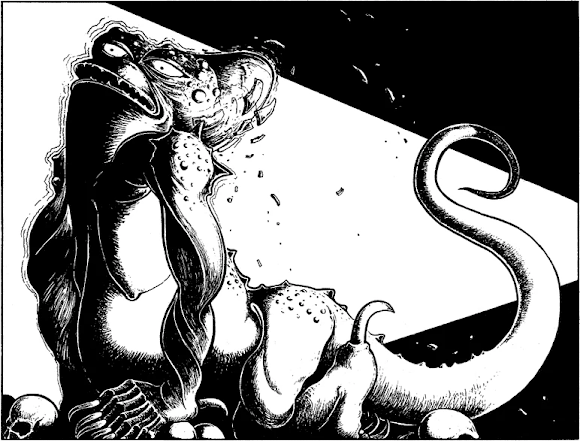
Lactate of Great Mother Vore.

The Dakomyd. Gary Chalk, The Kingdoms of Terror.

Yes, it does sound a bit death metal, doesn't it?

No mechanics. System agnostic. Fit to your system/setting. Black Milk and Black Ichor have canon status elsewhere, but don't you worry about that.

Odds/evens, Great Mother Vore is a physical entity you can encounter/ a symbolic phenomenon.

Odds/evens, the Lactate is only effective from the source (breaking down if exposed to the air/taken away)/ can be stored and distributed.

Roll d6:

  1. Black Milk: a powerful mutagen - blessing to some, corruption to others.
  2. Black Ichor: as you undertake your dismal delves thereafter, you are compelled to whisper thanks and imprecations to the Mother.
  3. Yellow Acid: lethal poison - save or die; permanent damage even if save made; burns through flesh and metal, bone and stone somewhat resistant; considered Holy Water.
  4. Amber Oil: soporific, stupefying, highly volatile, highly flammable, addictive.
  5. Ghostmilk: local term for ectoplasm; reacts to magical, psychic and powerful emotional stimuli; capable of possession and being possessed.
  6. Lactate Incarnadine: like no other high you have ever experienced; supercharges aura, body and mind; ultimately destroys mortal vessels - they were not made to contain it.


Saturday, April 10, 2021

Simple Aging For Old School.

It's a bit of a shower thought, but:

Mechanics from recent posts about the hazards of Outer Space and arctic conditions could also be applied to Aging.

Instead of age bands and multiple modifiers (as in D&D, for example), why not just rule that when a player character is significantly 'older' or 'elderly':

  • they must rest twice as often and/or twice as long
  • rates of natural healing are halved
  • optional: saves vs. disease at disadvantage/penalty

This hasn't been tested, but in principle I prefer it to unsoakable permanent Ability Score damage and penalising attack rolls.

Some of this came from mechanics; some from surveying my own decrepit corpus.

Thursday, April 8, 2021

GHOST OF A DEATH WATCH BEETLE - Monster for Old School Fantasy & Horror

From some thoughts I had while reading Monster Manual 2 and thinking about survival horror. Feels a bit of a work in progress and I wish I could find a suitable pic.

By stun, confusion, save, advantage and damage etc, I don't necessarily mean what's in any particular rulebook, but they should be familiar/generic enough terms for this to be system agnostic.

Decide if it's unique or a monster species. Prevention and/or cure of special effects as for your system and setting, or a blessing from the right priest.

  • Armour Class: as leather, scale or plate (your choice)
  • Move: 9 - it can climb walls, cling to ceilings, move through treetops and across webs, but usually just squats in place
  • Hit Dice: 5 (but it's got damage resistance, too)
  • Attacks: 2 (which you can treat as whips) + special
  • Intelligence: it can have Unratable with Neutral (evil) Alignment, which seems to be the default for alien intelligences (at least in AD&D MM2) - it's probably immune to charm.
It looks like a tarpaulin has been thrown over a squatting or cross-legged figure, and the tarpaulin has been festooned in rubbish and old bits of tree. Mushrooms sprout here and there, amongst the mosses and slime moulds. It rarely looks out of place or out of the ordinary.

When it shifts position - which it does so only seldom and slightly - a hint of its hidden form might peek out from beneath the debris - glistening chitinous claw, slender antennae, wan submarine glow of featureless orb, hairy tips of dozens of bony feet. The tarp is not a tarp but a skirt of tough fungus.

The Ghost of a Death Watch Beetle can only be harmed by magic, silver weapons and fire. It takes only 1 hit plus any magic bonus from weapons, and only 1 hit per damage die from fire because it is so wet and slimy (it does not always appear so due to a clinging layer of dust, debris and powdery spores).

It cannot see but can sense all movement around it (to 120', if you're measuring), and when it does it will start to click quietly - so quietly you'll need to roll Hear Noise to detect it with only 10% chance of pinpointing the source.

After 2 rounds, save or suffer Fatigue. It's audible as background noise, like the ticking of a clock or a Geiger counter.

After 4 rounds, save or suffer confusion. By now you can hear it all around you, nearly impossible to pinpoint the source (only 10%, and a critical fumble means you blunder straight into it's clutches, automatically surprised).

After 6 rounds, it's booming and cracking and tolling like a catastrophe - Morale and Loyalty Checks for everyone who has to make them. No communication is possible - even mind-to-mind requires both parties to do nothing else but concentrate on doing so. Spell casting is at disadvantage, however you rule that (chance of failure, mishap, corruption, cost in energy is increased etc).

The clicking abruptly ceases on the 7th round and everyone still in range must save or be inflicted with the Quivering Palm - in 5 days, anyone who succumbs will suddenly and gruesomely vibrate to death. Up until then, they will seem to have a slightly fuzzy outline, a metallic timbre to their voice and mild delusional parasitosis - they don't feel the cold as much, either (advantage to saves, reduction to damage).

The Ghost of a Death Watch Beetle is stunned by exposure to light, delaying or interrupting its clicking for 1-6 rounds depending on the brightness. Being exposed to daylight prevents it clicking at all until it has retreated into the darkness to recover.

Anything that gets close enough will be attacked with two long and slender fishing rod-like antennae that shoot from beneath (or through holes in) the tarp. These drain 2 Dexterity per hit by otherworldly chill (or use an alternative - even classic Energy Drain), and on a natural 20 whip around the throat of a victim and strangle for automatic damage - use your preferred mechanic for this (there are plenty). Treat the antennae as actual whips if you prefer.

Living beings reduced to 0 Dexterity (or slain) are released, having become the shambling servants of the Ghost of a Death Watch Beetle. They are will-less zombies and can only attack by strangling (again, use a preferred method). Servitors also produce a clicking noise not unlike that of the Ghost itself, though only causing confusion at most and over turns, not rounds - penalise saves for multiple clickers. Multiple clicking servitors makes it even harder to locate the Ghost.

All Ghost servitors will eventually die of natural causes, but will survive as some kind of fungoid undead until they rot to uselessness or are completely colonised. Fungoid monsters will associate with the Ghost, and there is communication between them.

The Ghost of a Death Watch Beetle is neither undead, nor arthropod, nor plant - but speak with dead and speak with plants allow communication, though there is still the gulf of incomprehension between minds so alien to each other. It can sometimes speak through its servitors.

If slain, it collapses into a pile of fungus-infested rubbish and liquefying slime, but will reform in a week if not exorcised - it can also be destroyed for good by spells such as dismissal, plane shift and dispel evil. 

The Ghost of a Death Watch Beetle and its servitors are unable to cross a protection from evil circle.


Monday, March 29, 2021

"First Goddamn Week Of Winter..." - Snow-Bound.

Misery (1990).

This is entirely intended to be used for survival scenarios - it might not be suitable for ongoing, in-game weather.

It's a blunt instrument that treats a night in the desert the same as a season at McMurdo Sound or an hour on the frozen lake around Satan's genitals or a bad day on the mountainside.

Unspecified variables of shelter, clothing, equipment and morale-sapping accident can adjust dice rolls, damage suffered, time needed to recover etc.

Gaming terms are generic - disadvantage could mean roll-twice-keep-worst or a penalty to the roll; saves are actual saving throws or relevant ability checks; 'Classic Six' Ability Scores should be easy enough to interpret; same for 'proper' names of conditions and spells.

My starting point was 1e AD&D Wilderness Survival Guide, but that's heavy on the tables, the variables and the Fahrenheit. It's there if you want it. Working on the Outer Space hazards gave me some ideas that I've applied here.

As an option, Hypothermia (or just being cold enough) or being in a Whiteout could be Altered States, if that sort of thing is part of your game.

Cold Conditions - An Easy Way.

Fold everything in together and abstract it as follows.

When it's cold, you take 1 (or more) temporary damage to CON, DEX and WIS every time you fail a save - and you make a save every time unit you spend in those conditions, with adjustments to the roll for wearing the proper clothes, or being soaked to the skin, or being a bare-chested barbarian.

The frequency of the save determines the severity of the cold: shorter time between saves is worse.

If any Ability Score hits 0, you collapse and take d6 hits per time unit until you are rescued or you die. 

Ability Scores recover at a rate of 1/hour in warmth and shelter.

(You could also mod this for hot conditions - temporary damage to DEX, INT and STR, and recovery requires shade and water)

Cold Conditions - Further Elaboration.

Severity is based on the length of the time units that trigger a save or are counted against your CON (or fraction of CON).

Failing a save or hitting the limit means you suffer harm: -1, -3 then -6 to STR, CON and DEX (does not stack).

Ability Scores recover at 1/hour in warmth and shelter.

Hypothermia.

If you fail 3 cold saves in a row or hit a pre-determined CON threshold, you will begin suffering from Hypothermia.

For each time unit you suffer Hypothermia, you advance levels of harm:

  • Disadvantage on attacks and manipulation (or -2 attack penalty).
  • Move rate halved, always lose Initiative, disadvantage on movements and manoeuvres (or slowed).
  • Disoriented, disadvantage on CHA, INT and WIS (or confusion).
  • Save per time unit or pass out (or damage per time unit).
  • Save per time unit or die (or damage per time unit).

Recovery is at the rate of 1 hour per level of harm once you're out of danger - regaining Ability Scores can stack with this if you're being properly looked after, otherwise it all happens in reverse order.

(This only slightly modified subsystem has been cheerfully pillaged from Leicester's Ramble because Vance's is better than the one I was trying to construct from the Wilderness Survival Guide)

Frostbite.

Hypothermia and Frostbite do not necessarily go together, but you can use the 3 failed saves in a row or CON threshold methods to determine when Frostbite sets in (or model it after chill metal). 

Frostbite has three stages:

  • Painful: disadvantage on attacks and manipulation if it's your hands; half move and disadvantage on movements and manoeuvres if it's your feet; treat in 2 turns or it becomes Severe.
  • Severe (Numb): take non-lethal hit point damage; treat in 2 turns or it becomes Permanent.
  • Permanent: take lethal hit point damage and you lose the body part. Risk of infection doubled until treated, plus new parts of the body are exposed.

Base hp damage on the severity of the cold and the size of the body part.

Timely treatment stops harm advancing. Recovery is 3 turns of proper treatment per level of harm, but that's not going to bring your nose back.

Snow Glare/ Snow Blindness.

When subjected to Snow Glare without eye-protection, it's like you are trying to avoid a gaze attack - apply the appropriate penalties (you at -1 to hit, enemy at +2 to hit you and no DEX, if you don't have something already).

You might still have to take the penalties even with eye protection, as it could obscure your vision in an equivalent manner, but at least you won't have to make a save every time unit (again, the shorter the more severe) or suffer Snow Blindness.

Snow Blindness means you are Blind, but you recover in exploding d6 hours once you are no longer exposed to the glare. Proper rest and treatment can reduce this to exploding d6 turns.

Blizzards.

Chances of getting lost are rolled with disadvantage or are rolled twice as often. You must also rest twice as often or twice as long, and you can only move at half rate.

Encounter distance is reduced to minimum. Surprise chances are doubled.

For melee and missile attacks, it's as if you are trying to avoid a gaze attack - apply the appropriate penalties. Missile attacks are at disadvantage (option for crossbows and firearms to be the exception).

In a Whiteout, it's as if everything is invisible and everyone is Blind. Save vs. confusion every time unit you attempt to do anything other than hunker down and wait it out.

30 Days of Night (2007).

Other People's Stuff.

These are self-contained systems I've mentioned before, but can be bolted onto any scenario with similar winter survival concerns - as alternative or supplement.

There's Something in the Ice.

Electricity and Heat in your base is yes/no - for each day you don't have Heat, you take damage or an Injury. Every time you take an Injury, roll over your total on 2d6 or you die.

(Food and Water is counted in units per person per day, with the same result if you go without)

Do Not Let Us Die in the Dark Night of This Cold Winter.

Cold vs. Fuel, measured as units, and Fuel is consumed even if there isn't enough to beat the Cold.

Someone dies every game turn (could be a day, could be a week) when Cold beats Fuel - or you could have a death with no Fuel, but with not enough a person gets Sick.

(Also covers Hungry? vs. Food and Sick? vs. Medicine, but it's only the NPCs that suffer in this mini-game)