Showing posts with label other people's stuff. Show all posts

Thursday, April 28, 2022

Other People's Stuff - Secret Jackalope 2022 & Giallo/Horror BX & Slush Piles & Iconoclastic Flow.

Secret Jackalope 2022 - Doomed and Saved, out on the Ice.

As well as being paired to write a response to a Secret Jackalope prompt, someone else was paired with mine: Mechanics/subsystems for isolation/loneliness, incorporating fantasy/horror/sci-fi inflected Third Man Factor/Syndrome.

This is/was Wyatt over at TBD: Tabletop, Books, and Dinner, who came up with some mechanics for manifesting and being aided by the Third Man - the presence sometimes reported by wanderers in the cold wastes and lofty places. Well worth a look. Thanks, Wyatt.

And below Wyatt's notification to me on the OSR Discord was this gem from the Foreign Planets blog (also a Secret Jackalope response) - Doomed Expeditions to Dread Hyperborea. Those cold wastes and lofty places I mentioned? They're one of my favourite settings, especially when you mix in an (un)healthy dose of fantasy, horror and sci fi.

(Also check out the likely discontinued Black City Project over at Dreams in the Lich House - it's from years back, but it was a more recent discovery for me)

The Erotic Art of Slaughterhouses.

I clicked through in the context of BX, giallo and survival horror, and was pretty happy with what I found. A new to 2022 blog, last updated in March.

I'm recommending this content with full awareness of possible non-neutral reaction to their Cool Shit From Other People - it's up to you to decide how powerful Hitler's jumper is. 

Anyway.

Iconic Clothing & Pocket Contents:

Two d50's worth of stuff for characters in giallo/survival horror games with the clothing and the random junk giving clues to your abilities/identity/situation. I like these like I like the uniform patches in Mothership.

With expansion up to 100 in the comments.

XP for BX/CoC hybrid:

A good alternative to the blood-and-gold method of BX, with no points for killing but some for encountering new monsters and saving people.

There is a legacy of XP=GP in that you'll get the worth of any eldritch artefacts you recover.

Some reference to Lovecraft's stories for illustration.

Improvised Weapons & an Improvised System:

d50 (expanded to 100 in the comments) things you can try and fight back with when trapped in the mansion with the murderous and mysterious. 

Includes 'Sliding Door'. Everything has a 1-4 on d6 chance of breaking when used for violence.

Plus the bare bones of a BX/LotFP hack for amnesiacs trapped in a mansion. Character special abilities boiled down to a bonus on related rolls, based on simple tags eg. Track Star, Camping Enthusiast. 

Personally, I would relate these to the Iconic Clothing and Pocket Contents you roll up at the start and - as you're amnesiacs - you don't have to decide on your tags at chargen. Being the master of unlocking in advance is all very well, only to be faced with nothing but broken-down doors and barricades.

Inspiration and Links.

A slush pile posting at Archons March On. This is the latest in a series and is dense with ideas and inspiration.

There are a number of people out there in the blogosphere doing these. Good. Be generous with your ideas, because maybe you don't have the time to deal with them and someone else might come up with something better than you imagined/exactly what you were dreaming of. The OSR blogosphere is a rich resource and you should tap it often. Cite and thank your sources when and where you can, and don't get too hung up on someone else already having had your ideas.

Also in this vein, check out Seed of Worlds for Slush Piles and TTRPG blog link compilations. They also post the r/osr blogroll every Sunday (within reason), which is always good to check in on.

New Blog - Iconoclastic Flow.

Contributors to a new collaborative blog just peeping out of the interpipes like sapient mercury: Max of Weird and Wonderful Worlds, Semiurge of Archons March On (already linked above), Spwack of Slight Adjustments, Sibylla of Devil Devil Devil, and Sofinho of Alone in the Labyrinth, Jones Smith of Was It Likely? and some more I'm less familiar with.

Nowt to do with me, chum, but I like a lot of their stuff, so it's probably worth keeping an eye on.


Wednesday, December 22, 2021

The Black Flask

It turns out that the recipe isn't symbolic, but absolutely literal.

A basic alchemical distillation from a very old recipe. Widespread throughout texts and traditions, it is believed to be a necessary step on the quest to extend life and cheat death. It appears to be an opaque black liquid with the consistency of milk. It tastes inky and metallic, and remains cooler than room temperature.

Once the Dark Sun has risen on the Astral Plane, quaffing from the Black Flask (which does not detect as magic) has the following effects:

First Dose: For 10 minutes (1 turn), you are under the effect of a blur spell. This is does not detect as magic.

Second Dose: For 10 minutes (1 turn), all damage you give and receive is halved but you get an extra attack as your shadow takes on some of your substance and volition. This does not detect as magic.

You must make a Powers Check.

Third Dose: You dematerialise/turn Ethereal and everything held/worn drops to the floor. You can only detected by those in a similar state or by true seeing. Those with second sight will be aware of your presence, but no more.

For 30 minutes (3 turns), you are naked, insubstantial, invisible and unable to interact with the material world, but free do what you can/wish in your new state. You are apparent to any other entities in a similar state, native or otherwise.

You can feel the pull of the Dark Sun even if you do not recognise it. You perceive shadows and reflective surfaces on the material plane as absolute liquid darkness, in contrast to the hazy greys of everything else.

You must make a Powers Check, remaining immaterial if you fail.


Until such time as the Dark Sun rises on the Astral Plane, the Black Flask is merely an otherwise hollow ritual of alchemical research with the following effects:

Obtaining the Black Flask: researching and creating the Black Flask requires a Powers Check, and the resulting potion detects as magical.

Taking a Dose: Save or be nauseated for d6 x10 minutes (not cumulative with further doses).

You experience the effects above as standard drug-based hallucinations and come away disappointed, or determined to try again. 

You are in an Altered State for the durations given above (no save). 

During this time, you will have the sense of being stared at by invisible and/or astral/ethereal creatures, if any happen to be present. Astral/ethereal creatures can be confident that you cannot actually see them; those in the material world might believe they have been detected.


Commentary.

All credit for the original to u/the_pint_is_the_bowl, posting in r/DnDBehindTheScreen.

Powers Checks are from Ravenloft (2e AD&D setting), specifically the Masque of the Red Death supplement. 

I've got a particular setting in mind for this, and the original slotted straight in like there was already a space for it.


Monday, November 22, 2021

Helm and Shield for the Unarmoured Old School Fighter (D&D adjacent)

Bearing in mind cavalier attitudes to encumbrance mechanics, this is the common-or-garden 1st level Fighter in the D&D I started out with:

Plate and Shield AC +7
(Citadel D&D Adventurers set/Lost Minis wiki)

Until magic items get into the mix, there is no reason not to load up like this: plate and shield is just better than chain and no shield.  And probably one of the reasons why it has been said that every Human Fighter is/was the same.

Shield AC +1
(Citadel D&D Adventurers set/Lost Minis wiki)

Mechanically, there's no reason to play the Unarmoured Fighter or even to give them a helmet in some of the older editions - except for an exceptionally bad starting gold roll, or after an encounter with one of the equipment-destroying monsters. But this Fighter-type is, I think, an iconic/important archetype/figure in the fiction and was poorly supported by the game.

(I know the Unarmoured DEX Fighter comes into their own and then goes beyond in later editions (3e onwards?), but I'm still living in a past when Clerics were Clumsy and Thieves were Foolish)

Shields.

I owe an awful lot to this post I stumbled on via an OSR Facebook group.

It covers (the now venerable) Shields Will Be Splintered, but my main takeaway was from Wolves of God: shields give you significant AC bonus, but don't stack with worn armour

So, I'll offer three shields following the basic/classic AC scale, with cost and weight half that of the equivalent armour. There’s even room for a buckler/parrying dagger at +1 AC (cost and weight of a shortsword?).

Materials and designs as you see fit. Pay extra for mods like horns or spikes. Still can be splintered. Shield bash like a club or subdual strike. 

Whether as a Fighter benefit or so it's not just an either/or choice, +1 AC for having a shield when using armour that's the same or better.

Maybe there shouldn't be an AC +6 shield so that plate mail remains The Best. This is better than full cover in a number of D&D adjacents, and might be better applied to static (or semi-static) shields like the pavise or mantlet. Or you need a trained shieldbearer to wield it two-handed on your behalf.

With shields having many more ‘points’ in them and possibly scaling to 6, there’s room for doing something with them if you want that sweet further complexity. Like, they can suffer attrition until they are broken or repaired - WFRP rimless shields were only good for one adventure. Or the AC value is also a save vs. shield-breaking attacks, or the threshold for triggering a usage die.

Gary Chalk for Talisman.

Helmets.

In lots of D&D adjacents, the helmet is more something that you lose for a penalty than possess for its defensive value, which seems to do it a disservice. After all, it's one of the pieces of armour kit that has survived into the modern era. 

I believe (as in "I heard or read it somewhere") that the (re)introduction of the helmet into the British (?) army led to a rise in recorded head-injuries, as soldiers survived previously fatal wounds. Like with that diagram of the bullet holes in the aeroplane.

Tucked away in the 1e AD&D DMG is the information that, if you're not wearing a helmet, there's a 1 on d6 chance of attacks going for the unarmoured head and being made vs. unarmoured AC (don't think it specifies whether or not you get your DEX adjustment). This feels like a spot ruling that made it into the rules (d6 would break down into a basic hit location roll of head, torso, each arms, each leg) and feels a bit clunky.

Instead, use the 1 in d6 as a save vs. critical hits (thank you, abstract combat and hit points). I don’t think this is game breaking, and makes it worth wearing one if you can’t afford full armour. 

(Yes, not all systems use crits, but it's one of those houserules that was so instinctive a lot of us thought it was written down somewhere. I can't remember ever not using it)

This x-in-x save vs. crit/fatality can also be used for pocket Bibles, a locket from your beloved, silver cigarette cases and so on, if you like.

Commentary.

Does this mean everyone in a suit of chain or plate (my assumption is that leather doesn't come with a metal helmet) gets a save vs. crit? 

My intention was to make helmets mean something by themselves, rather than give all armour a boost, and I was coming at it from the perspective of a low armour setting where people don't go around in full battle dress day-to-day.

In Dragonwarriors, wielding a shield in combat gave a 1 on d6 saving throw. There was no guidance on whether shields were class specific, how many blocks per round they could do, nor if they were effective vs. crits (in DW, crits auto-penetrate armour). Magical shields gave you a Defence bonus rather than improved the save, and a little reading around suggests that the d6 save was often forgotten at the table or houseruled as a Defence bonus (so back to +1 AC for a shield).

A feature of the older editions of Talisman and Warhammer that I'm familiar with: roll d6 to save your life.

Which is why I've labelled this post BOSR.

DW makes the shield different in execution to worn armour and to normal combat defence, and I like that mechanical diversity for its own sake.

I've seen (in passing, over years, so not sure where or when) other options for unarmoured Fighters, such as allowing them to use a STR or CHA modifier to their AC (in addition to DEX and shield), representing the bare-chested barbarian/chainmail bikini end of the fiction.


Tuesday, March 23, 2021

Other People's Stuff - FKR Challenge & Monster Horror Show.

CW: nostalgic digression.

I accepted Jim Parkin's Design Challenge over at d66 Classless Kobolds, and it turned out to be a great way to think and make. Link to my attempt - I'm planning use this template in future to put stuff together when I can't yet see the whole of it.

My favourite I've seen so far is this one based on The Terror.

I could see it being turned into a full-on mini-campaign with optional additions from There's Something In The Ice and/or Do Not Let Us Die In The Dark Night Of This Cold Winter. Both of these are system minimal/ system agnostic enough that they're already FKR adjacent.

I've only been dimly aware of FKR up till now, but the system agnosticism strongly appeals to me - as well as the random tables that are part of these world-building exercises. Apparently, this is how Traveller was played BITD - so I'm sorry that I never took a proper look at it in my formative years.

Talking of formative years, FKR also puts me in mind of Monster Horror Show (which I'd love to be able to look at again, but not so much that I'm going to drop £312.17 on it).

I think I paid about 15-20 quid for a copy of Maelstrom the other year, but interest and nostalgia have their limits - and mine is a lot lower than £300.

MHS provides you with rules and monsters and spells and magic items and then says that you don't actually need any of that to run a game - you can use the Absolutely Anything Table instead. Just decide on a difficulty/likelihood for the action/situation and roll the dice - a universal mechanic using d6.

I think it even goes on to say that you don't even need to use the table, just make a judgment. Seems at least FKR adjacent.

IIRC, the included adventure is a werewolf mystery with a dungeon that (a possible false memory, I'll admit) changed depending on whether it was day or night when you went in. It had a large NPC cast, and I think the werewolf's identity was undecided at the start. I remember there being little guidance, but a sense of social space beyond The Dungeon.


Friday, March 19, 2021

Race-as-Class: Normal Human for Old School.

Jennifer Connelly as Sarah in Labyrinth (1986).
Same as illustrates the original Noncombatant class.

This class owes a massive debt to the Noncombatant BX character class at Against the Wicked City, of which it's largely a recapitulation, with some adjustments. Theirs fits on a page, mine spills over the edges and slops onto the floor.

The Normal Human only exists in opposition/relation to The Adventure and the adventuring classes, and their special abilities will sometimes be neutralised by genre conventions and/or in-game realism.

I've tagged this as 'survival horror' because it's part of a process, but as presented this class might be lighter-hearted than the genre demands. Cut off anything that offends you herein.

Description: A Normal Human, about to cross from the mundane world to the extraordinary. 

Hopefully this is going to be a once-in-a-lifetime experience and you'll make it home. Or you might die.

Attacks: As Normal Human.

Hit Dice: If Strength and Constitution are both 13+, use a d8; if both are 6 or less, use d4. Otherwise, use d6.

Child characters always use d4, no matter how high or low their Ability Scores are. A child character can be up to three individuals, run by the same player - they each get their own HD.

You count as having a full HD against a Fighter's multiple attacks vs. low-level monsters.

Saving Throws: As Normal Human.

XP: As a Thief n/a, you're a Normal Human.

Prime Requisite: Intelligence or Charisma, but you have to randomise - life is unfair. n/a

Armour: Any, but all the Ability Score and encumbrance restrictions, penalties for bulk/weight and fatigue rules for wearing armour that you normally handwave in your game should be applied rigorously. Introduce some if there aren't any, or don't worry about it.

Weapons: Any. You could even be skilled or specialised.

Alignment Restrictions: None.

Special Abilities.

Aging: Between adventures/experiences, your character can Age. They can skip ahead, but not back. 

Children - friends or siblings - can grow apart or remain together, but once they reach adulthood must become characters in their own right.

Adjust Ability Scores (and possibly HD) as appropriate.

Implied Abilities: Roll checks at advantage/with a bonus if they relate to your personal expertise/ experience, and you don't need to roll if it's a routine task.

Really, all characters have these, not just Normal Humans - character class is not necessarily your job, your living, or even your dream. 

Select or randomly generate a suite of possibilities based on failed/previous careers, education, background/backstory, culture, social standing and personal interests. 

Luck: If not already being used as a supplemental Ability Score, Normal Humans possess Luck as a class ability - it can only be used during adventures and has no impact on their mundane life.

Misery/Morale: If you're using this subsystem (or similar), Normal Humans start out with 0 Misery.

Normal Humans can start with 2 Misery if this is appropriate to the character, but it's not mechanically advantageous.

Once per adventure/day, you can choose to reroll a failed Misery/Morale check (or fear save or SAN roll); if you prefer, you can choose to reroll a failed death or mind-control save instead.

Arthur Dent - Hitchhikers Guide to the Galaxy.
It's funny because his homeworld was destroyed and it turned out it was just an island of ignorance anyway.

Mostly Harmless/ Not A Threat: As long as you have caused no damage, you are not considered a credible threat and enemies will attack your companions for preference - you are still vulnerable to indirect and area of effect attacks.

You get +4 to your attack and damage rolls, but once you inflict damage you become a credible threat and lose the bonus.

Assist: Narratively, you make a vital (though possibly accidental) contribution to an ally’s attack; mechanically, you roll an extra attack for your ally at +2 to Hit/damage (or with advantage, if you prefer).

This will not make you seem a credible threat, and can be used once per adventure/day.

Duck For Cover: Once per adventure/day, you can turn a hit against you into a miss. You can decide after the roll is made, but before damage is determined.
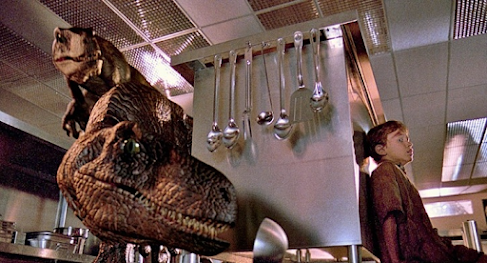
Joseph Mazello as Tim in Jurassic Park (1993).

Hiding/ Inconspicuous: By staying put and keeping quiet, you are able to hide from pursuit/ avoid discovery. Roll d6, on a 1-2 you avoided the immediate danger and can attempt to move to a new hiding place - otherwise, stay put and put your trust in the dice and the narrative.

Roll again if the searchers persist or attempt to trick you. Three successes in a row means they move on, believing you have escaped or that there was nothing there in the first place. 

Three 'fails' in a row means that they have closed in and have you right where they want you.

Knock Out: Usually done with an improvised weapon close at hand - vase of flowers, bottle of wine, decorative lamp, pot plant, skull, Mother's ashes - which breaks in the process, but can be a weapon or bare hands.

You attack from behind - your target must save or be KO'd for d6 rounds. Ignores helmets, unless that helmet is plot armour.

Can be done because you are stealthy, or because you are Mostly Harmless/ Not A Threat. Normally only possible once per encounter, if you are spotted.

Ashley Laurence as Kirsty in Hellraiser (1987).

Whoa!/ Listen!/ Wait!: +1 Reaction Roll as long as no blood has been shed - not being perceived as a credible threat (so it doesn't work if you are) means you have a better chance of defusing tense situations. Stacks with Charisma.

Works across language and species barriers, but doesn't allow more than very basic communication in this case. Doesn't work on other Normal Humans.

Hold It!: A non-magical command or mass command effect that pauses the actors on the stage long enough to get a dia/monologue going. While it will halt proceedings for a minimum of 1 round, it cannot really be used for anything other than opening communications.

Completely optional because some people have strong opinions about this kind of 4th wall-breaking metagame genre awareness.

In-game characters like Deadpool (ffs) and (my version of) Anthraxus the Decayed are the only ones that will recognise that this is anything other than a natural lull in the action, but it affects them just the same. 

Once per adventure, specifically.

Take The Bullet: Once per encounter, a companion can 'take the bullet' to save you, though they aren't compelled to.

If an attack or effect will take you to 0 hp or less, a companion can suffer the damage instead.

Taken Prisoner/ Left for Dead: If you surrender, you will be taken prisoner by enemies, but your bonds will be loose enough that you can wriggle free in d6 hours.

If taken to 0 hp or otherwise knocked out of combat, you will be left for dead without further confirmation and will come to d6 hours later. 

One or the other, once per adventure, and no guarantee your adventurer companions are treated the same.

Adventuring.

You're not an adventurer - you're a Normal Human who's stumbled into another world you did not know existed/ did not acknowledge. You're frequently the only one of your type in an adventuring party, though you may be the figure the party has formed around. 

Most of your special abilities only exist in relation to The Adventure (however that is defined), so cannot be used in your mundane life, and your lack of an advancement scheme means that all you take from an adventure is memories and all you bring is yourself.

When more than one Normal Human PC is involved in an adventure, they must share special abilities. They can cooperate to use them as a unit (if that makes sense in-game), or using an ability closes it off to the other(s) until it refreshes - roll dice, draw cards or rock-paper-scissors for dominance if there's a disagreement. 

  • Luck: shared as a single Ability Score between multiple Normal Humans in a party, but the individuals can use it as they wish - it is only the 'stock' that is communal.
  • Implied Abilities: always belong to the individual.
  • Mostly Harmless/ Not A Threat: the group benefits, but only needs one of them to all lose it. Exception: treat multiple child characters as individuals, even if run as a single character.
  • Take the Bullet: Normal Humans can do this for each other, if they like.
  • Taken Prisoner/ Left For Dead: what happens to one, happens to the others.

Advancement/ Experience.

Normal Humans aren't really meant to advance - to do so would mean they were adventurers in the proper sense - as they're usually just happy to get back home alive.

The original Noncombatant class advances with XP, and gets more uses of certain special abilities, as well as the usual advances for saves, hit points and attacks.

Something like the X System (which also features as the advance system in PARIAH) should work, as it allows for some mechanical growth without making the character too strongly smell of a class. It's a way of advancing like in Call of Cthulhu but without using percentiles.

Or use XP as a kind of currency (my unoriginal suggestion for Basic 1), so the Normal Human can come to a second adventure a little better prepared.

Alternatives.

The Everyman/woman and True Innocent classes from Ghastly Affair would also suffice for Normal Human characters, and there wouldn't need to be any competition over special ability use. Strictly speaking, though, they wouldn't be Normal Humans (especially if they are able to gain levels).

The True Innocent, being an archetype from Gothic fiction, is closer in spirit to the Normal Human than the Everyman/woman or Tradesperson (below).

AD&D 2e Ravenloft supplement, The Masque of the Red Death, includes classes as approximations of the Cleric, Fighter, Magic User and Thief for 19th-century Gothic horror adventures. 

The Tradesperson (Thief) class is closest to a Normal Human - again, allowing them to gain levels makes them something other. As an option, all character kits in the ruleset could be options for the Tradesperson - it's not going to upset things significantly.

Examples.

You probably already get where I'm coming from, but let's hammer it a bit more. These are the kind of people I'm thinking of when I think of Normal Humans. Some of these are more adventurous than the others, and some are going through a funnel*:

  • Miss Marple, Jessica Fletcher, Poirot (it might actually be their irregular sidekicks who are the Normal Humans, not them).
  • Sarah Williams.
  • Kirsty Cotton, Nancy Thompson, Laurie Strode, Sidney Prescott (not all Final Girls are Normal Humans, and sometimes they're going through a funnel anyway). 
  • Lex and Tim Murphy, the Baudelaire siblings, Newt.
  • Peter aka Sugarbear. 
  • Bilbo and the LOTR Hobbits, though they're going through a funnel to become... Halflings (Sam's a Cleric).
  • Jonathan Harker.
  • Mina Murray/Harker (in Dracula and the earlier League of Extraordinary Gentlemen comics - not the film!)
  • Xander Harris, Cordelia Chase, The Wishverse White Hats.
  • Ferdinand Lyle (Penny Dreadful - Sir Malcolm and Victor Frankenstein are edge cases, but could at least be Tradespersons with the Explorer and Physician kit, respectively - or straight Ghastly Affair characters).
  • Mystery Incorporated (Velma and Daphne in particular are edge cases, depending on the iteration).
  • Arthur Dent, most of Dr. Who's Companions.
  • Sarah Connor, Ellen Ripley (definitely going through a funnel).
  • Abbot and Costello (I've got an idea that I've seen something like a Bumbling Comedy Duo class somewhere...)
  • Billy Peltzer, Marty McFly.
  • All versions of the Ghostbusters, film and cartoon (though they don't have a mundane life to go back to, unless they quit).
  • The Goonies.
  • Harry Mason, James Sutherland, Heather Mason.
  • You. Me.
*I've not played or read DCC, so hope I'm using this in a way that makes sense.


Sunday, February 21, 2021

Other People's Stuff - Survivor Levelling & Hit Dice vs. Damage.

Two things that I encountered this week that I liked/gave me food for thought.

Survivor Levelling.

On Twitter, Claytonian (of the Kill It With Fire! blog) shared the latest version of their A Carcosan Hack this week, and I was taken with this little house-rule gem from the advancement subsystem: 

'To be honest, we just adopted a system where if a PC dies the other PCs level up'

I really like this idea, either as addition/ alternative to XP counting and/or milestone advancement. It makes a narrative sense I find pleasing, as well as encouraging both risky and cautious play.

Claytonian says that the obvious PvP exploit hasn't been a problem in play.

Has anyone else used something similar, or are there published games that took this route?

HD vs. Damage.

Doing a little searching for whale and whaling related gaming material brought me to this post from 2016 (the blog has not been updated since 2018). 

To quote the author: 

for those new to Dungeons and Dragons terminology, “Hit Dice” – often abbreviated HD – are an abstract representation of toughness and fighting skill. when a Player or Monster is injured in Dungeons and Dragons, the attacker rolls an appropriate number of dice for damage – tougher fighters and graver injuries call for more dice or dice of larger size (a 12 sided dice, instead of a 6 sided dice, for example). The defender then rolls their Hit Dice, one at a time, until either they have totaled enough to survive the attack, or they have exhausted their pool of Hit Dice and are unable to fight on. [sic & my emphasis]

This is not a method I have encountered before, though I have been thinking about something not unlike it, on and off - see 'Logical Progression from Abstract hp?' (at the end of the post).

It's one of those things that I could have missed completely during rpg hiatus: was this ever a thing in core D&D (any edition)? Is it a house-rule or a mis-interpretation? Does it come from the assumptions of a different gateway system that D&D?