Tuesday, January 24, 2023

DMR2 Creature Catalog - S (Part 1): Saberclaw to Slime Worm + Sacrol

Occasional and non-affiliated reminder to check out the Monster Man podcast (and/or support on Patreon), because monsters are great. I started years late so I'm only up to D in Monster Manual II (3rd season), but looking forward to eventually catching up to a look at the CC (whether AC9 or DMR2 edition) and seeing where thoughts con/diverge, and hoping for some segments of surprise.

A typically extensive S section, which I've split it into two for easier digestion.

Saberclaw.

You are faced with a monster. It has 500 hit points, 20 attacks at 1d12 a go, immune to 1st to 3rd level spells (and saving as a 100th level Fighter, if such a thing could be) as well as poison. Luckily (?), it only attacks as a 5 HD foe, but it does get +4 to hit because of limited telepathic ability.

Oh, and sometimes there might be 5 of them. And they can see invisible, ethereal and hidden creatures and objects with truesight.

Mechanically, that's the Saberclaw (Sabreclaw in AC9). Intelligence of 2. If that was all you had to go with, you'd be thinking maybe something from the first printing of Deities & Demigods.
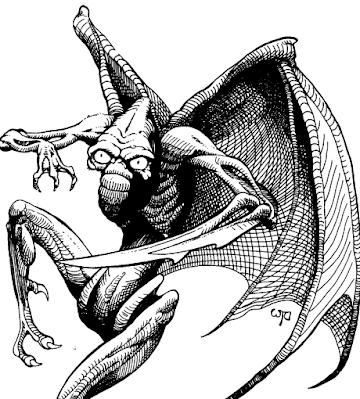
Doug Watson forgetting to make it hairy for its appearance in CM3 Sabre River. 
It makes more sense knowing it appeared in a Companion level adventure.

Narratively, it's a nasty greasy hairy winged monster (conjured from befouled waters) with a large bone extension that resembles a sword on its right arm - y'know, a scimitar talon, a rapier nail, a katana paw, something like that. 

Number Appearing is d100, and they're sub-divided into wings of 1-20. Each wing shares total hp of (25 x the number of Sabreclaws), with the complication that no individual dies until all those hp have been depleted. They save as Fighters of level x5 the members of the wing.

Anyone faced/used them in a game (CM3 or DIY)? How did that play out?

2e tidies them up for 2e, but that's about it. They can carry you off and drop you, and you roll 2d10 rather than d20 for a wing - so they won't be lonely?

Scamille.

This is a Mimic, with a range of Intelligence (1 to 9) and it might be friendly, it might not, because it's a Mimic. It even has the same eavesdrop-and-gossip characteristic.
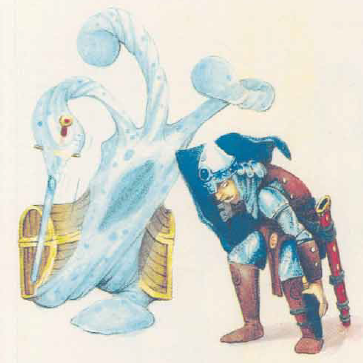
Arnie Swekel even references the chest in 2e, for goodness sake.

Apart from the name and the flat 10 HD, the main difference between CC and MM is that the Scamille get 6 attacks per round (only one of which is sticky) for 3-18 hp each.

Surprisingly, the Scamille makes it to 2e as a monster in its own right, and is a relative of the Ochre Jelly with no stated connection to the Mimic despite it being a Mimic, though with Average (8) Intelligence, not a range.

An odd choice to carry over into 2e. 

Scorpion, Normal.

A 1 hp monster with save-for-half-damage venom; a hazard when searching or a trap vs. looters.

You could use this statblock for any other small venomous creature.

Sea Horse.

The favorite steeds of mermen and tritons. Of course.

Their body is not described beyond being 15' in length, but they have the head of the horse and some are coloured after land-dwelling horses.

They have approximately the same stats as the AD&D MM Sea Horse, Giant, but the description sounds more like a Hippocampus.

Sea Serpent.

Basic and functional; snakes/serpents are an absolute foundation monster IMO. 

Can constrict vessels for hull damage. I like the illo, too.

Serpentweed, Giant.

Flesh-eating plant with d6 stalks, each has 9 HD and a 2d6 bite attack. The name says snakes, but description could suggest Little Shop of Horrors. 

Main body/root is underwater (habitat is swamps etc) and has to be burned (somehow) to kill it, or severed stalks will have grown back in 6 months.

Is there a non-giant Serpentweed? I can't find one, and the plant with that name in the real world isn't anything like this.

Shargugh.

A hairy little elemental/fairy-folk guardian/spirit of the woods. Wield silver daggers or bite you in combat.

Kill it and the 24 mile hex of woodland it is tied to becomes cursed and infertile for a folkloric seven years (unless a Druid casts remove curse - BECMI/RC Druids being Clerics with a few extra spells and restrictions). Equally, should the Shargugh be forced to leave its home, it will sicken and die in one or two days.
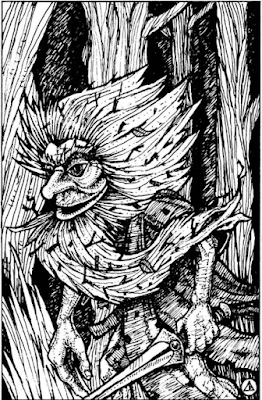
Jez Goodwin, by the looks. #BOSR

Ability to transport via plants in its territory, hide like a Halfling, move silently and pick pockets. Mentions that woodland folk leave it gifts of food and drink to discourage it from robbing them, but I'm not sure if this is elves-and-pixies or charcoal-burners-and-lumberjacks.

No guidance on pronunciation, until 2e (SHAR - guh) plus the italicising of its transport via plants ability to bring it in line with the spell. The usual stuff about family structure and lifecycle.

Shark, Vamora.

Three feet long with 6 HD, they bite and shake you like a terrier does (auto-damage and to Hit penalty).

Is this a fantastic animal or something real statted-up? Quick online search for the name leads me back to gaming material.

It's okay. I'd knock down the HD and use this as a Wolf or olde schoole Call of Cthulhu Ghoul.

Shark-Kin. 

They're not quite the Sahuagin analogue I originally took them to be, but these are scaly, fish-tailed undersea tribal humanoids that have an affinity (and empathic link) with sharks.

Normally fully aquatic and Neutral, they pose their biggest threat to landlubbers when their tribal elder (3 HD leader) dies. At this (over weeks), the Shark-kin sprout legs and their gills adapt to breathing out of water, and they then march ashore to a sacred site where they carry out the ritual that creates a new elder. During this time, they are more aggressive, as they don't want anything upsetting their transformative ritual.

Then they go back to the sea and get rid of those legs. 

2e adds that they're possessive of shipwrecks in their tribal territory, which is a decent adventure complication.

Silver Warrior.

The summoned warriors of the Faedornae. They're invisible and remain so while attacking, with all relevant bonuses/penalties. Wear silver plate armour and wield silver swords +1, but these dissolve along with a slain warrior.

One interpretation of the text is that the usual methods of perceiving the invisible only function for Elves with regard to the Silver Warriors. I would go with this, because I also go with Elves being vulnerable to protection from evil.

They could be styled as elemental conjurations or emanations, as they appear to be formed from the substance of a Shining Isle.

Sirenflower.

For some reason, it's a giant carnivorous fungus masquerading as a giant flower rather than just a giant carnivorous flower. 

Lures using bioluminescence and olfactory mimicry, but this is not a special ability. .

If you enter the plant, it traps you - apparently with no attack roll or saving throw - and you take d4 crushing damage per round and d10 digestive enzyme damage per 10 minute turn. 

Escape by reducing it to 0 hp to represent cutting away all its crushing appendages, which you can even do it trapped (but at penalty, and while losing your own hp). AC as Unarmoured and 5 HD.

Kill it by digging it up and burning the root.
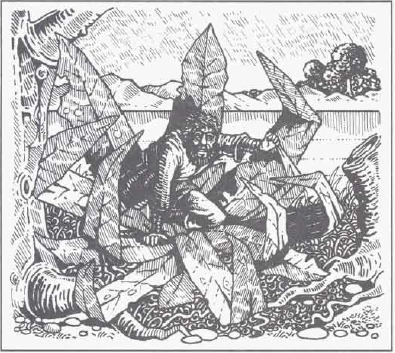

I'm not sure how it's going to threaten player characters unless they make the decision to climb into it, or blunder into it while not taking proper care. The illo seems to hint at some kind of compulsion, but this monster rather feels like a missed opportunity - it's even more of an environmental hazard/trap than many others of its type.

Sis'thik (Desert Scourge).

Lizard folk adapted to extreme desert conditions (eyes and nostrils protected vs. sand storms, heat endurance and low water requirements; they basically get resist fire, too), with a nomadic matriarchal warrior culture. Xytars are their battle mount of choice, and they sometimes join up with Blue Dragons to raid settlements. Shamans (Clerics?) of up to 8th level.

It's specified they want fine wines as part of the tribute they demand of those crossing or hoping to cross their territory. 

2e says they like to eat Copper Dragons.

This is one of the longest entries, if not the longest [edit: no - that's the Hivebrood, at 2 whole pages], in the CC, and the entry for Xytar is supplemental to it. I've read somewhere that they serve as the inspiration/prototype for a later monster or culture; like the Quariks, there's a lot of specific context for a monster that doesn't feature in an adventure or sourcebook.

Skunk. 

Primarily for delivering stinky musk (Charisma is 3 until you get rid of the stench), these come in Normal and Giant varieties.

Reskin as Troglodyte variants.

Slime Worm.

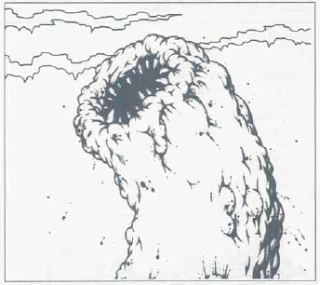
A sparse, mainly mechanical description of this giant slimy/sticky worm that can swallow you whole, and surprises you 1-5 on d6 because it's rolled around in a treasure hoard and now looks like a pile of coins, jewels, weapons and armour.

On the one hand, I like this as adaptive behaviour in the dungeon ecology. On the other, maybe the worm has a different natural habitat with a transferable ability. It feels pretty old school.

2e gives it a limit to how many victims of what size it can swallow and keep doing so, as well as a 15% chance of being recognised for what it is before it has a chance to attack. One reading of the text implies that it doesn't necessarily have to be camouflaged with treasure.

What Was Left Out - Sacrol.

All the angry dead of a particular site collected into the undead form of a big skull cloaked in multi-coloured mist - nothing concrete on size/area. Its attacks using misty tentacles: 2 per round for 1 level energy drain, followed by automatic choking damage (hit points not energy drain). Can animate dead of its original type to do its bidding.
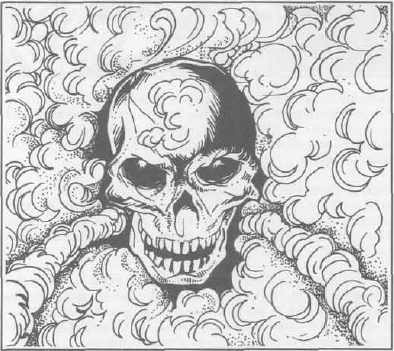
With a bit of tinkering, maybe a lower-level Demilich variant?

2e gives it the upgrade of a slay living shriek. Says it's 4' across - whether it means the skull or the mist, I don't know.

One of the monsters I preferred as a simple stat block in the BECMI Master DM's book because there was more room to imagine it.


Tuesday, January 3, 2023

DMR2 Creature Catalog - P, R: Pachydermion to Roper + Phygorax, Possession, Reflecter.

Pachydermion.

Elephant people. 

Very strong and can triple wield (two swords and a mace in the trunk). Never forget anything (so don't have/need a written culture). Can have spell-casters up to 12th level.

You're probably expected to give them African or Indian cultural trappings depending on where you place them.

Make them shaggy mammoth/mastodon people with spears and axes, or have them as lone sages of a dying race, each sole repository of vast knowledge that would otherwise be lost. 

Or paint them psychedelic and give them psionics, shift them into the astral/ethereal/limbo planes and make them the new analogue for Gith (yanki/zerai, either or both) - I think this has possibilities.

Pegataur.

Winged Elf Centaurs. And that Elf bit is really only for the Fighter/Magic User synergy - these are beefy fellows, though that could be modified if a more delicate image appeals.

As written, they're mercenaries who can be hired by anyone (my emphasis). They need money and respect, and I think that makes them wonderfully, unexpectedly grey for what should so obviously be paragons of goodness - like Gygaxian Cavalier-Paladins.

As they specifically train in BECMI Weapon Mastery they could serve as Chiron-like sponsors/teachers of heroes rather than just spell-casting flying cavalry. Options are longbow, lance, two-handed sword, and mace.

2e eliminates those purely mercenary tendencies by stating that they won't serve evil employers. Making them less interesting.

Phanaton.

Within the context of X1 Isle of Dread, I really like them - hang-gliding halfling-monkey-racoons that team up with Dryads and Treants to fight the Aranea.

Taken from that context, I start to get a more Zoog-y vibe from them, and their 1-1 HD tribal humanoid stats can look more like a Goblin than a Halfling, if you know what I mean. They can definitely sit amongst the other ambivalent 'little people' on the edges of human habitation.

They're Lawful in CC, Chaotic Good in 2e, but I've never met an Alignment I wouldn't cheerfully disregard.

Phantom, Lesser.

Another not-undead that's basically some kind of a ghost. This one's possibly an elemental, because it's made of mist. Feeds on the fear generated by leading you into danger, having taken on a harmless/pathetic appearance and/or used its ability to fly/walk on water to have you follow it into quicksand etc.

Can also turn invisible at will, and cast confusion, hallucinatory terrain and phantasmal force 1/day each. Tries to escape once you pull things together to resist it, but can bash you for d4 hp in extremis.

Unrelated to the BECMI Phantom (high-level undead), or the AD&D monster from MM2.

Because it's a ghost, I like it, and would add its stats and abilities to the suite available for haunting spirits.

Piranha Bird.

Lesser and Greater, both types are always hungry for fresh meat. They're brightly coloured, have infravision and do not like bright sunlight (prefer the dimmest woods and underground) - a perfect lair-share monster for Cynidiceans, I think.

For whatever reason, they're no longer really birds when they transfer to 2e and wouldn't look out of place in Dark Sun because of it.

Flock/swarm mechanic for the Lesser Piranha Bird; similar to that of the Raven & Crow (see below).

Change the Flying Move for Swimming and these also serve as Piranhas.

Polymar.

A non-magical polymorph monster that can change into any creature of up to 10 HD, or any object up to 100 cubic feet. Doesn't get special abilities with the new shape and can be spotted with the same likelihood of noticing a secret door.

Gets three attacks for d6 hp each, apparently unrelated to size, shape or number of extremities. We don't learn what it looks like when not transformed. 

Chaotic alignment, so baddies, but nothing on their habits or motives, so presumably 'just monsters'. One of two variations on the classic Mimic in the CC (see Scamille).

2e makes them telepathic and cooperative with each other, all taking shapes to fill out a scene. They reproduce by fission, and digest organic matter they engulf (including adventurers). A Lawful Neutral alignment adds another dimension to them, and makes me think that they form societies - even covertly living amongst humanoids as their furniture and domestic animals.

The Monster Man podcast links the Polymar to the Protein Polymorph (1e Fiend Folio) via Tom Moldvay as originator. Interestingly, there's also suggestion of it being The Thing (based on the short story rather than the at-the-time yet-to-be-released John Carpenter classic), though the Polymar doesn't have the same in-description malignancy as the Protein Polymorph.

Porcupine, Giant.

Not very different to the one in AD&D. 

It can shoot quills, so you could use the statblock as the basis for a Manticore variant or some sort of Cactus People.

Rakasta.

The Rakasta, as they were presented in X1 Isle of Dread, are an exception to my general indifference to cat-people (characters and monsters) - sabre-tooth tiger mounts and war claws worn over their natural ones. Might be just because they caught me at the right time.

As presented in X1. Good.

Mystaran Samurai Moon Cats and iterations thereafter might have lots of interesting stuff, but that would mean having to make an effort to overcome my mild aversion.

2e gives some details of their special code of honour.

Randara.

An evil being of legendary power

It would appear that the Randara is the BECMI/Mystara stand-in for the AD&D Rakshasa. Name changed because it was (almost) already taken by the Rakasta. 

There's no physical description for the Rakshasa in the MM, but that Trampier image of the pipe-smoking tiger-man was just too iconic. And of the Randara, its true appearance is unknown.

The Randara is approximately twice as powerful as the Rakshasa (HD and damage output), with spells as an 11th level Cleric (Rakshasa gets 3 MU levels and 1 Cleric), plus ESP and non-magical polymorph (Rakshasa uses illusion) at will, and charm person 1/day. It's immune to normal weapons and 1st to 3rd level spells; the Rakshasa gets immunity up to 8th level (meaning it is unaffected by any Cleric spells, I've just realised). Both take only half damage from magic weapons.

The 2e Randara casts its spells as an 11th level caster, which doesn't have much effect on charm person and ESP, and loses its Cleric spells. Is this a mistake corrected from CC or introduced in 2e? 

This later iteration also loses its hefty claw/claw/bite of 2-12 (x2)/3-18, causing damage as appropriate to the form it takes.

2e describes them tracking and researching a suitable member of a society for weeks in order to imitate and replace them, suggesting that their likeness is (near) perfect but mannerisms, habits and knowledge must be practiced diligently.

I'm not entirely sure the slight differences justify getting its own entry in 2e rather than it simply being a more powerful Rakshasa, but slight differences have always been enough to do so in D&D. It's a feature/quirk that suits the collecting/listing mindset that isn't rare in ttrpg folks.

In a similar way to the Herex, the Randara allows high-level parties to revisit lower level types of adventure; in this case, rooting out the Doppelganger.  

The Randara is a good template to build on for epic/legendary supernatural entities. With those Cleric spells and a Juggernaut, Wood, you've got a serviceable Baba Yaga equivalent. Bolt on a diet of blood, you've got Dracula etc, etc.

Raven & Crow.

Normal and Large (Giant?) varieties. Not much more to them.

Normal size have a swarm mechanic attack: 3-6 of them attack you for d6 hp, one attack per round per group as a quarter-HD monster with effective hp of 1-2 per bird. Doesn't specify if they keep that d6 attack to the bitter end or if they need a minimum surviving number.

Red Worm.

Immature Fyrsnaca, and an encounter with them indicates that an adult lies dormant in a body of water nearby. According to their illo, they look at lot more like the Purple Worms they're meant to be related to.

Otherwise, you can use them as standard burrowing monster worms. They have a poisonous bite (save or take double damage), and can burst out of the earth/rock to surprise you (50%).

2e gives them the added characteristic of skin that is almost transparent, revealing the veins and organs within.

Rhinoceros.

Normal and Woolly (Prehistoric) varieties. Here if you need them.

Lower HD but higher damage compared to the AD&D equivalents in the Monster Manual.

Rock Man.

Like the Geonid, there's some plausible ambiguity to the text as to whether the Rock Man is wholly mineral or partly organic: a strange creature whose skin has the appearance of granite. Though they crumble to pieces when killed, leaving behind a heart-shaped ruby (d10 x 10 gp value) - and they'll try to kill you if they find out you've got one.

Cone-shaped little fellas, they look like rocks when stood still and so surprise 1-4 on d6 (1-3 if you keep careful watch, 1-2 if you're a Dwarf). They are presumably stiff and slow, having Initiative penalties.

They're a little troll-like in their behaviour, demanding tolls of c. 500gp to pass through their territory.

In 2e, they get an Ent-y attitude to time and language, which is reasonable. They also get a significant damage boost by gaining 18/00 Exceptional Strength, which is also reasonable. Apparently have grey blood that can be used as building mortar, which I think is unnecessary but interesting. They have eyes that shine like gold nuggets - a nice little detail, because of the gruesome implications.

Roper.

Basically the same as the AD&D version, though with much lower Intelligence (4 compared to Exceptional) and the possibility of pretending to be trees in the wilderness as well as rocks in a cave.

5d6 damage vs. 5d4 in AD&D, too.

Grenadier miniature - the Writhing Crusher.
Off-brand Roper or possibly Zargon from B4 The Lost City.

I quite like the Roper in both iterations, animal intelligence ambush predator or hostile subterranean Cthulhuvian intellectual.

What Was Left Out - Phygorax, Possession, Reflecter.

Phygorax.

I am extremely disappointed to find this didn't make it any further than AC9: a beautiful... undead fish with level-draining spines, and you turn into one of them if it kills you (rising again in 1-6 days). It has 14 Intelligence and is Turned as a Vampire.

See - beautiful.

It uses ESP to select a victim, then creates an appropriate illusion, any touchable part of which is a deadly spine - you feel the energy drain, but the illusion adapts/reacts rather being dispelled. 

It's also pretty buff, with 8 HD, immunity to normal weapons, and being unaffected by spells up to 4th level.

I would love to know more - what's the living fish like, for a start? Energy drain, undead status and physical form aside, it's very much like the Rakshasa/Randara.

Possession.

Also known as sword spirits, these monsters are a pun on the double meaning of 'possession': an object owned, and being inhabited by a spirit.

A Possession is not restricted to swords, and can possess almost any object and animate it. So you get haunted suits of armour, self-activating magic items, and clothes that can attempt to smother and strangle you for d8 hp like something out of M.R. James. They can also attempt to take control of anyone handling the object, using the rules for special magical swords (with a Willpower of up to 27).

For me, this is a logical progression of the magic item/weapon sub-systems (much like the Huptzeen is) into monster form, with the added bonus of being of the realm of the dead and the spirits, and I feel a little cheated I never knew about it until now. I suppose because it is a monsterisation of a sub-system is why it didn't survive longer.

We also learn that the natural AC of a weapon is 2 (+7 for ascending), and wooden objects/normal clothes are AC 7 (+2).

Reflecter.

This is a weird one: mobile human statues of perfectly reflective silvery metal... rumoured to be from the far future. If you're able to open one up (implied to be a difficult task, requiring 5-50 additional hp damage post mortem), you find that they're a hard shell filled with brain-like material. 

After gathering up c. 100,000gp of treasure + min. 5 magic items, a group/lair of Reflecters will (folklorically rather than science-fictionally) gather at the next full moon and vanish (along with their loot) at midnight. They will track (50%) the theft of their magical treasures, but can be bought off (80%) with any book, map, or scroll (magical or otherwise) which seems overly exploitable.

Shiny robbing time-bastards.

Naked and unarmed, they zap you with lightning bolts for x4 their HD in otherwise flat damage. Mechanics for dodged/missed bolts to inadvertently hit something else. They can defensively wrestle with a Strength and Dexterity of 18 each, and immunity to stun and damage.

You need a min. +4 weapon to hit them, and only score 1 hp regardless. If you cast spells at them, the Reflecter is unaffected and the spell (if applicable) is reflected (do you see?) back at you. Making a wish will turn the Reflecter(s) vulnerable for 3 turns - though they will simply vanish within that time. This ability (if it is one) isn't detailed further. 

Because they may be time-travellers collecting magic items, you could see them as anti-Oards, and because of the brain-stuff, you could frame them as connected to Mind Flayers. There's definitely a whiff of Spelljammer about them, though that could be purely retrospective on my part.

Neutral alignment and Unknown Intelligence (with a suggested value of 15). Maybe a candidate for the ranks of the Neutral (evil) with Unratable Intelligence?

Looking at their habits and near invulnerability, I wonder if the main intention of the Reflecter was as a method of removing campaign upsetting magic items.


Monday, December 19, 2022

DMR2 Creature Catalog - M, N, O: Magen to Oyster, Giant.

Magen.

Four types: Caldron, stretchy acidic limbs; Demos, just your basic artificial people; Galvan, discharge bolts of electricity; Hypnos, telepathic charm.

Magen are constructs that resemble perfectly formed humans - so you can decide whether this means idealised or indistinguishable. I think of them as being colourless, hairless clones with the genital blankness of an action figure, but might all look like each other or their creator or their creator's one true love or the true love of the creator's nemesis. Furthermore, they might need to be made-up and bewigged and/or crudely dyed during the creation process to pass as human(ish):

Like this.

Or like this.

The Magen are in the same approximate category as the Living Statue: intelligent constructs, with the implication of personality. They're as expendably loyal as any other construct, as they will follow the commands of their creator to the death. There's no hint that they will subvert orders, but who knows: they've got an Intelligence of 9, approx. human average, so who's to say they don't want to die while being compelled to? 

2e goes into some detail on Magen mentality, but it's still up to you and your interpretation of the stats.

The Magen strike me as being down the sci-fi end of the fantasy spectrum, though with obvious magical trappings - think The Dying Earth and Hellboy (Roger and Abe, really). Possibly also Species. As I've already decided, they look like humans with make-up fails or shonky sci-fi make-up or following a trend that you can't quite get your head around.

Lots more detail, including how to make them and the mishaps that can occur, in 2e. The Hypnos gets suggestion in addition to charm person, and can set up a minion network for its creator. 

We also learn the Magen go on a rampage of senseless destruction if their creator dies. I think I'd prefer it if they suddenly found themselves with free will, but no real motivation. They don't need to eat, sleep, or breath, so might end up hanging around a dungeon being miserable observers for years, or struggling to integrate with other humanoid society.

Possibly some crossover with the Oards (see below), if you like - the seed here being planted by proximity during re-examination.

Magpie.

Normal and Giant, and the Normal ones won't ever fight back.

Some percentages for success when stealing shiny things (can be better than a 7th level Thief) and weight limits to what they can pilfer. 

Not so much a monster, as a thing-that-happens, or as something to charm/train instead of inviting the Thief along.

Man, Isolated.

Some guidance on what makes a Man, Isolated different from a Man, Any Other Kind. Three examples are statted.

Cynidiceans from module B4 The Lost City: masked and drugged-up weirdos in an underground city. Based on a Conan story, I think. 

Look at those Men, Isolated go!

Statwise these are basically Orcs, right down to the penalty for fighting in sunlight. Lots more detail and context in the module, of course. 

I've always liked a decadent mask-wearing culture, being a Granbretanian myself. Multiple thumbs up.

Quariks ride Ice Wolves, are bigger/stronger than Normal Humans, have visible fangs and clawed feet (for gripping the ice of their Isolated domed crystal city within the polar regions).

Ruled over by the Firelords, a group of eight (possibly) cannibalistic/carnivorous Magic Users that masquerade as gods (mighty supernatural beings), the Quariks are utterly loyal to them and ignorant of/resistant to the truth.

There's quite a lot of specific detail for a monster that, as far as I can tell, doesn't appear anywhere except AC9 and DMR2. Did they crop up in a magazine? Were they the focus of an abandoned module? Why are they Men and not just Quariks - they're basically another tribal humanoid?

The Traldar were once the slaves of the Hutaakans, so they're pretty setting specific. Bald humanoids with hairy hands.

Special characters called Vocals can shout really loud, for communication and sonic attacks.

Man, Primitive (Barbarian, Native, Wild Man).

More sub-divisions of the 'Man' type, with not that much to distinguish them from each other: Fighter types, armour/weapon choice, some spell-casters. They are/aren't as useful as any other variation on the tribal humanoid theme. There's quite a lot you can do with these not-so-useful categories, but you're essentially making up a new culture for your game rather than building much on the descriptions/stats.

Barbarians can also be Clerics, Druids or even Thieves, putting me in mind of Fritz Lieber's Ice Barbarians. No mention of Berserkers.

Natives are native to jungles and tropical islands. AC9 says including cannibals; DMR2 doesn't.

Seems familiar...

Wild Men seems to be somewhere between Neanderthals and Barbarians, and are called pagans if they have Cleric characters. I think they might be based on Stone Age/Cro-Magnon humans (I'm pretty sure the illo is of Wild Men rather than Barbarians and is based on an illo of Cro-Magnons -vague memory, rather than concrete sourcing). They also get their name in inverted commas in AC9, for some reason.

Masher.

From a sparse, unillustrated entry in the 1e MM, the Masher gets a power-up from a coral-eating weird wildlife worm-like fish to a 100' long, 20 HD segmented sea worm with a save or die stinger and a 3d8 bite. Shades of the Purple/Mottled Worm.

Normally just as inoffensive as their AD&D original, during the breeding season they become aggressive and congregate together... to temporarily form huge, fearsome, writhing masses. No clues to numbers, beyond No. Appearing 0 (1), but it's 2-8 in the MM so at least that.

Kna remove their stings and use them as pack animals, mounts and to sink ships.

This is a pretty good upgrade on a pre-existing monster, though I would keep the multiple spines of the AD&D version - the image of getting spiked either in passing or through incautious approach is more powerful when the thing is gigantic.

Mesmer.

The Mesmer is the aquatic undead version of the enigmatic and alien AD&D Morkoth/Morlock - a logical progression starting from one of its alternate names, wraith of the deep. It's even described in CC as an undead wraith-like creature.

AD&D-style preferred. I'm happy with this being undead, after the Akraa'Neonor from Lone Wolf 3 Caverns of Kalte.

Statblocks identical and abilities approximately the same - the Mesmer's being slightly more powerful (automatically reflects spells and they gain an AoE even if they didn't have one before). Obviously, the Mesmer also gets the basic undead immunities; Turned as a special.

Leaves out that charmed characters aren't aware the monster is eating them (as in AD&D), which I think is a shame.

Nagpa.

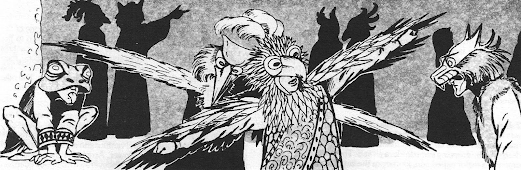
I've liked the Nagpa since before I even knew what it was/they were, being drawn into the possibilities sparked by the statblock in the BECMI Master DM's monster jam.

Then I found out they were weird crusty vulture people (trapped?) in a cycle of reincarnation (from a Dragon magazine series, Voyage of the Princess Ark, I think).

Then I found out they were the gamification of the Skeksis from Dark Crystal, which in turn made sense of the Hamakei in Out of the Pit.

See also this conversion to Call of Cthulhu (olde schoole) I did.

2e gives them 9 to 12 wizard levels and staves that function as rings of spell storing. Their origin is a curse on especially selfish mages, twisting their form; denying them the ability to eat, sleep, laugh, reproduce, or take part in any other activity enjoyed by living humans, and making them aware of anyone gossiping/talking about them within 100 miles (their ears - such as they are - burn hotter the closer they get). Interesting development, but I didn't need it.

Nightmare.

The BECMI/Mystara version of the MM Nightmare, and fairly close in stats and abilities.

The CC Nightmare can fly and turn invisible at will, as the spells, three times per day - although it has a Flying Move rate already so it's possible the limit refers to invisibility, with the spell reference to fly being for purposes of dispelling and anti-magic effect, maybe?

Being able to turn invisible thrice in a day is a bit of a comedown from being able to become ethereal, and roam the astral plane like in AD&D.

However, the CC Nightmare gets an ability I really like, and is not unlike (though less potent) that of other Mystaran Night-prefixed horrors (-crawler, -walker, and -wing). Its presence kills small animals (1 hp or less) up to 30', and paralyses anything with 3 HD or less that fails a save (roll each round to break free and no longer be affected). Even the places where a nightmare has touched the ground become blighted and barren.

Octopus, Giant.

Almost identical to the MM Octopus, Giant - though lacking the evil intelligence of its AD&D cousin.

Nothing extraordinary here, but I think the Octopus (or Squid) is/was a mechanically important monster for any basic fantasy bestiary  

Owl, Giant.

Almost identical to the one in the 1e MM.

Although owls have a reputation for wisdom and intelligence, they are neither more nor less friendly towards people than most animals - thanks for that.

Oyster, Giant.

They have a Move of 0 and bite for 4d6. I can't quite visualise how combat would look.

Would not use as written - make it more of a hazard/trap than a monster.

What Was Left Out - Oard.

Time-travelling anti-magic cyber-bastards from the same module as the Garl and Hephaeston.

I get why they were left out. I suppose at the time D&D was clearer in its intention as a fantasy game  - despite the sci-fi trappings that persisted and even with Spelljammer in the mix.

Converted to old school Call of Cthulhu here.


Monday, November 28, 2022

DMR2 Creature Catalog - L.

Lamara.

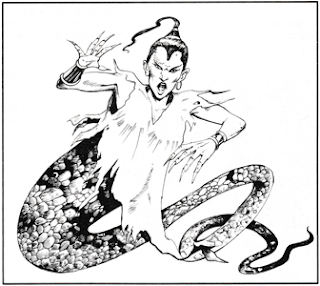
This is the analogue of the Lamia Noble (FF), serpent below the human(oid) waist, male or female. I don't think there's a BECMI/Mystaran equivalent of the non-noble sort (note: it says as much in the Mystara MC supplement).

I can only guess that someone else does her hair, because she's made a right mess of that shirt.

One of the most interesting things about the Lamara is that it cannot speak, although it understands all languages and is intelligent (score of 14). There's no information on how it communicates, even with each other (though No. Appearing is 1).

It can assume an illusory appearance that casts a powerful charm (-2 to save) against anyone of the opposite sex (of the Lamara? of the illusory appearance? what about the wider world of gender and sexuality?). We only get combat context - subjects will defend the Lamara to the death, even against their friends and allies.

It can also create an illusory enemy (apparently it only does this vs. solo adventurers), though the injuries are inflicted by the Lamara itself rather than the illusion. So this illusion is not phantasmal force, and there is no mention of disbelieving or dispelling it. Does the victim believe they are confronted by an invulnerable summoned ally of the Lamara, and can they elect to attack the Lamara in preference? 

Lava Lizard.

This is a piece of D&D fantasy fauna that feels like it should be an elemental or a construct, rather than weird wildlife. Basically, a rock-scaled/shelled giant lizard that inflicts additional heat damage and can melt nonmagical metal weapons that strike it.

That they need to stay close to lava (or other intense heat) to survive, and will freeze into statue-like immobility if they stray too far and get too cool, is interesting. Otherwise, this for me is ripe for mechanic transplant and/or reskinning.

Leviathan.

They are among the mightiest of creatures currently living on the Prime Plane at 60 HD and 3d12 bite for the Desert kind, 70 and 4d10 bite for the Marine. On top of their HD and hp, they only take half damage from all weapons and spells (so effectively x2 hp), and are additionally immune to spells that don't cause hp damage. Poison doesn't work either.

The Desert Leviathan in not-that-big shock.

The Desert Leviathan is 'only' 500' long, so significantly shorter than a full-grown Great Annelid (at 1000'), and the Marine a mere 650'. With their stats, I don't think there's any problem making them bigger, especially as the Desert Leviathan is obviously a Sandworm/Shai-Hulud analogue (it's even attracted by vibrations).

Their bite attack is an AoE weapon, allowing a -4 dragon breath save to avoid being swallowed; otherwise, 4d12 hp digestion damage per round. If you survive/aren't dissolved in 1 turn, then it will spit you out. Magical items can't be digested and the Leviathan's innards have a worse AC than the exterior.

Marine Leviathans can swim around and around to create a whirlpool capable of sinking a ship of up to 80+d100 hull points. This appears to be a narrative ability with a mechanical limit.

Because of CoC, I'm always rather taken with fairly simple but destructively awesome monsters. However, the same caveats apply here as with Juggernauts and Earthquake Beetles - I think they absolutely should be more than just a straight fight (is there a one-page dungeon set inside a giant worm?). Of course, these big-hitter monsters are not just part of the fantasy world ecology - they're a necessary (meta)game challenge for Companion and Master level adventurers.

Could a Marine Leviathan swallow the CC Kraken? Which would win in a simple fight of hit-and-damage rolls? Which would deserve to? How many retainers with crossbows would you need to take either down in one round?

They are classed as Worms in 2e, but aren't changed much - the main takeaway is that you only need to score 50 hp to cut your way out after being swallowed. The Marine Leviathan's whirlpool takes it 3 rounds to swirl up - that's 3 minutes in AD&D.

Living Statue.

The Living Statues, as they are presented in older D&D, are a fun little category I've always enjoyed - partly because they're golems that you can get to grips with at lower levels. And who doesn't like shooting/ being shot at by magma from their fingertips?

The other thing I like is that they're somewhat intelligent - score of 7, so the upper end of the Bugbear/Ogre intelligence range. Implying some kind of free-will? Personality? Feelings? I don't think they're mere constructs, and I'm happy for them to be playable characters under the right circumstances.

2e elaborates a little on their intelligence, describing it as modest but allowing them to fight sensibly and effectively - targeting spell-casters, using simple devices/mechanisms, sounding alarms, even lighting burning oil to dump on adventurers.

Not specifically immune to poison in CC.

Anyway.

Jade: Very magic resistant, so much so that magical weapons don't get to apply their plusses. Leave only worthless powder instead of valuable fragments when destroyed. Implied (by the illo) that these would be 'oriental' in design.

Rock/Ooze: magic-resistant rock statues full of Grey Ooze instead of magma to squirt out of their fingertips, with the ability to merge into the surface of a rock wall, floor, or ceiling. I take this to mean 'becoming one with' but could also just mean dungeon camouflage. See MM2's Vilstrak.

In 2e, it splits open when you kill it and you get to fight the Grey Ooze that spills out.

Silver: Much smaller than normal living statues (about one foot high) with 1+1 HD and a 2d4 bite attack. Immune to non-metallic weapons, non-magical weapons and non-magical fire. Half damage only from edged weapons. Leave 50gp of silver behind when destroyed.

Either these are toothy imp statues or shaped like animals. I would definitely consider crossing with the Silver Golem, or at least the growth/shrink ability. 

Probably my favourite of the lot; it gets my imagination going.

2e says they are humanoid, and that they bite because their tiny fists are ineffective. Makes me think of an acting award or sporting trophy come to life.

Steel: Non-magical iron and steel weapons stick to it, and are absorbed on the next round to heal the statue 2-5 hp. An advance on the classic Iron Living Statue.

2e has magical weapons getting stuck but not absorbed. Retrieve them with an open doors roll.

Lizard, Giant Foot-Pad.

Apart from it being specified that they can be trained as mounts and pack animals (you get speed vs. load stats), this is basically a lower damage, lower HD reskin of the Giant Gecko.

I have almost no opinion on them.

Lizard, Rockhome*.

The possible ancestor of the lizard man (which is both grim in its way, and interesting) and taking d6 hits per hour when exposed to sunlight... but these are pretty much '3 HD flightless birds'. 

In-setting, they're the subterranean pack animals of Dwarves and Gnomes, from GAZ6 Dwarves of Rockhome. They're a nice feature of the culture of another 'monster' but not that much in themselves.

Lupin.

Lawful tribal humanoids (they're basically Gnolls as goodies, but with dog heads) that can spot Werewolves even in human form and attack them on sight. Armed with silver swords, and lances and arrows tipped with silver. Ride and fight on Dire Wolves.

Due to a Monty Python sketch I hear the flower rather than the wolf in their name. 

They were one of the factions in my long-lost Neolithic/Proto-Celtic settings, though I think I made them full on wolf-headed rather than dog.

2e puts forward that they could be related to Werewolves, mentioning a Great Division, and gives them only 90% chance of spotting Werewolves in human form (15% for other Lycanthropes). That they are repelled by wolfsbane. That they have human-like hair on their heads. That a white-furred Lupin has special abilities - spell-casting, psionics. That not all Lupins hunt Werewolves.

No mention of any relation to or with the Wolfwere (MM2).

Lycanthrope, Werejaguar*.

Apart from that there are Cleric Werejaguars that are minions of evil Immortals, this is an unremarkable fil-in-the-gaps were-monster. 

What Was Left Out - Leveller (Bodendruker).

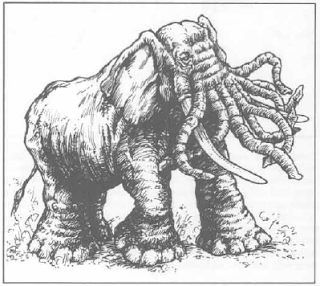
Gargantuan green elephant with eight trunks and specially adapted feet for 'levelling' the ground it tramples. Eats Purple Worms, which it pounds the ground to expose. Stomp attack is AoE; save vs. death ray or die and all your gear flattened/destroyed, otherwise d100 hp.


A curiosity. Feels more like a denizen of All The Worlds Monsters, if not for The Book of Imaginary Beings (Borges) being such an influence on D&D monsters.

Doesn't make it to DMR2, let alone 2e. Native to our planet Neptune, according to sources.

Monday, November 21, 2022

DMR2 Creature Catalog - I, J & K.

Ice Wolf.

They come in three sizes (3+1, 4+1 and 5+1 HD varieties, though described generally as big as a pony), and can be trained as mounts by the kind of humanoids you'd expect. They have a frosty breath weapon (d4 damage per HD).

The AD&D Winter Wolf (MM) has 6 HD and its breath weapon scores 6-24 hp, so Ice Wolves are just the Mystaran variant. 

It might just be clumsy editing/writing, but the text describes them as huge hounds so maybe they had a different name at some point close to publication. I wonder if there's any relation to the Hounds of Kerenos as statted by Graham Staplehurst.

Jellyfish, Giant.

Giant jellyfish if you need them. I have trouble visualising a standard combat involving them vs. adventurers - even though the text makes clear they use their tentacles as an active attack.

Two types, the Marauder and the Man-o-War. The Marauder is mechanically identical to the largest (4 HD) Portuguese Man-o-War, Giant from the 1e MM, though its sting is weaker (+4 to save).

They do make it into the 2e Mystara supplement, or rather the Marauder does, joined by the Death's Head (it's got a skull pattern) and the Galley (a fast swimmer and a deadly surface combatant, which can also shoot a stream of venom).

Juggernaut.

Huge magical machines - Golems on rollers/wheels, built like house, pyramids... even statues.

Stone Juggernauts (30 HD) crush you for 10d10 hp, Wooden (25 HD) for 8d10 - this attack is 30' wide, can harm multiple targets (they are allowed save vs. dragon breath to evade). Against a single victim, no save if it hits. 

Stone juggernauts can easily crush small buildings.

They have a basic save of 4+ (Stone) or 5+ (Wood, but auto-fail vs. magical fire), and carry their treasure inside.

I like the idea of these Juggernauts being adventure sites or monster lairs rather than simply brutal opponents, running them like I might something like the Earthquake Beetle.

I know I once had plans for undead-infested Juggernauts, along Triumph of Death lines, with names expressing their themes (Puzzlebox, Skinning Parlour, Flesh Foundry, Bonemachine and Ziggurat are the only ones I can remember).

Kal-Muru (Shipbane).

Some sort of Air Elemental that haunts the seas, making mist and mischief (of the ship's crew slaying variety). A real danger to mundane sailors who lack the HD and magic weapons to have any sort of chance against them.

A minimum of 10 Kal-Muru are needed to generate a thick, obscuring sea-fog, and the more of them there are, the further it spreads. As well as being unaffected by the winds, the fog also induces confusion (save at +4 if 5 HD or more, no effect at 8 and above).

Keep them as elementals, make them undead or demonic or djinni - whatever you like.

Featured in module X8, with the Kara-kara, below.

Kara-kara.

If you think Orcs are racist, then get ready for the Kara-kara. Not only Orcs, but also a caricature of the bone-through-the-nose-cannibal-savages-of-the-tropical-isles.

X8 Drums on Fire Mountain.
Art by Brian Williams.

Even so, for a tribal humanoid with some trappings that have not well stood the passage of time, broadening of audiences, and evolution of attitudes, the Kara-kara are... okay monsters?

CC gives us a description pretty close to what you can see in the pic above, and there's the standard tribal monster notes on females, young, weapon choice/distribution and spell-casters. In this case, they're known as manwu-papas or witch doctors - preferring the reverse of Cleric spells, because they're Chaotic.

As well as being followers of a pig cult, they are also a singing people. I imagine them having pleasant voices (to human ears), far from the presumed gutturals of Orcish. The males have a battle chant which gives a non-magical boost to their Morale and hit points, and makes them equivalent to 2 HD monsters when dealing with certain effects (sleep spell is the given example). Presumably, there can be other songs.

They consider precious metals to be worthless (no good for making practical implements), but pearl and jade can be found in their treasure hoards.

They're the feature-creature of module X8, so that's their context and expanded background if you have it for reference. As far as I know, they don't turn up anywhere else.

Killer Tree.

2e says that this is the Mystaran Hangman Tree (MM2).

Which could work.

RAW, the Killer Tree is a 6 HD monster with 4 grabbing attacks, followed by a 3d6 bite - a lot less subtle and Tolkien-adjacent than the Hangman Tree. And look at that maw.

Kna.

I'm fairly sure these are the BECMI/Mystaran analogue of the Locathah, though the Kna are orange rather than yellow, ride Mashers (the higher HD version in the M section) rather than giant eels, are enormously strong if their +5 to damage is not a typo (it's in AC9 earlier, but there's no comment on Strength or a damage bonus when they appear in 2e) and are 10 to 12 feet tall. 

I'm not specifically saying that the Locathah (or the wider aquatic tribal humanoid monster family) are boring, but this really feels like someone decided they could do with a zhuzhing-up.

Apart from that +5 damage in the statblock, there are no mechanics - the text is pure flavour; culture, technology, habitat, that there are both peaceful traders and ship-wrecking pirates amongst them. It is this that makes it (for me) a monster worth thinking about.

They can't breathe air, which I think is an interesting touch. Intermediaries or magic if you want to trade with them (maybe the Aquatic Elves are really keen for the Kna to join the community of intelligent humanoids and that's why they make and trade potions of water breathing).

2e tells us that Kna is pronounced NAH, that the wrecker-pirates call themselves uyagh and the Kna have a special body/sign language (in addition to a spoken one) that can get across basic concepts. Some details on family and tribal composition (including tame sea animals/monsters), claw and bite damage, infravision, half damage from blunt weapons (rubbery skin), +1 save vs. normal fire, how long they survive out of water (2d4 rounds). And that they're the sworn and ancient enemy of the Kopru (next monster). 

We also learn that Kna blood is an ingredient in potions of water breathing, which could put those Aquatic Elves mentioned earlier in a whole different light - the haughty, magic-using Elves taking a blood tithe from the beings they see as primitive brutes, perhaps, and the uyagh are those who would not submit (or survivors seeking revenge).

Yeah. I like the Kna.

Kopru.

Described as amphibians, but maybe just amphibious (and restricted to hot springs and tropical swamps): facial tentacles around a sphincter mouth, humanoid torso, clawed arms, three fluke-like tails instead of legs. They will bite you for 1d4 hp, but can also crush you in the coils of all three tails for 3d6 (doesn't specify if this is auto-damage/constriction).

Their signature weapon is a powerful charm - save vs. death ray (which means it's an easier save than vs. spells, unless I'm mistaken) or you are now completely loyal to the Kopru; it can read your thoughts and knows your memories, as well as direct you at any distance. Not only that but you will work in their interests even without direct orders, and will also carry on as normally as you can to disguise your allegiance. 

Fortunately, if you make your save (or throw off control - check each month; or apply dispel magic etc; or kill the controller) you are no longer subject to charm from that Kopru or the rest of the same group (this is not further defined).

They're one of the feature-creatures of X1 Isle of Dread, and one of way of reading things is that the (two? three?) Kopru you encounter are the only ones left.

I've always felt the Kopru were conceptually and/or thematically in the same kind of monster category as Mind Flayers, and not just because of the facial tentacles (as a matter of fact both the CC Kopru and the MM Mind Flayer have 8+4 HD, checking now). 2e goes as far as to venture that kopru are related to mind flayers as mermen are related to humans.

Also, compare with the Kappa (Dragon Warriors rpg & Golden Dragon gamebooks).

2e gives them a claw/claw/bite and more detailed tail(s) attack. The charm is further defined to include the victim being completely unaware that they are being controlled, and the effect is permanent until dispelled. Some notes on families/eggs, that they are female led, that their charm-related mind-reading is possibly a vestige of their past psionic ability at the height of their civilisation.

Kraken.

What it lacks in intelligence and special abilities in comparison to the 1e MM2 Kraken, it makes up for with 64 HD and almost 1000' of tentacular monstrosity. 

You need to score 60 hp to sever one of its tentacles.

Quite awesome. Definitely eats sperm whales; probably also Dragon Turtles.

Monday, November 14, 2022

DMR2 Creature Catalog - H

I'm going to say the Huptzeen is my favourite from this section, but it's also the one I've had the least time to think about - only learned anything about it by doing the research for this readthrough.

Haunt, Lesser.

Fairly traditional ghostly entity. Similar in motive, but not execution, to the MM2 Haunt.

You can't Turn it, you can't fight it - only certain haunts have the ability to cause fear (save or flee and unwilling to return), and you can only defeat/help it by special means decided by the DM.

It's a puzzle to solve or a (side)quest giver. For which you receive 100 XP.

Hawk.

If a Hawk (Normal or Giant) surprises you, it scores double-damage on its first attack.

Hephaeston.

Another one from Where Chaos Reigns - an iron-skinned giant with 25 HD. Can levitate and heat iron/steel objects, as well as grab you and throw you to the ground.

Basically Hephaestus/Vulcan as a monster species, and they're primarily interested in metalwork. Awesome as threat, ally or quest goal.

2e tells us that the weapons they make are +2 (non-magical), though I'm not sure how small, fiddly and human-sized they can manage. 

Herex.

I had some idea that the Herex were based on the Cynthians from Susan Schwartz's Heritage of Flight, but the novel is 1989 compared to AC9's 1986. But maybe that's because there are a lot of giant bug monsters across the monster manuals as well as sci-fi, and they start to blur into one another.

Their eggs can lie dormant for many years before hatching when you disturb them. The larva start out at 6 HD with an acidic, armour-damaging bite and they're hungry. The larvae then spend 5-10 months devouring everything they can, remaining underground, and growing an extra 6 HD.

At 12 HD, they burrow up to the surface, shed their skin and emerge as a 13 HD winged adult with acid bite and paralysing tail-stinger. Then they look for a mate, lay some eggs and die.

A fairly conventional lifecycle.

Without knowing their original context, the Herex feel like an almost-nostalgic monster pest scenario for high-level characters. For lower level play, the Herex could be something not meant to be fought - a source of devastation to shake up a campaign or to shape a setting.

2e says there's a use for their acid saliva, but not for their shed carapaces.

Hivebrood.

They're called The Hivebrood in AC9, suggesting equally a one-off and an omnipresent threat. They're not evil, but they use paralysed victims as hosts for their young and converting them into insectoids as their method of propagation. 

There's a heavy sci-fi scent to them, with a flavour profile incorporating Alien/Aliens, The Thing, Starship Troopers and 40k's Tyranids. How much of this retrospection, I can't really say, especially as the aforementioned are only the easiest examples - a hierarchical-hive-bug-monster that assimilates other creatures is not the rarest concept.

Presented as ant-like in their implacability, the Hivebrood could also work as a more flexible-minded and subtle foe - closer to Tyranid Genestealers or Innsmouth Deep Ones. In fact, they don't need to be enemies by motive, just biological and social incompatibility.

Lots of stats and mechanics, because there are multiple types that derive from each other - Broodlings, Hivebrood (workers and soldiers), Hiveleaders, Broodmothers and Hiveminds.

Hiveminds can gain the abilities of creatures they devour, including spell-casting, and share this ability with other Hivebrood through chemical transmission. So, Cy-Bugs from Wreck-It Ralph, too.

Simply because of their proximity on the page, you could combine Herex with Hivebrood (as one creature or separate threats) to really wreck a campaign.

They get a little bit of a name-change in 2e: Broodling, Soldier, Lieutenant, Mother and Controller. Nice detail that the Broodlings use their host's teeth to imitate the wet clacking sounds the more insectoid Hivebrood make with their mandibles.

Homunculus.

The Fylgar (a bit like a cherub/putti with a whip-like tail), Gretch and Ulzaq (Imp/Quasit analogues; with the Gretch/Quasit similarities being closest) - they're familiars, but are also the special form taken by an Immortal (demi-god and upwards) on a special mission or as a penance. You can attempt to bind them to you if they haven't chosen to serve willingly.

They're all closer to the Imp and Quasit in terms of abilities than they are to the MM's Homonculous (sic). 

Unanswered questions regarding the interface between Immortal and Homunculus identity, and the process of becoming/unbecoming. Could the Homunculus be a shortcut to binding a deity to your will, or an opportunity to overthrow them?

Called Familiars in 2e, because Homunculus/Homonculous is already taken, and because of the more complex alignment system of AD&D, the category is swelled by the (good) Aryth and the (evil) Bogan.

Bogan is an example of why you should (nowadays) always Google your made-up monster names.

Hook Beast.

The Hook Horror and the Hulker (Umber Hulk without confusion ability) are apparently related, with the latter being the brains of the operation (INT 6 vs. 4).

The Hulker - more eyes, less confusion, and those teeny claws do 2d6 damage each.

The Hook Horror stats are pretty much identical to the Fiend Folio version: it gets a hefty 3d6 bite in CC.

I never really cared for Hook Horrors in the first place, and pairing them with not-quite-Umber Hulks doesn't do much to change that.

Hutaakan.

Anubis-people. Jackal-headed 'tribal' humanoids that once ruled a great empire but are now reduced to isolated communities in the kind of places adventurers end up in. They've got infravision and Move Silently % as a Thief of equivalent level to their HD (so 1st or 2nd for most of them).

They're a haughty, callous race, dominated by their priests (min. 2 HD so they all have a spell, up to 11th level), but see themselves as a sensitive, civilized, intellectual people. No mention that they were slavers until the entry for Man, Isolated further down the line.

I can see potential in these stealthy Anubises, possibly seasoned with a little Cynidicean (see also Man, Isolated), to make something out of them away from their original Mystaran context. Possibly hidden people of the necropolis, pretending (as tricksters or delusional) to be spirits, ghouls and gods amongst the tombs and temples of the human inheritors/conquerors.

Hypnosnake.

Monster snake (8 HD) with psychedelic hypnotic gaze that puts you to sleep - and itself if you can make it gaze into a mirror for a full round (so not just a flash of the glass).

It doesn't need to be a snake; transplant the special ability onto any name and statblock you like.

What Was Left Out - Huptzeen.

A construct that resembles a fancy/ornamental/precious object, can cast spells (MU level=HD but only spells known to its creator) and moves by slow, magical flight. Explodes if you take it to 0 hp or less.

They have an INT of 11 and understand language (at least, Common).

You can leave one as a guardian (possibly a spy, but it doesn't say how they talk back); it's not clear how obvious it is as the source of the spells it casts.

More intriguingly, you can carry or wear one, and amulet and staff are given as examples. A cooperative Huptzeen gives a Magic User significantly augmented casting power: not only do you get extra castings of some of your spells, it can also cast them simultaneously with (better than haste) and independently of you (approaching contingency).

It makes a comeback in 2e, and some of my points above are addressed. For instance, it gets the ability to talk back to you, but only if it has access to a relevant spell. Costs but not process for construction, as well as recoupable fragments on destruction and price for selling on (you have to trust the seller hasn't told the Huptzeen to betray you).

It's a cool magic item as much as it is a monster; the intelligent sword for Magic Users.

Wednesday, November 9, 2022

DMR2 Creature Catalog - G

There're a lot of high HD monsters in the CC (in this section, the Gakarak and the Iron Gargoyle both have 16 HD) and this is partly a feature of BECMI/RC, with things scaled to 36 character levels. As far as I can tell, every monster that survives into AD&D 2e carries over their original HD (except where they are subsumed into a pre-existing monster).

Gakarak (Forest Brooder).

A double-strength Treant with special abilities that is one of the oldest creatures on the Prime Plane. They hang out in the deepest and most ancient woods, thinking about how much they hate humans and humanoids (except maybe for Druids). This feeling is so intense it pervades the woodlands, giving a palpable atmosphere of doom and hostility (no mechanical effect).

There's nothing in the text about their relationship with Treants.

They have un-italicised abilities to speak with and charm/control/grow plants in their vicinity - hiding trails and traps, hindering progress, blocking off routes. At closer range, they can animate trees and bushes like a Treant - up to 6 at a time, bushes somewhat weaker than trees. 

The Gakarak can teleport (no chance of error) through vegetation within its wood. It can shoot four wooden darts each round or smite you with its 4d6 magic club (save or entangled and helpless for 6 turns).

As well as regenerating 3 hp/round when in contact with vegetation (does not say if this is overcome by acid/fire, or brings it back from the dead), it can't be harmed by electricity, wooden weapons or attacks from plants and animals (though I think this latter is restricted to its home territory). Blunt weapons only score 1 hp, plus magic and Strength bonus.

Treat as an elemental terror of the wilderness, rather than a homicidally grumpy Ent and I think there's a great monster here. The darts feel a little bit incongruous, but I suspect this is to do with the power scaling of BECMI/RC and it 'needs' multiple attacks per round to stand against Companion level champions.

Compare with the DW Okeman, with which this is worth combining to make a mighty elder forest spirit. I'd also consider the Gakarak an excellent choice as a precursor form for a special Fomorian.

Gargoyle, Iron.

Due to the intense heat within its body, the Iron Gargoyle is very bright to infravision, but it doesn't cause heat damage or heat exhaustion - though it can breathe a cone of fire. Counterintuitively (to my mind), it takes x2 damage from cold attacks. 

If it strikes you with its tail, you must save or be stunned d3 rounds, and it can try to crush you with its body from flight (damage and stun - save to avoid); 16 HD; a bunch of immunities (including spells up to 3rd level); can detect invisible. Otherwise, a big metal construct, made to guard stuff.

I like this kind of almost-robot monster, but it doesn't really fit with my personal take on standard Gargoyles as being a weird species rather than constructed beings. However, maybe the Iron Gargoyle is the thing Gargoyles make (or release) when they go to war.

2e gives you the recipe for making one: 125,000gp; 5 months to do; 18th level+ Magic User; spells - wish, polymorph any object, geas, fireball, fly. 

In CC, it has 5 Intelligence to zero in 2e.

Garl.

Originally, they're the world-specific evolutionary rivals of Humans and Elves in Where Chaos Reigns, guided by the time-travelling Oards.

Here, they're very primitive humans, more primitive even than the neanderthals with 6 HD and +4 Strength bonus, making them Ogre-beating. Basically a narratively and mechanically underdeveloped tribal humanoid.

Jez Goodwin and #BOSR

Use their stats for big Ogres and/or small Hill Giants, or Sasquatches in a cryptids-based game.

Gator Man.

More tribal humanoids, with 7 HD and up to 7th level Clerics. Supposedly the result of an evil wizard's experiments centuries ago, they're the mortal enemies of lizard men

As well as a weapon attack at +3 hit and damage due to 18 Strength, they also get a bite attack for 3d6. All told, they're about on a par with RAW Hill and Stone Giants while 'only' being 7-8' tall.

I've not even said that they're scaly humanoids with alligator heads. Did you need me to?

Stripped down to stats and basic description, I could use them as the basis for Dinosaur or Dragon People because the alligator head image is pretty strong, but otherwise I think they're fairly unremarkable outside of whatever gaming context they originally had.

In 2e they only get 2d4 damage for their bite, and their Strength gives less bonus in AD&D - though this gives their stronger chiefs a hefty +7 damage bonus over BECMI/RC.

Geonid.

Weird little subterranean rock people. Tribal humanoids with non-spell casting priests as leaders. They are described as having a shell, so I think they're living beings rather than elemental. Geonids can pull in their limbs like a turtle and look almost indistinguishable from a lump of rock in a cave.


They get a whole page entry in the 2e Mystara MC, which makes it a lot clearer that they're fleshy under that boulder-like shell, as well as having a language of clicks and shell gestures incomprehensible to outsiders. They also cultivate mosses to eat, and supplement their diet with hunted/scavenged/meat.

Possibly interesting when integrated into a larger dungeon ecology, especially if they are able to hide their presence until a suitably dramatic moment.

Ghoul, Elder.

It's a more powerful Ghoul, but it can also generate a sphere of eerie green light that causes weakness if you fail your save.

Hmm.

Basically a fool-you-once monster (it looks exactly like a normal ghoul) for when you've got complacent about Ghouls.

That it's Elder (whether because it is actually a revered elder of the pack or because it's got eldritch history) is not expanded on. 

Ghostly Horde.

Not so much a monster but a special location (where an army met a sudden and catastrophic defeat). Rather than a variety of undead or Enchanted (the type given in CC) monster, it's a projection of the character's experience. And you don't get XP for interacting with it.

You make three saves in a row. Fail the 1st and you see the horde appear, fail the 2nd and you see them ready to charge, fail the 3rd and you have to fight a single 3 HD opponent during what appears to be an overwhelming assault. Make any of these saves and the horde doesn't appear/fades away.

Should you be hit by the ghostly soldier, you save vs. KO. If you defeat your foe, you will not see the horde again. Presumably it vanishes.

The mechanics of the Ghostly Horde feel like they have more of a place in a parapsychological setting than a fantastical one - why have phenomena when you can have actual undead? However, I like it precisely because it ties into that parapsychological worldview.

2e addresses the fact that not everyone in a party is going to see or experience the same thing when they 'encounter' a Ghostly Horde.

Golem.

Rock: A sort-of analogue for the Stone Golem, it can be shaped to look like a statue or caryatid, but usually just looks like a rock formation until it attacks.

Normal weapons automatically break when used against it; magic weapons get a save.

It gets two fist attacks for 2d10 damage each. Which is the same as the Fungoid, but the Golem doesn't have a chance of knocking you down.

2e recipe: 1 month; 50k gp; 14th+ level MU; limited wish, move earth, stoneskin, geas.

Silver Golem: Always wins Initiative, gets double attacks per round (in this case, a total of 4 fist attacks) and is immune to slow, presumably because it is filled with quicksilver.

Fire (heat?) makes it grow and cold makes it shrink, 1 HD per spell level RAW and no equivalences for unlevelled/non-magical attacks or hazards. While a number of specific immunities are listed (including any form of electrical attack), fire and cold are not among these. Nor whether the growth/shrinkage is durational or not. Interpret this as you wish.

I quite like this - especially the growth/shrink ability, but it's definitely more a Quicksilver than Silver Golem. 

Leaves 1000gp of salvageable silver when defeated.

2e recipe: all the normal conjurings; 50lbs of quicksilver; 100k gp; 14th+ level MU; 6 months; limited wish; haste; lightning bolt; domination; major creation.

Grey Philosopher.

Undead (ghostly) Chaotic Cleric that just sits there in some dungeon, grappling with some unresolved deep thoughts. Ironically, having survived bodily death, it will not reach a conclusion/enlightenment until it is destroyed by adventurers. It seems to think this is worth laughing about.

The Philosopher doesn't do anything except think really deeply (and cannot be Turned), but is defended by wispy little horrors formed from its evil notions, and called Malices. These cause more damage the further your Alignment lies from Chaotic, and are Turned as Spectres. Get rid of them and you can set to the Philosopher with magic weapons.

2e adds a lingering fear effect from its laughter-on-destruction (save or -1 Dex from shivering), and gives a Malices-to-centuries calculation.

It's an interesting monster concept that could be applied to other undead. Malices as written are little faces, gaping maws and little claws, but there's no reason they couldn't look like wasps, bluebottles, owls, crows, moths, shuriken, holy/unholy symbols, skulls, ostentatious quill pens etc. 

Guardian Warrior & Horse.

The Terracotta Army for D&D.

Some immunities/resistances that could be common to lots of other constructs; a little bit of how-to-make.

Gyerian.

Basically, this is a 3 HD flightless bird monster that has been given intelligence and some fleshing out with regards diet, society, habits etc. to make a tribal humanoid.

I get strong Alice in Wonderland vibes from them. Their personality: very excitable, extremely nervous, and impatient. Their special ability: knocking you over with a powerful sneeze.

How seriously are you meant to take them? Possibly there's some context I'm missing. I don't have a burning desire to search it out.

From D&D to 2e AD&D they keep their Morale value of 8, effectively lowering it as the latter is on a d20 scale, the former 2d6.

What Was Left Out - Ghoul, Vapour.

I could have waited until V, as it's given as Vapour Ghoul in AC9, but I'll stick it here with the Ghoul, Elder for consistency.

Tim Sell illustrated House of Hell, too.

They look like and are Turned as Wraiths, with stats closer to Wights. 

Their special attack is mind-paralysis, meaning you carry on your present activity for 2-8 rounds (how to manage this isn't expanded on). 

You also take temporary Intelligence damage, going insane at 0 (recover in 2-20 days) - this kind of insanity is acting as opposite to your Alignment/Class/stats/background/character as possible.

These creatures form in areas of strife where the vapours are heavy. Suggestive of pre-scientific, proto- parapsychological reasoning. I could work with this.

I wonder if they reappeared in any Ravenloft supplements?