Showing posts sorted by relevance for query wolfwere. Sort by date Show all posts

Thursday, February 25, 2021

AD&D Monster Manual 2 - To The End: W,X,Y & Z

Link back to T, U & V...


Weasel.

This statblock also covers mink, ferrets and stoats, according to the text.

Because the AD&D Weasel has no special abilities, this could just as easily be stats for a Giant Rat. 

Webbird.

This is from 3rd edition, but I like it more than the older illos - probably been drinking too much of The Green Tea.

Feathered winged arachnids that tangle you in strands of webbing and inject you with their eggs, which rapidly hatch - the larvae eat their way out of you.

Though specific to the Webbird, there is the basis for a swarm subsystem here. Their attack is rolled on d6, with a bonus for No. Appearing, and read against a table - only 1-3 is ineffective, and on an 11+ everyone in the area of effect is entangled. Even a bare-handed hit is an instakill on them, though they always give you a dying bite. Carrying a flaming torch means you are safe from attack, because they will avoid you.

Feels like a Gamma World monster. Could also just reskin as undead crows or something.

Wemic.

Lion centaurs. Wargame-y entry. 

Definitely someone's favourite monster or their dream PC kindred.

I think I'd go in a 'lost world' direction with these - 'they know how to use fire'. Or they could only appear in the dream-world, never the waking.

Willow, Black.

An evil tree that eats people after putting them to sleep. 

Says nothing about whether they like to eat hobbits halflings, but that they relish 'elves, gnomes and humans'.

Wolf-In-Sheep's-Clothing.

I didn't dislike it, just thought it was a weird and probably a Pun Monster (like the Wight Dwarf, of course). It grew on me over the years due to this immediate weirdness, and I know its pedigree now.

Sometimes regarded as a Stupid Monster.

Wolfwere.

Reverse werewolf that hates werewolves. 

Not sure if they're specifically a Gotcha! monster, or a logical progression of the Jackalwere, or based on something from folklore (wolves turning into humans as much as humans turning into wolves).

They sing, though this is here mentioned only as an attack form (slow). 

Like.

Worm.

Tenebrous Worm.

The larval form of the Gloomwing.

The largest part of the entry deals with its poisonous bristles, including the % subsystem to work out how exposed you are to them. The poison is old school - save or die (though with an onset grace period of 1-4 rounds - minutes in AD&D).

Tenebrous Worms 'inhabit most of the Plane of Shadows, though they are more common in forested areas' - does this means the forests of the Shadow Plane or forests when they are not encountered on their native plane? I like to think both.

Tunnel Worm.

When it bursts out of the tunnel wall and grasps you in its mandibles, it chews through your armour and inflicts automatic damage. 

Causing 15+ hits with fire or reducing its hp to 40% of total will drive it off - I feel like these kinds of thresholds should feature for more monsters, as complement or alternative to Morale.

Actually the Rock Grub from Fighting Fantasy #6: Deathtrap Dungeon.


Xag-Ya and Xeg-Yi.

Their (near) anagrammatical names aside, the 'silver and fiery' Xag-Ya and the 'black, lifeless' Xeg-Yi are solid alien/ sword-and-sorcery monsters. 

If the two opposites meet, they explosively cancel each other out. They're psionic, too.

Because of being absorbed by Call of Cthulhu at the same time as first reading MM2, I also think of the Xag-Ya/Xeg-Yi as being bubble-organ-units of Yog Sothoth superentity.

Xaren.

A bit of a dud, because it's basically a Xorn - it feels like someone forgot to put the 'eat magic weapons to gain hp' and 'how much metal etc. to satisfy its appetite' in MM1 and making a new monster was the only way they could think to fix that.

Consider making Xorn and Xaren interchangeable, but some might get a kick out of treating them as the Big Endians and Little Endians of the Lilliput and Blefescu of the Earth Elemental Plane.

Yeth Hound.

A local (Devon, UK - where it's the headless-dog ghost of an unbaptised child) name for the 'Black Dog' entity. Because this is AD&D, it gets statted up as a standalone-but-generic dog-monster. 

Their two main special abilities are to suffer damage only from the magical pluses of a weapon (or 1 hit from a silver weapon) and a 'ghastly baying' that causes panic (save or flee, no other details).

Yeth Hounds run with other creatures as part of a hunt, and their baying does not effect those who hunt with them - it is not specified whether this is a function of the Yeth or the companion. Night Hags and Evil humans are mentioned.

They prefer to eat the flesh of 'demihumans' (so dwarves, elves, gnomes and halflings) and Brownies.

Yochlol (Handmaiden of Lolth).

In the first 5e game I played in-  first D&D in about 20 years, a (PC) Tortle Warlock asked to marry me (actually, anyone and everyone) because there was a ceremony that would give us both AC bonuses if we did.

Anyway, if a Yochlol does not take a mate, it has an AC of -10 - this is not elaborated on further, and I now wonder if this is something that was cut. There's nothing to clarify this in the entry in the 2e Planescape Monstrous Compendium 2 - it looks like it was dropped completely.

A stinky gas that can turn into 'an amorphous column' or a Giant Spider or a 'beautiful human or elf'. Has psionics and a d10 Hit Dice (rather than a d8). Slight brush of the Cthulhuvian to them.

Doesn't go into their relationship with Lolth in any depth. It doesn't say it in the entry, but give them basic Drow abilities when they were in elf form - at the least.

Yuan Ti.

"Great Shades of Arthur Machen and Robert E. Howard! It's the Serpent People!"

I know that they're meant to be humans turned into snakes, but I prefer 'Pureblood' to be the most snaky and the 'Abominations' to be the most human, rather than RAW.

Season to taste for your setting - I have them as multi-generational cults, based on the 80s 40K Genestealers (the Great Old Ones or the Snake Demons are their Tyranids).

Their lairs are largely wheelchair accessible. 

Zombie, Juju.

Stronger, tougher, more versatile Zombies. Magic weapons to hit.

They're the result of energy drain (animate dead afterwards is not specified) so maybe they could also be hanging around lairs with Wights, Wraiths, Spectres and Vampires - Strahd made his own zombies, but he's a major character and a spell-caster.

If you were bamboozled by AD&D's profusion of polearms, this entry tells you that both the bardiche and voulge are 'cleaving weapons'.

Zombie, Monster.

Zombies with more hit dice and damage dice - animate dead Bugbears rather than Giants for economy.

Zorbo.

With a name like this and its signature special ability, this could easily have been an old school He-Man or She-Ra figure.

Monster bear that can take on the AC and damage bonus of its surroundings and your equipment.

Zygom.

More spunky-cock mushrooms! They even have '"milk"'

While it says the host is only 'occasionally a small humanoid', I take the text to mean that this is the case 'in the wild', and that adventurers are not specially protected by their size.

Sort of going out with a bang, then. FFS.


That's not your lot, yet - I'll try and follow up with some overall thoughts and observations.


And a reminder to check in on some other monster surveys:


Monday, November 28, 2022

DMR2 Creature Catalog - L.

Lamara.

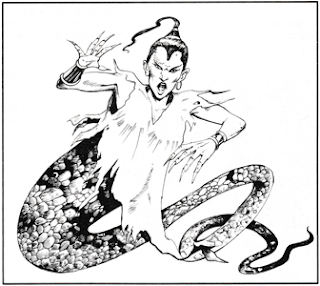
This is the analogue of the Lamia Noble (FF), serpent below the human(oid) waist, male or female. I don't think there's a BECMI/Mystaran equivalent of the non-noble sort (note: it says as much in the Mystara MC supplement).

I can only guess that someone else does her hair, because she's made a right mess of that shirt.

One of the most interesting things about the Lamara is that it cannot speak, although it understands all languages and is intelligent (score of 14). There's no information on how it communicates, even with each other (though No. Appearing is 1).

It can assume an illusory appearance that casts a powerful charm (-2 to save) against anyone of the opposite sex (of the Lamara? of the illusory appearance? what about the wider world of gender and sexuality?). We only get combat context - subjects will defend the Lamara to the death, even against their friends and allies.

It can also create an illusory enemy (apparently it only does this vs. solo adventurers), though the injuries are inflicted by the Lamara itself rather than the illusion. So this illusion is not phantasmal force, and there is no mention of disbelieving or dispelling it. Does the victim believe they are confronted by an invulnerable summoned ally of the Lamara, and can they elect to attack the Lamara in preference? 

Lava Lizard.

This is a piece of D&D fantasy fauna that feels like it should be an elemental or a construct, rather than weird wildlife. Basically, a rock-scaled/shelled giant lizard that inflicts additional heat damage and can melt nonmagical metal weapons that strike it.

That they need to stay close to lava (or other intense heat) to survive, and will freeze into statue-like immobility if they stray too far and get too cool, is interesting. Otherwise, this for me is ripe for mechanic transplant and/or reskinning.

Leviathan.

They are among the mightiest of creatures currently living on the Prime Plane at 60 HD and 3d12 bite for the Desert kind, 70 and 4d10 bite for the Marine. On top of their HD and hp, they only take half damage from all weapons and spells (so effectively x2 hp), and are additionally immune to spells that don't cause hp damage. Poison doesn't work either.

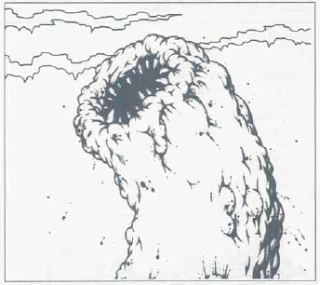
The Desert Leviathan in not-that-big shock.

The Desert Leviathan is 'only' 500' long, so significantly shorter than a full-grown Great Annelid (at 1000'), and the Marine a mere 650'. With their stats, I don't think there's any problem making them bigger, especially as the Desert Leviathan is obviously a Sandworm/Shai-Hulud analogue (it's even attracted by vibrations).

Their bite attack is an AoE weapon, allowing a -4 dragon breath save to avoid being swallowed; otherwise, 4d12 hp digestion damage per round. If you survive/aren't dissolved in 1 turn, then it will spit you out. Magical items can't be digested and the Leviathan's innards have a worse AC than the exterior.

Marine Leviathans can swim around and around to create a whirlpool capable of sinking a ship of up to 80+d100 hull points. This appears to be a narrative ability with a mechanical limit.

Because of CoC, I'm always rather taken with fairly simple but destructively awesome monsters. However, the same caveats apply here as with Juggernauts and Earthquake Beetles - I think they absolutely should be more than just a straight fight (is there a one-page dungeon set inside a giant worm?). Of course, these big-hitter monsters are not just part of the fantasy world ecology - they're a necessary (meta)game challenge for Companion and Master level adventurers.

Could a Marine Leviathan swallow the CC Kraken? Which would win in a simple fight of hit-and-damage rolls? Which would deserve to? How many retainers with crossbows would you need to take either down in one round?

They are classed as Worms in 2e, but aren't changed much - the main takeaway is that you only need to score 50 hp to cut your way out after being swallowed. The Marine Leviathan's whirlpool takes it 3 rounds to swirl up - that's 3 minutes in AD&D.

Living Statue.

The Living Statues, as they are presented in older D&D, are a fun little category I've always enjoyed - partly because they're golems that you can get to grips with at lower levels. And who doesn't like shooting/ being shot at by magma from their fingertips?

The other thing I like is that they're somewhat intelligent - score of 7, so the upper end of the Bugbear/Ogre intelligence range. Implying some kind of free-will? Personality? Feelings? I don't think they're mere constructs, and I'm happy for them to be playable characters under the right circumstances.

2e elaborates a little on their intelligence, describing it as modest but allowing them to fight sensibly and effectively - targeting spell-casters, using simple devices/mechanisms, sounding alarms, even lighting burning oil to dump on adventurers.

Not specifically immune to poison in CC.

Anyway.

Jade: Very magic resistant, so much so that magical weapons don't get to apply their plusses. Leave only worthless powder instead of valuable fragments when destroyed. Implied (by the illo) that these would be 'oriental' in design.

Rock/Ooze: magic-resistant rock statues full of Grey Ooze instead of magma to squirt out of their fingertips, with the ability to merge into the surface of a rock wall, floor, or ceiling. I take this to mean 'becoming one with' but could also just mean dungeon camouflage. See MM2's Vilstrak.

In 2e, it splits open when you kill it and you get to fight the Grey Ooze that spills out.

Silver: Much smaller than normal living statues (about one foot high) with 1+1 HD and a 2d4 bite attack. Immune to non-metallic weapons, non-magical weapons and non-magical fire. Half damage only from edged weapons. Leave 50gp of silver behind when destroyed.

Either these are toothy imp statues or shaped like animals. I would definitely consider crossing with the Silver Golem, or at least the growth/shrink ability. 

Probably my favourite of the lot; it gets my imagination going.

2e says they are humanoid, and that they bite because their tiny fists are ineffective. Makes me think of an acting award or sporting trophy come to life.

Steel: Non-magical iron and steel weapons stick to it, and are absorbed on the next round to heal the statue 2-5 hp. An advance on the classic Iron Living Statue.

2e has magical weapons getting stuck but not absorbed. Retrieve them with an open doors roll.

Lizard, Giant Foot-Pad.

Apart from it being specified that they can be trained as mounts and pack animals (you get speed vs. load stats), this is basically a lower damage, lower HD reskin of the Giant Gecko.

I have almost no opinion on them.

Lizard, Rockhome*.

The possible ancestor of the lizard man (which is both grim in its way, and interesting) and taking d6 hits per hour when exposed to sunlight... but these are pretty much '3 HD flightless birds'. 

In-setting, they're the subterranean pack animals of Dwarves and Gnomes, from GAZ6 Dwarves of Rockhome. They're a nice feature of the culture of another 'monster' but not that much in themselves.

Lupin.

Lawful tribal humanoids (they're basically Gnolls as goodies, but with dog heads) that can spot Werewolves even in human form and attack them on sight. Armed with silver swords, and lances and arrows tipped with silver. Ride and fight on Dire Wolves.

Due to a Monty Python sketch I hear the flower rather than the wolf in their name. 

They were one of the factions in my long-lost Neolithic/Proto-Celtic settings, though I think I made them full on wolf-headed rather than dog.

2e puts forward that they could be related to Werewolves, mentioning a Great Division, and gives them only 90% chance of spotting Werewolves in human form (15% for other Lycanthropes). That they are repelled by wolfsbane. That they have human-like hair on their heads. That a white-furred Lupin has special abilities - spell-casting, psionics. That not all Lupins hunt Werewolves.

No mention of any relation to or with the Wolfwere (MM2).

Lycanthrope, Werejaguar*.

Apart from that there are Cleric Werejaguars that are minions of evil Immortals, this is an unremarkable fil-in-the-gaps were-monster. 

What Was Left Out - Leveller (Bodendruker).

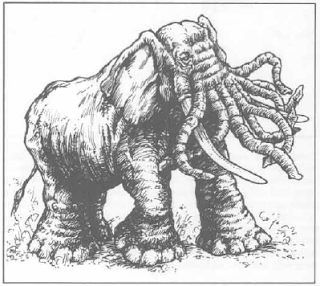
Gargantuan green elephant with eight trunks and specially adapted feet for 'levelling' the ground it tramples. Eats Purple Worms, which it pounds the ground to expose. Stomp attack is AoE; save vs. death ray or die and all your gear flattened/destroyed, otherwise d100 hp.


A curiosity. Feels more like a denizen of All The Worlds Monsters, if not for The Book of Imaginary Beings (Borges) being such an influence on D&D monsters.

Doesn't make it to DMR2, let alone 2e. Native to our planet Neptune, according to sources.